01Facts
The petitioner sought quashing of Complaint No. COMA-1151-2018 under Section 138 of the Negotiable Instruments Act, 1881, and the summoning order dated 01.10.2018 passed by the Judicial Magistrate First Class, Sonepat
¶ 1He contended that he was merely an employee of the complainant-company, working as an Assistant Manager from 2011 until February 2017. He alleged that the complainant misused a blank signed cheque linked to his salary account, that he had no legally enforceable liability for the supply of solar lights to Panchayats, and that the goods were supplied to third parties
¶ 2The trial had reached the stage of defence evidence, with the next date fixed for 02.12.2026 and the trial described as being at its "fag end"
¶ 7The respondent did not appear
02Issues
i.1. Whether the High Court should exercise its inherent power under Section 482 CrPC to quash the Section 138 NI Act complaint and summoning order, where the petitioner disputes employment status, cheque issuance, and liability for the underlying transaction
¶ 2, 4, 7ii.2. Whether the petitioner's disputed factual pleas can be examined at the advanced stage of trial, when defence evidence is being recorded
¶ 7, 903Law Applied
The Court relied on Section 482 CrPC, which preserves inherent power to secure the ends of justice and prevent abuse of process, but held that this power is extraordinary and must be exercised sparingly, and cannot be used for a mini-trial or to decide disputed facts
¶ 4It cited N. Soundaram v. P.K. Pounraj, (2014) 10 SCC 616, for the principle that inherent power must not stifle a legitimate prosecution and that the High Court should not render a prima facie decision absent compelling circumstances
¶ 5It cited Indian Oil Corporation v. NEPC India Ltd., (2006) 6 SCC 736, for the caution that quashing must be done with abundant caution
¶ 5It applied Narinder Singh v. State of Punjab, (2014) 6 SCC 466, holding that quashing at a late stage, when evidence is nearly complete or arguments have commenced, should ordinarily be refused because the trial court can decide on merits
¶ 6It also referred to Sanjeev Sharma v. Kusum Gupta, CRM-M-3601-2013 (P HC, 08.08.2013), where quashing of a Section 138 complaint at the defence-evidence stage was declined
¶ 8Provisions in the judgment · 2 · Linked ones open on LawLens
Code of Criminal Procedure, 1973 Section 482
Negotiable Instruments Act, 1881 Section 138
04Reasoning
The Court first noted that the petitioner's contentions (nature of employment, circumstances of cheque issuance, absence of enforceable liability, and the underlying transaction) are factual and require appreciation of pleadings and evidence. Because the trial had reached defence evidence and was nearing completion, the Court held that assessing these disputed questions at this stage would amount to a mini-trial and would pre-empt the trial court's evidentiary findings. Applying Narinder Singh and Sanjeev Sharma, the Court found the advanced procedural stage weighed decisively against quashing
¶ 2, 4, 6, 7, 8The Court expressly declined to evaluate the merits of the defence, leaving the petitioner free to raise all permissible pleas before the trial court
¶ 905Holding
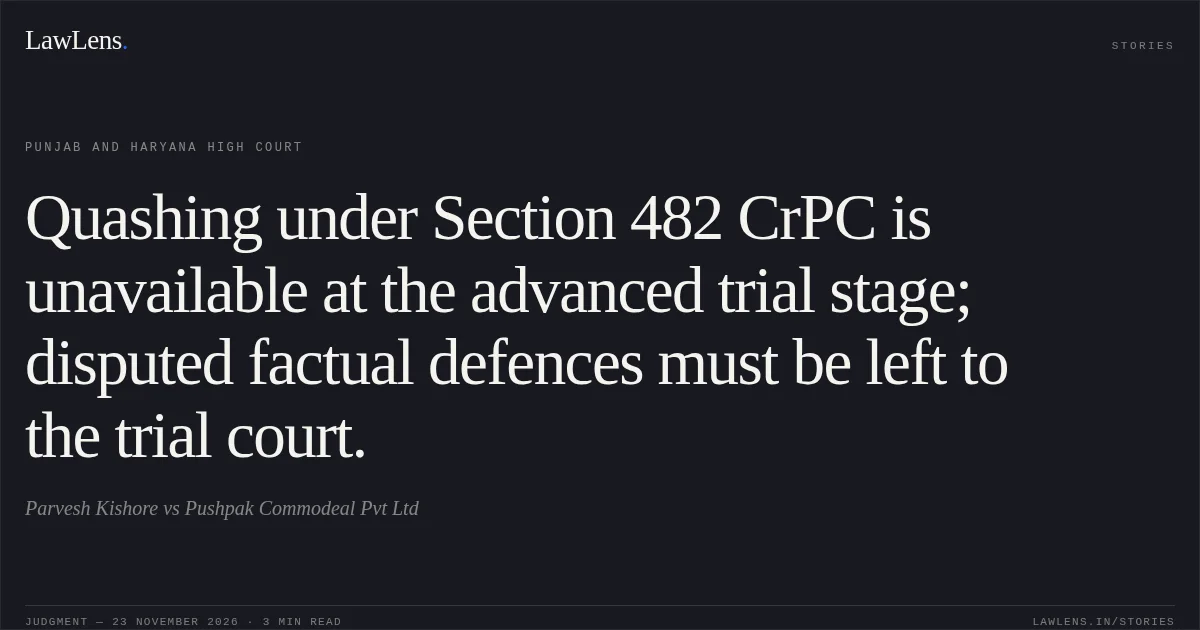
The High Court held that no ground existed to exercise inherent jurisdiction under Section 482 CrPC at the fag end of trial, and dismissed the petition
¶ 10The Court clarified that nothing in the order expresses an opinion on the merits, and that the trial court must decide the complaint independently on the evidence. It directed the trial court to conclude proceedings expeditiously, without unnecessary adjournments, and directed the parties to cooperate. Pending applications, if any, were disposed of
¶ 9, 11, 12, 13Original Court PDF
Parvesh KishorevsPushpak Commodeal Pvt Ltd
Click to open original judgment
Original judgment, available to read, download and summarize on LawLens.in