Facts
The petitioner challenged the order dated 22 December 2020 whereby the Chief Judicial Magistrate, Darbhanga, took cognizance in Laheriasarai P.S. Case No. 250 of 2018 for offences under Sections 323, 353, 504 and 427 of the Indian Penal Code (IPC).
Source reference: para. 2, p. 1The FIR was lodged by Ranjan Kumar, an Assistant Sub-Inspector-cum-Station House Officer, alleging that the petitioner and another person threatened the guardian of a victim in Sakatpur P.S. Case No. 24 of 2018, threatened and assaulted the informant when he intervened, and forcibly threw his mobile phone to the ground, causing injury to his hand and little finger.
Source reference: para. 3, p. 2The petitioner alleged that the accusations were false and motivated by personal animosity. He relied on a counter-case, Laheriasarai P.S. Case No. 251 of 2018, registered against the informant, contending that the prosecution was malicious.
Source reference: paras. 4–5, pp. 2–3It was further brought to the Court’s notice that charges had been framed on 12 September 2022, nine prosecution witnesses had been examined before the quashing petition was filed, and the tenth witness had been partly cross-examined during the pendency of the application.
Source reference: para. 8, p. 4; para. 9, p. 5Issues
Whether the order taking cognizance under Sections 323, 353, 504 and 427 IPC suffered from patent illegality or reflected non-application of judicial mind so as to warrant interference under Section 482 of the Code of Criminal Procedure (CrPC)?
Source reference: paras. 2, 5, 7, 10, pp. 1, 3–4, 6Whether the existence of a case and counter-case established that the prosecution against the petitioner was malicious and liable to be quashed?
Source reference: paras. 5, 10, pp. 3, 5–6Whether the advanced stage of the trial, coupled with the petitioner’s alleged non-disclosure of material facts while obtaining a stay order, justified refusal to exercise the Court’s inherent jurisdiction?
Source reference: paras. 8–11, pp. 4–6Law Applied
The Court considered the inherent jurisdiction under Section 482 CrPC, which may be exercised to prevent abuse of the process of court or secure the ends of justice, but not to conduct a mini-trial or assess the truthfulness of disputed prosecution allegations at the quashing stage.
Source reference: no citationThe Court applied the provisions of Sections 323, 353, 504 and 427 IPC, concerning voluntarily causing hurt, assault or criminal force to deter a public servant from discharge of duty, intentional insult, and mischief causing damage, respectively.
Source reference: para. 2, p. 1It relied on Babubhai v. State of Gujarat, (2010) 12 SCC 254, distinguishing the rule concerning a second FIR relating to the same transaction from a genuine case and counter-case.
Source reference: para. 10, p. 6It also considered Rajiv Thapar v. Madan Lal Kapoor, (2013) 3 SCC 330, for the principle that disputed questions concerning the truth or falsity of allegations should ordinarily be established during trial rather than determined under Section 482 CrPC.
Source reference: para. 10, p. 6Reasoning
The Court found that the cognizance order was not mechanically passed or vitiated by patent illegality because the Magistrate had referred to the materials collected during investigation and had applied judicial mind.
Source reference: para. 10, p. 6The allegations in the FIR, if accepted at face value, disclosed a prima facie case under the invoked IPC provisions, while the petitioner’s denial and allegation of animosity raised disputed factual matters unsuitable for determination in proceedings under Section 482 CrPC.
Source reference: paras. 3, 5, 7, 10, pp. 2–3, 4, 6The existence of a counter-case did not, by itself, establish malicious prosecution; rather, the two FIRs constituted a case and counter-case and were not a second FIR concerning the same transaction of the kind addressed in Babubhai.
Source reference: para. 10, p. 6The Court also gave substantial weight to the advanced stage of the trial, noting that nine witnesses had already been examined before the quashing petition was filed and the tenth witness had been partly cross-examined.
Source reference: paras. 8–9, pp. 4–5The alleged failure to disclose this progress while obtaining a stay order further militated against the petitioner and was treated as suppression of a material fact.
Source reference: para. 10, p. 6Holding
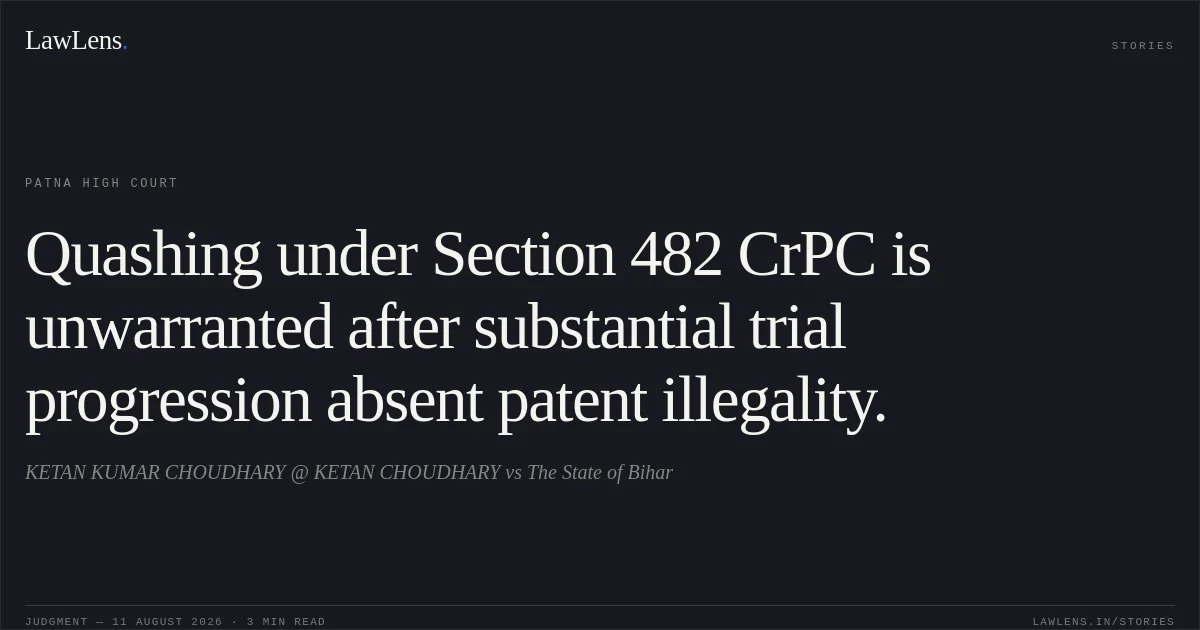
The Court held that the order taking cognizance did not suffer from any patent illegality or lack of judicial application of mind, and that the case and counter-case did not, without more, establish malicious prosecution.
In view of the substantial progress of the trial, the limited challenge being directed only against the cognizance order, and the alleged suppression of the trial’s progress, the Court declined to exercise its inherent jurisdiction under Section 482 CrPC.
Source reference: para. 11, p. 6The application was accordingly dismissed.
Source reference: para. 12, p. 6Acts & Sections Cited
4 provisions across 1 statute referred to in this judgment. Each provision opens on LawLens.
Indian Penal Code, 18604
Original Court PDF
KETAN KUMAR CHOUDHARY @ KETAN CHOUDHARYvsThe State of Bihar
Click to open original judgment
Original judgment, available to read, download and summarize on LawLens.in