Facts
The petitioner, a driver, was issued a show-cause notice by respondent No. 4 alleging dereliction of duty and failure to follow government instructions
Source reference: p. 2Despite filing a detailed reply, the Disciplinary Authority issued an order on 03.10.2018 (Annexure P/3) imposing a punishment of withholding one annual increment with non-cumulative effect
Source reference: p. 2, 3The petitioner’s appeal was subsequently rejected by the appellate authority via order dated 26.06.2020 (Annexure P/5)
Source reference: p. 2, 4The petitioner challenged these orders under Article 226 of the Constitution of India on the grounds that they were non-speaking and unreasoned
Source reference: p. 1, 2Issues
1. Whether the disciplinary and appellate orders were "speaking orders" that recorded valid and justifiable reasons for the punishment
Source reference: para. 6, 82. Whether an administrative or quasi-judicial authority is mandated to assign reasons when affecting the rights of a party
Source reference: para. 9, 10Law Applied
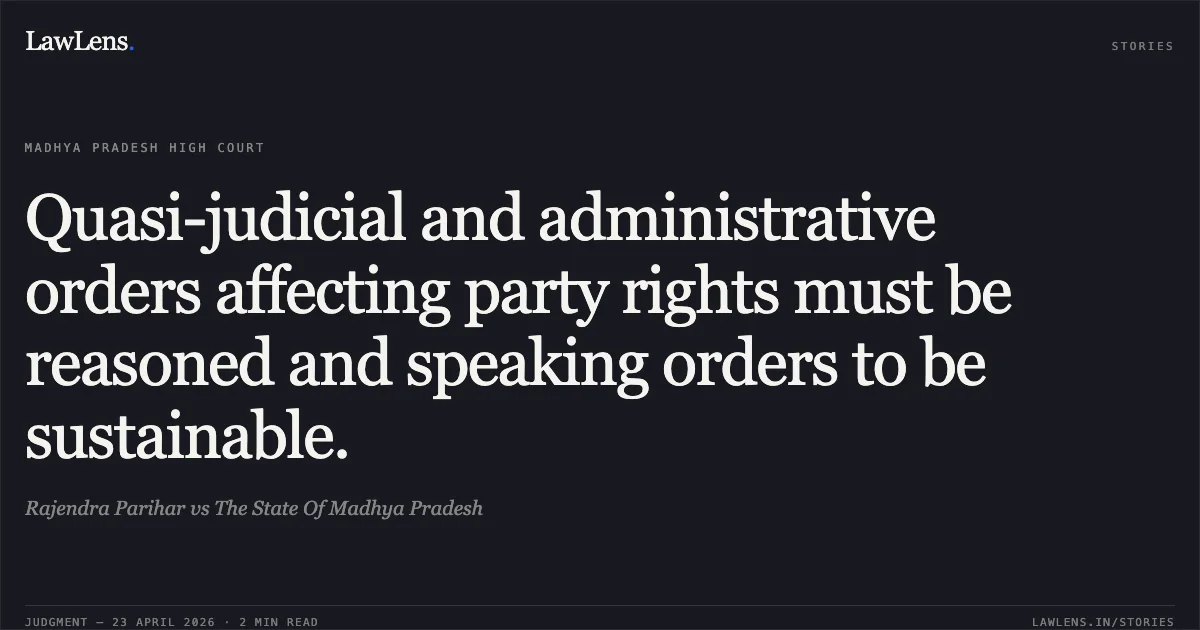
The court applied the principle that quasi-judicial and administrative authorities must pass reasoned, "speaking" orders as a component of natural justice and fairness
Source reference: para. 6, 12It relied on State of Punjab v. Bandip Singh (2016), which held that executive decisions must be composite, self-sustaining, and impregnated with reasons
Source reference: para. 10, 11It further cited Kranti Associates Pvt. Ltd. v. Masood Ahmed Khan (2010), establishing that reasons are the "lifeblood" of judicial decision-making and a component of human rights, ensuring that the "face of an order" is not like an "inscrutable sphinx"
Source reference: para. 12Reasoning
The Court examined the impugned punishment order (Annexure P/3) and the appellate order (Annexure P/5) and found that both authorities failed to exercise their quasi-judicial powers properly.
Source reference: para. 6, 8Specifically, the Disciplinary Authority did not consider the petitioner's detailed reply or record justifiable grounds for its conclusion.
Source reference: para. 2, 6Although the State counsel admitted that the appellate authority concurred with the findings, they conceded that no independent reasoning was assigned.
Source reference: para. 3The Court reasoned that since the orders affected the rights of a government servant, the authorities were required to demonstrate—through recorded reasons—that they had objectively considered all relevant factors to maintain faith in the justice delivery system.
Source reference: para. 9, 12Holding
The Court answered the issues in the negative, holding that the impugned orders were non-speaking and lacked legal validity.
The Court set aside the punishment order dated 03.10.2018 and the appellate order dated 26.06.2020. The respondents were directed to provide all consequential benefits to the petitioner within three months, while being granted liberty to take fresh action in accordance with the law if so advised.
Source reference: para. 13, 14, 15Original Court PDF
Rajendra PariharvsThe State Of Madhya Pradesh
Click to open original judgment
Original judgment, available to read, download and summarize on LawLens.in


![Authorities must decide pensionary and retiral-benefit claims through a reasoned order within eight weeks.. Habibullah khan vs HOME DEPARTMENT. CAT - ['Srinagar']. LawLens](/stories/thumbnails/authorities-must-decide-pensionary-and-retiral-benefit-claims-through-a-reasoned-order-wit-d0cbe8a8119c48fbabe7df9f2d353488.webp)