Facts
The petitioner complained that a Government-constructed drain in his village had become clogged, causing seepage and alleged obstruction to cultivation on his agricultural land.
Source reference: p.3–4The Block Development Officer initially reported defects in the drain but later stated that, with the petitioner’s consent, drainage water had earlier been allowed to flow into his land and that the petitioner subsequently stopped the flow.
Source reference: p.3–4The Sub-Divisional Public Grievance Redressal Officer directed repair of the drain and concluded the proceeding on 20 September 2022.
Source reference: p.4The petitioner’s first appeal was dismissed on the ground that a land-related dispute had rendered the drain non-functional.
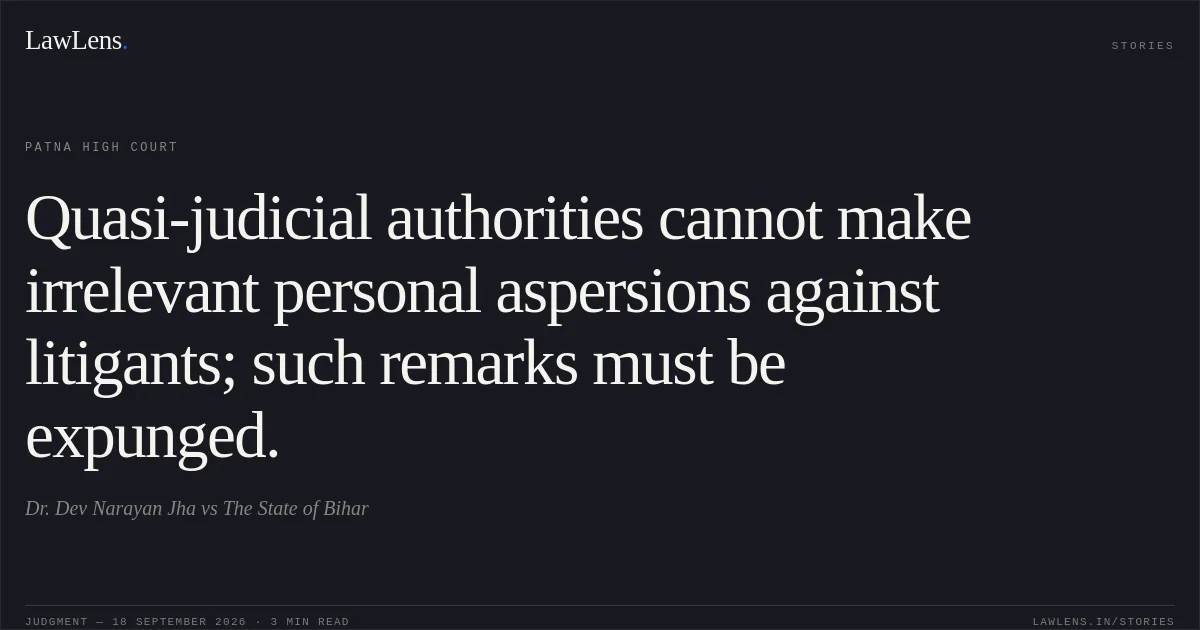
Source reference: p.4In the second appeal, the District Magistrate-cum-Second Appellate Authority dismissed the petitioner’s case on 25 February 2023 and made remarks that the petitioner appeared to have a mentality to harass members of the Scheduled Caste/Scheduled Tribe communities residing nearby.
Source reference: p.4–5The petitioner sought review before the Divisional Commissioner, but the review was rejected on 2 May 2023 on the ground that the Bihar Public Grievance Redressal Act, 2015 contained no power of review.
Source reference: p.4–5During the writ proceedings, a subsequent joint inspection report stated that the drain was dry, no continuous source of water-flow onto the petitioner’s land was found, and no waterlogging was visible.
Source reference: p.6–7Issues
Whether the High Court should interfere with the administrative orders concerning the alleged drain blockage and waterlogging on the petitioner’s land?
Source reference: paras. 3, 6, 8Whether the personal and stigmatic remarks made by the District Magistrate against the petitioner were legally impermissible and liable to be expunged?
Source reference: paras. 3–5, 8–12Whether the statutory protection under Section 10 of the Bihar Public Grievance Redressal Act, 2015 barred challenge to the remarks, and whether the reviewing authority correctly declined review under Section 9?
Source reference: paras. 7–8Law Applied
The Court applied the principle that quasi-judicial authorities must determine disputes strictly on the basis of relevant facts and law and must use sober, temperate and respectful language; personal attacks, irrelevant observations and remarks concerning a litigant’s character, morality or background, when unrelated to the adjudication, constitute an abuse of power.
Source reference: para. 9Relying on A.M. Mathur v. Pramod Kumar Gupta, (1990) 2 SCC 533, the Court reiterated that judicial restraint and discipline are essential to the proper administration of justice and that adjudicatory authorities must focus on the merits rather than make personal comments.
Source reference: para. 10The Court also considered the State’s reliance on Sections 9 and 10 of the Bihar Public Grievance Redressal Act, 2015, concerning the limits of review and protection for acts done in good faith under the Act.
Source reference: paras. 7–8Reasoning
The Court declined to interfere with the substantive administrative findings regarding the drain because the subsequent physical verification found no visible waterlogging and no continuous source of water flowing onto the petitioner’s land.
Source reference: para. 8However, the District Magistrate’s observation that the petitioner had a mentality to harass SC/ST residents was unrelated to the determination of whether the drain was blocked or whether waterlogging existed.
Source reference: paras. 8–9, 12Such a stigmatic conclusion was not shown to be supported by relevant material and violated the requirement that quasi-judicial authorities act objectively and confine themselves to the dispute before them.
Source reference: paras. 8–9, 12The statutory protection under Section 10 could not justify irrelevant or unwarranted personal aspersions, while the question of review did not validate the remarks themselves.
Source reference: para. 7Accordingly, the Court preserved the substantive administrative orders but removed the offending observations.
Source reference: no citationHolding
The writ petition was disposed of without interfering with the impugned orders on the drain and waterlogging issue.
However, the Court held that the District Magistrate’s uncharitable and unwarranted personal remarks against the petitioner were impermissible and directed that the order dated 25 February 2023 be expunged to the extent that it contained personal aspersions against the petitioner.
Source reference: para. 12Acts & Sections Cited
2 provisions across 1 statute referred to in this judgment. Each provision opens on LawLens.
BIHAR RIGHT TO PUBLIC GRIEVANCE REDRESSAL ACT, 20152
Original Court PDF
Dr. Dev Narayan JhavsThe State of Bihar
Click to open original judgment
Original judgment, available to read, download and summarize on LawLens.in