Facts
The petitioner, a police constable, was posted at Police Station Dabra City.
Source reference: no citationDuring an operation to apprehend accused Gambhir Jatav, the accused allegedly fled after the police party reached the Lakshmanpura area.
Source reference: para. 2The petitioner was charged with assisting the accused in escaping and with misconduct while accompanying the police force sent for his apprehension.
Source reference: para. 2A departmental inquiry was conducted, following which the Disciplinary Authority supplied the inquiry report to the petitioner and considered his explanation.
Source reference: paras. 2, 5–6By order dated 23 February 2022, the petitioner was removed from service.
Source reference: paras. 2, 5–6His departmental appeal was rejected by the Appellate Authority on 3 October 2022.
Source reference: paras. 7–8The petitioner challenged both orders under Article 226, alleging that they were non-speaking and that the authorities had failed to consider Police Regulation 226, particularly clauses (iii) and (v), before imposing the extreme penalty of removal.
Source reference: paras. 1–2Issues
1. Whether the Disciplinary Authority’s order imposing removal from service was invalid for being non-speaking, unreasoned, and for failing to consider the petitioner’s defence and relevant circumstances.
Source reference: paras. 5–62. Whether the Appellate Authority’s order rejecting the appeal was invalid for failure to independently consider the grounds raised by the petitioner and record adequate reasons.
Source reference: paras. 7–83. Whether, before imposing the extreme penalty on a constable, the authorities were required to consider clauses (iii) and (v) of Police Regulation 226 concerning penalties applicable to constables.
Source reference: paras. 13–14Law Applied
The Court exercised judicial review under Article 226 of the Constitution over the disciplinary and appellate orders.
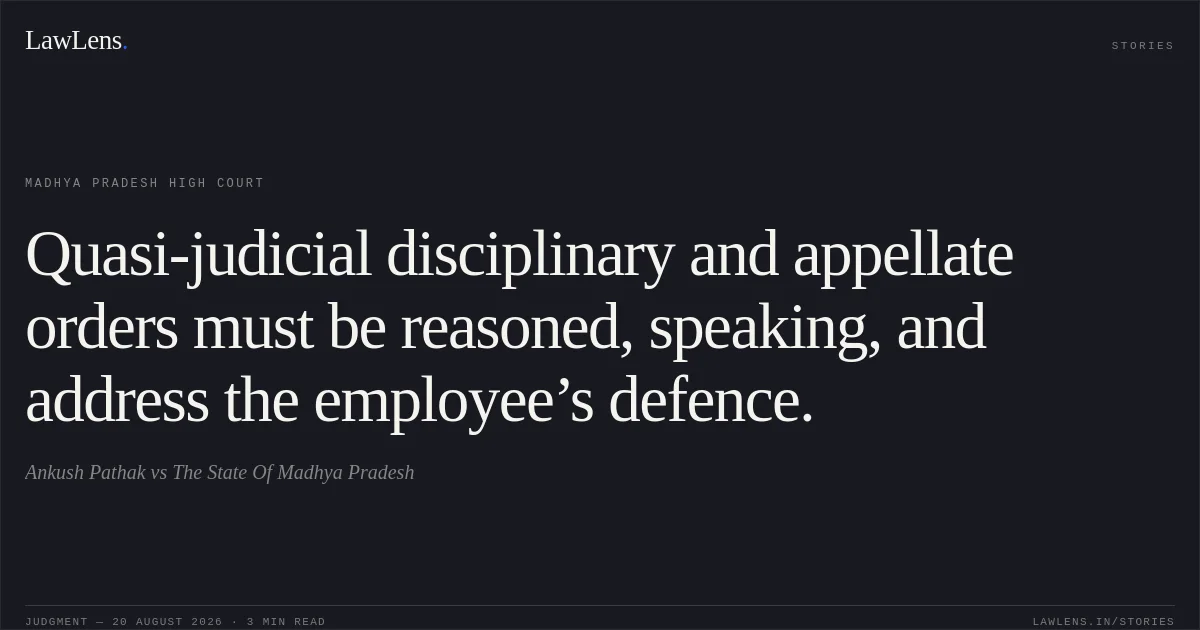
Source reference: no citationIt applied the settled principle that a quasi-judicial or administrative order affecting civil rights must be reasoned and speaking, and must disclose consideration of the relevant facts and the affected party’s defence.
Source reference: no citationRelying on State of Punjab v. Bandip Singh, (2016) 1 SCC 724, the Court held that an administrative or executive decision must be composite, self-sustaining, and supported by the reasons that actually prevailed with the decision-maker.
Source reference: paras. 9–11It also relied on Kranti Associates Pvt. Ltd. v. Masood Ahmed Khan, (2010) 9 SCC 496, which recognises reasons as an essential component of fair decision-making by judicial, quasi-judicial, and administrative authorities.
Source reference: para. 12Police Regulation 226(iii) treats withholding of increments as a suitable punishment for serious dereliction of duty and requires warning and an opportunity for amendment, while Regulation 226(v) addresses fines for certain misconduct and prohibits fining constables.
Source reference: para. 13These provisions had to be considered alongside Regulation 64(iv), concerning discipline, subordination, and obedience to lawful orders.
Source reference: para. 14Reasoning
The Court found that the Disciplinary Authority’s order merely referred to the proved charges and the petitioner’s alleged misconduct but did not meaningfully examine the explanation submitted by him or provide adequate reasons for selecting removal from service.
Source reference: paras. 5–6The appellate order likewise affirmed the punishment in general terms without independently addressing the grounds raised in the appeal or explaining why the penalty was proportionate.
Source reference: paras. 7–8Since both authorities were exercising quasi-judicial powers, their conclusions were required to be reasoned and based on an objective consideration of the petitioner’s defence.
Source reference: no citationThe Court further held that, although the charge concerned disobedience of lawful orders under Regulation 64(iv), the authorities were also required to consider the specific penalty framework in Regulation 226 applicable to constables, particularly clauses (iii) and (v), before imposing the extreme punishment of removal.
Source reference: paras. 13–14The Court did not examine or decide the merits of the underlying charges.
Source reference: para. 17Holding
The Court set aside the Disciplinary Authority’s punishment order dated 23 February 2022 and the Appellate Authority’s rejection order dated 3 October 2022.
The matter was remanded to the Disciplinary Authority for fresh consideration.
Source reference: para. 16The authority was directed to issue a fresh show-cause notice with the inquiry report, permit the petitioner to submit a reply, provide him a personal hearing, consider every fact and ground raised, specifically consider Police Regulation 226, and pass a reasoned and speaking order within two months of receiving the certified copy of the judgment.
Source reference: para. 16The petition was accordingly disposed of, without any expression of opinion on the merits of the case.
Source reference: para. 17Original Court PDF
Ankush PathakvsThe State Of Madhya Pradesh
Click to open original judgment
Original judgment, available to read, download and summarize on LawLens.in