Facts
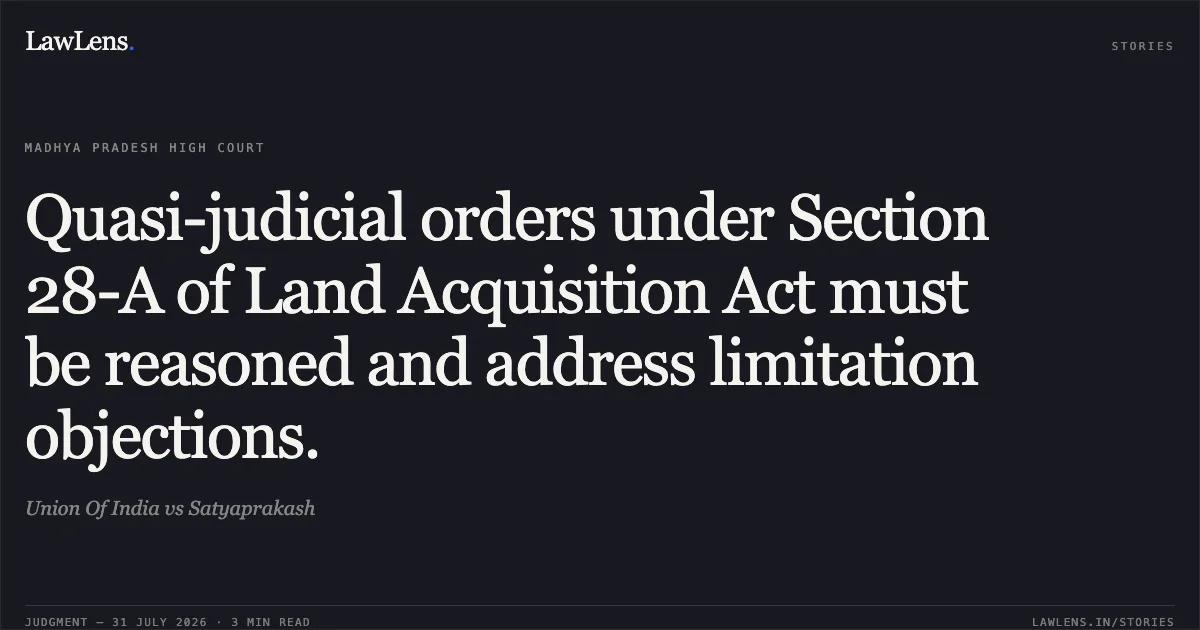
The Union of India challenged an order/award dated 31.01.2020 passed by the Sub-Divisional Officer (SDO) and Land Acquisition Officer (LAO), Karera.
Source reference: p. 1-2The land (209.80 hectares) in Village Kalothra was originally acquired under the Land Acquisition Act, 1894, with an award passed on 30.03.1996.
Source reference: p. 2While some landholders sought a reference under Section 18, the respondents herein later filed applications under Section 28-A of the Act for re-determination of compensation based on enhanced awards granted to other landholders by the Reference Court.
Source reference: p. 2The SDO allowed these applications and enhanced the compensation.
Source reference: p. 2The petitioners (Union of India) argued that the impugned order was passed without an adequate hearing and ignored the mandatory three-month limitation period prescribed under Section 28-A.
Source reference: p. 3Issues
1. Whether the Sub-Divisional Officer/Land Acquisition Officer failed to pass a reasoned and speaking order while adjudicating the jurisdictional issue of limitation under Section 28-A of the Land Acquisition Act, 1894.
Source reference: p. 72. Whether the impugned order violated the principles of natural justice by failing to consider the specific objections raised by the petitioners.
Source reference: p. 7Law Applied
The Court applied Section 28-A of the Land Acquisition Act, 1894, which provides for the re-determination of compensation based on the award of the "Court" (Reference Court), provided the application is filed within three months from the date of the award.
Source reference: p. 3-4The Court relied on the principle that the term "Court" under Section 3(d) refers to the principal Civil Court of original jurisdiction and not appellate courts.
Source reference: p. 4The Court further applied the doctrine of natural justice as articulated in State of A.P. vs. Marri Venkaiah (2003) 7 SCC 280 and Jose Antonio Cruz Dos R. Rodrigues vs. LAO (1996) 6 SCC 746, establishing that quasi-judicial authorities must pass reasoned and speaking orders on jurisdictional facts, particularly the strict computation of limitation under Section 28-A.
Source reference: p. 4-7Reasoning
The Court observed that the issue of limitation under Section 28-A is a "jurisdictional prerequisite" that goes to the root of the authority’s competence.
Source reference: p. 6-7Upon perusing the impugned order dated 31.01.2020, the Court found that while the LAO recorded a conclusion, the order lacked "cogent reasoning" or a proper analysis of relevant dates and statutory requirements.
Source reference: p. 7The LAO failed to meaningfully address the petitioners' objections regarding the expiry of the three-month window or the applicability of time exclusions for obtaining certified copies.
Source reference: p. 6, 7The Court determined that the absence of a reasoned finding on such a vital issue constituted a non-application of mind and a violation of the principles of natural justice.
Source reference: p. 6, 8Following the precedent set in a similar case (W.P. No. 29708/2022), the Court held that the decision-making process was fundamentally flawed because transparency and fairness require a quasi-judicial body to deal with all material objections in a detailed manner.
Source reference: p. 7-8Holding
The Court set aside the impugned order dated 31.01.2020 passed by the SDO and Land Acquisition Officer, Karera.
The matter was remanded to the competent authority for fresh consideration of the applications under Section 28-A with directions to afford a fresh opportunity of hearing to all parties and pass a detailed, reasoned and speaking order within three months.
Source reference: p. 8-9Acts & Sections Cited
7 provisions across 1 statute referred to in this judgment. Linked provisions open on LawLens.
Land Acquisition Act, 18947
Original Court PDF
Union Of IndiavsSatyaprakash
Click to open original judgment
Original judgment, available to read, download and summarize on LawLens.in