Facts
The petitioner, while serving as Deputy Director, Agriculture, was issued a charge-sheet on 27.09.2016 containing ten charges related to financial irregularities and lesser distribution of agricultural materials.
Source reference: para 2Simultaneously, an FIR (Crime No. 329/2016) was registered on the same charges.
Source reference: para 2Following a departmental inquiry, a show-cause notice was issued with the inquiry report. The petitioner submitted a detailed reply on 10.11.2017.
Source reference: para 2On 02.05.2018, the disciplinary authority passed an order imposing the punishment of compulsory retirement.
Source reference: para 2, 5The petitioner challenged this order under Article 226, alleging it was non-speaking and failed to consider the grounds raised in his reply.
Source reference: para 2Issues
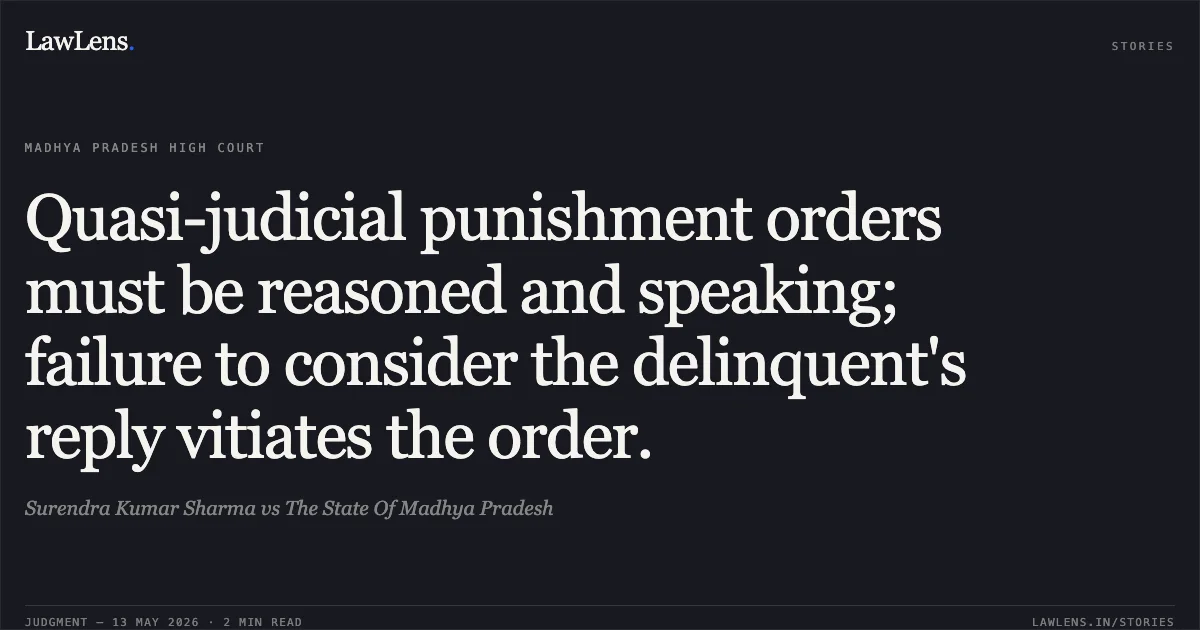
1. Whether the disciplinary authority, while exercising quasi-judicial powers, is required to pass a reasoned and speaking order that addresses the specific defenses raised by the delinquent employee.
Source reference: para 62. Whether the impugned order of compulsory retirement dated 02.05.2018 is legally sustainable in light of the principles of natural justice and administrative law.
Source reference: para 7-8Law Applied
The Court primarily applied the principle that a disciplinary authority exercising quasi-judicial power must pass a "speaking order" that reflects an application of mind to the facts and evidence.
Source reference: para 6It relied on State of Punjab v. Bandip Singh (2016) 1 SCC 724, establishing that administrative decisions must be self-sustaining and impregnated with reasons.
Source reference: para 9-10Further, it applied Kranti Associates Pvt. Ltd. v. Masood Ahmed Khan (2010) 9 SCC 496 and Oryx Fisheries Pvt. Ltd. v. Union of India (2010) 13 SCC 427, which dictate that recording reasons is an indispensable component of the decision-making process, a prerequisite for judicial review, and a component of fairness and human rights.
Source reference: para 11-12Reasoning
The Court observed that the disciplinary authority’s order dated 02.05.2018 failed to satisfy the legal requirement of being a "speaking order".
Source reference: para 7Upon perusing the order, the Court found that the authority did not provide valid or justifiable reasons for its conclusions, nor did it address the specific facts and grounds raised by the petitioner in his detailed reply dated 10.11.2017.
Source reference: para 6, 8The Court reasoned that since the order affects the rights of the party, the "face of the order" must speak so the affected party knows how their defense was considered.
Source reference: para 8Relying on the Oryx Fisheries precedent, the Court emphasized that a "pretence of reasons" or "rubber-stamp reasons" cannot equate to a valid decision-making process.
Source reference: para 12Consequently, the lack of independent reasoning and failure to consider the petitioner's response rendered the order arbitrary and capricious.
Source reference: para 10Holding
The Court allowed the writ petition and quashed the impugned punishment order dated 02.05.2018.
The matter was remanded to the disciplinary authority with directions to decide the case afresh by passing a reasoned and speaking order within three months, considering the grounds in the petitioner's reply, affording him a personal hearing, and taking into account the final outcome of the parallel criminal proceedings.
Source reference: para 13(ii-v)Original Court PDF
Surendra Kumar SharmavsThe State Of Madhya Pradesh
Click to open original judgment
Original judgment, available to read, download and summarize on LawLens.in