Facts
Respondent No. 1 booked a consignment of 3,760 quintals of rice from Tilda to New Guwahati
Source reference: p. 2The Appellant (Railways) imposed penal undercharges of ₹31,733 and demurrage charges of ₹20,475, alleging excess weight
Source reference: p. 2-3Respondent No. 1 filed an application for a refund before the Railway Claims Tribunal (RCT), Guwahati Bench
Source reference: p. 3The Appellant failed to produce any evidence of overloading, such as a weighment chart, before the RCT despite a discovery application filed by the Respondent
Source reference: p. 7-8The RCT allowed the claim, directing a refund with 9% interest
Source reference: p. 3The Union of India appealed this decision under Section 23 of the Railway Claims Tribunal Act, 1987
Source reference: p. 2Issues
1. Whether the Railways can impose punitive charges for overloading under Section 73 of the Railways Act without providing a weighment chart or a basis for such allegations
Source reference: p. 112. Whether the burden of proof regarding the weight of the consignment was discharged by the consignor in view of Section 110 and the proviso to Section 65(2) of the Railways Act, 1989
Source reference: p. 4-5Law Applied
The Court applied Section 73 of the Railways Act, 1989, which permits the levy of punitive charges for overloading, and Section 110, which places the burden of proving the correctness of declared weight on the consignor when the weight is not checked by a railway servant
Source reference: p. 4-5The Court referred to Union of India v. Megha Technical & Engineers (Pvt.) Ltd. (SLP (c) No. 8024/2018), which held that a mini-trial is not required at the time of offloading, but scientific methods of proof are necessary
Source reference: p. 3-4, 9-10It also considered Jagjit Cotton Textile Mills v. Chief Commercial Superintendent N.R. (1998) 5 SCC 126, affirming the validity of Section 73 while maintaining the consignee's right to know the basis of the penalty
Source reference: p. 11Reasoning
The Court found that while Megha Technical removed the necessity for a full hearing at the point of offloading, it did not eliminate the requirement for the Railways to provide a factual basis for penalties during adjudication
Source reference: p. 9-10In this case, the Respondent (consignor) discharged their initial burden under Section 110 by producing sale invoices and money receipts consistent with the weight declared in the Railway Receipt
Source reference: p. 10Conversely, the Appellant failed to produce the weighment chart or any documentation before the RCT to substantiate the claim of overloading
Source reference: p. 10-11Although the Appellant's counsel presented a photocopy of a weighment chart during the appeal, the Court noted this was never furnished to the Respondent or the RCT, rendering the imposition of punitive charges arbitrary and without a record-based foundation
Source reference: p. 11-12Holding
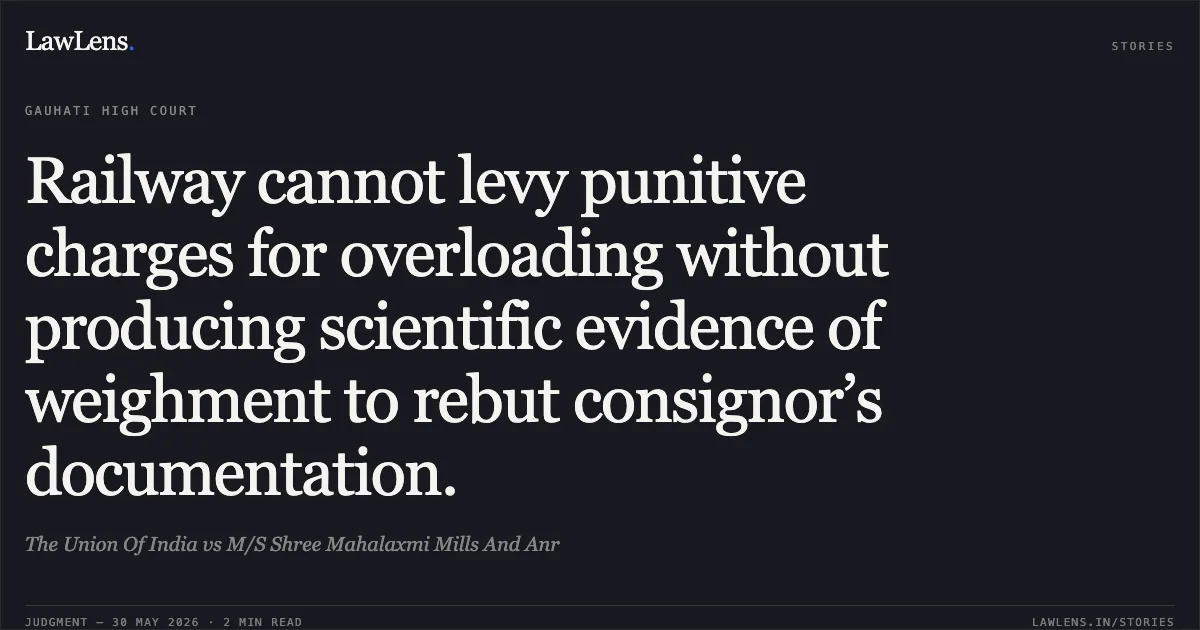
The Court held that the Railways failed to rebut the evidence of weight provided by the Respondent and failed to substantiate the basis for imposing punitive and demurrage charges
The appeal was dismissed, and the RCT's order directing the refund of undercharges and demurrage with 9% interest was upheld
Source reference: p. 12The records were ordered to be returned to the RCT
Source reference: p. 12Acts & Sections Cited
5 provisions across 2 statutes referred to in this judgment. Each provision opens on LawLens.
Railway Claims Tribunal Act, 19872
Railways Act, 19893
Original Court PDF
The Union Of IndiavsM/S Shree Mahalaxmi Mills And Anr
Click to open original judgment
Original judgment, available to read, download and summarize on LawLens.in


![Subsequent exoneration does not retrospectively invalidate a finalized promotion select list.. UNNIKRISHNAN M vs M/o Environment And Forests. CAT - ['Ernakulam']. LawLens](/stories/thumbnails/subsequent-exoneration-does-not-retrospectively-invalidate-a-finalized-promotion-select-li-ce80a0e84f2f4887857271e8b4341c42.webp)