Facts
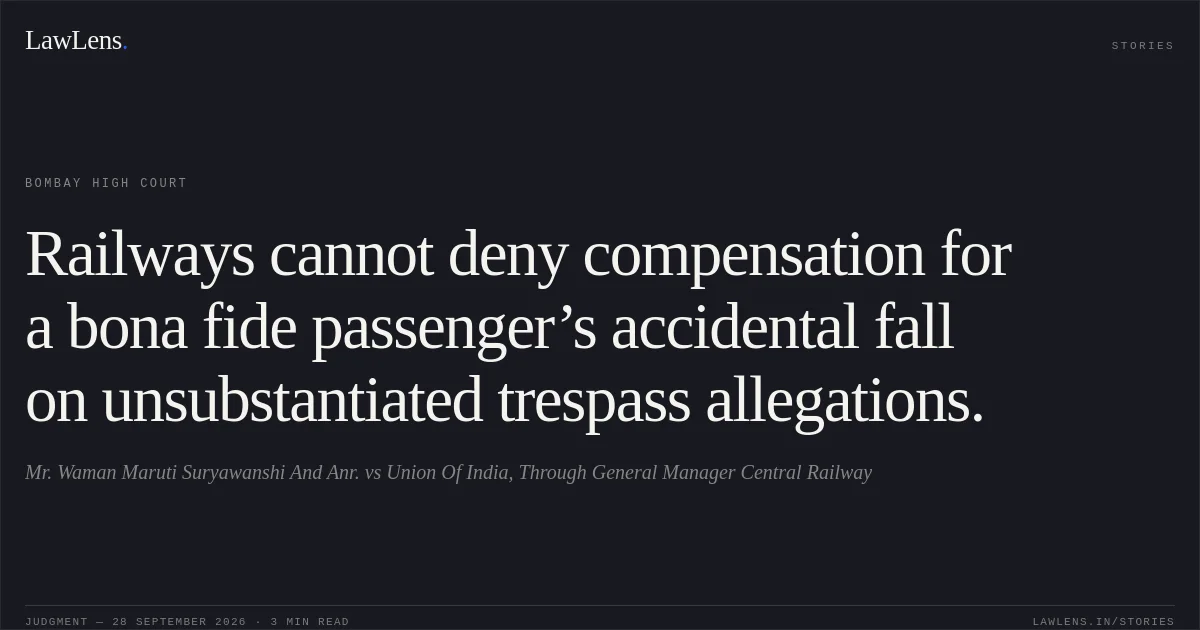
The appellants, the deceased’s parents, claimed compensation under Section 124A of the Railways Act, 1989, after their son Rahul died on 22 March 2015 from injuries sustained between Ghansoli and Rabale railway stations.
Source reference: pp. 2–4The inquest panchanama recorded that he had fallen from an unknown local train and that a railway ticket was found on his person.
Source reference: pp. 2–4The Railway’s DRM report, relying on a Station Master’s memo, stated that the incident might have occurred while he was crossing the tracks.
Source reference: pp. 2–4The Tribunal accepted that the deceased was a bona fide passenger but dismissed the claim, finding that the appellants had not proved that he fell from a train.
Source reference: pp. 2–4The parents appealed under Section 23 of the Railway Claims Tribunal Act, 1987.
Source reference: pp. 2–4Issues
Whether the deceased was a bona fide passenger travelling with a valid railway ticket
Source reference: p. 4Whether the deceased died after accidentally falling from a train or after being struck by a train while trespassing on the tracks
Source reference: p. 4Whether the death resulted from an “untoward incident” under Section 123(c)(2) of the Railways Act and whether any exception under Section 124A applied
Source reference: pp. 4, 9What compensation and other relief the appellants were entitled to
Source reference: pp. 4, 16–18Law Applied
Section 123(c)(2) of the Railways Act defines an “untoward incident” to include the accidental falling of a passenger from a train; Section 124A imposes liability for such an incident irrespective of railway fault, subject to the listed exceptions, including the passenger’s own criminal act.
Source reference: pp. 8, 13–14Section 2(29) defines a passenger as a person travelling with a valid pass or ticket.
Source reference: p. 8Under Jameela v. Union of India, negligence in falling from a train does not by itself defeat compensation, and a railway assertion about the manner of a fall cannot rest on speculation.
Source reference: pp. 13–15Under Union of India v. Rina Devi, interest may be awarded from the date of the accident, and the applicable compensation is assessed by comparing the amount with the prescribed compensation.
Source reference: pp. 6–7, 15–17Railway records admissible under Section 191 are not conclusive proof of their contents; their reliability and probative value must be judicially assessed.
Source reference: p. 12Reasoning
The Tribunal’s finding that the deceased was a bona fide passenger, together with the ticket recorded in the inquest panchanama, supported the claim.
Source reference: pp. 10–11, 13The panchanama recorded a fall from a local train, while the DRM report stated only that the incident might have occurred while the deceased was crossing the tracks.
Source reference: pp. 9–12, 14In the absence of eyewitness evidence or other reliable proof, the report and memo did not establish trespass or that the deceased was struck by a train; nor could the Tribunal determine the cause from its own assessment of the injuries.
Source reference: pp. 9–12, 14The Railways therefore failed to establish a basis to deny compensation under Section 124A, and negligence alone would not bar recovery.
Source reference: pp. 13–15Holding
The High Court allowed the appeal and set aside the Tribunal’s judgment.
It awarded the appellants ₹8,14,641, to be divided equally between them, and directed the Railways to deposit the amount in their bank accounts within eight weeks after receiving their bank details.
Source reference: pp. 17–18Any delay beyond that period would attract further interest at 9% per annum until payment.
Source reference: pp. 17–18Acts & Sections Cited
5 provisions across 3 statutes referred to in this judgment. Each provision opens on LawLens.
Railway Claims Tribunal Act, 19871
Railways Act, 19893
Code of Criminal Procedure, 19731
Original Court PDF
Mr. Waman Maruti Suryawanshi And Anr.vsUnion Of India, Through General Manager Central Railway
Click to open original judgment
Original judgment, available to read, download and summarize on LawLens.in