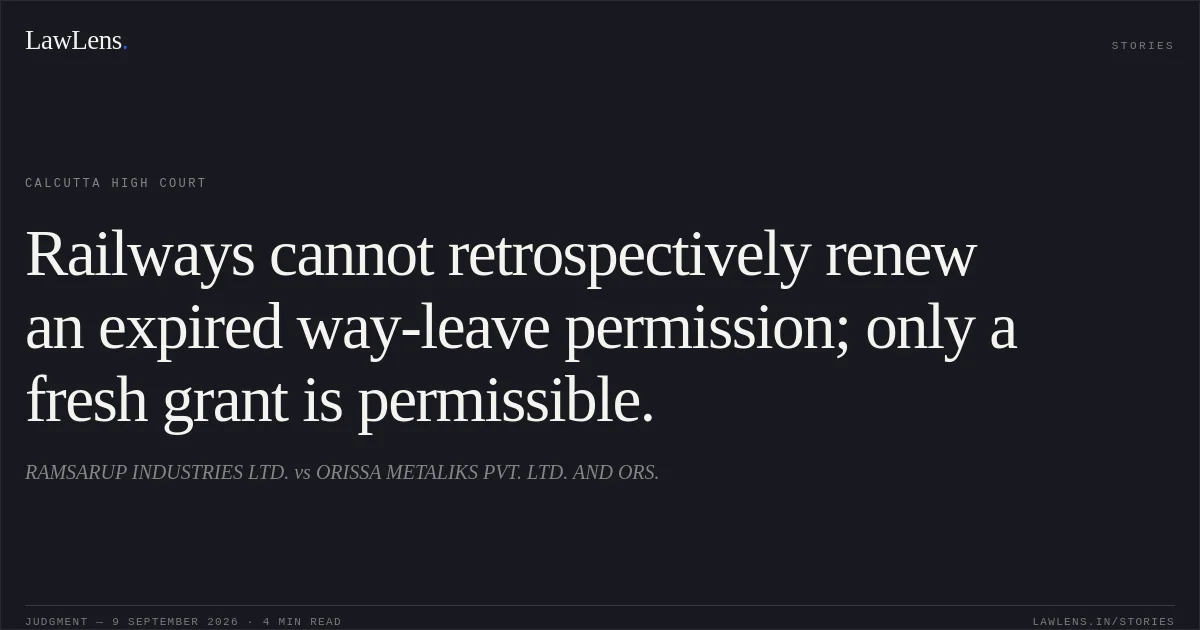
Facts
Ramsarup Lohh Udyog Ltd. obtained a ten-year Way Leave Permission from the Railways on 10 July 2007 to lay a water pipeline through railway property; following its amalgamation with Ramsarup Industries Ltd., the permission stood transferred to the appellant.
Source reference: para. 2(i)–(ii)The permission expired by efflux of time on 9 July 2017.
Source reference: para. 26In the meantime, Orissa Metaliks Pvt. Ltd. (“OMPL”) obtained Railway permissions in 2019 and 2022 to construct two road underbridges (“RUBs”) at locations allegedly intersected by the appellant’s pipeline, and the RUBs were subsequently constructed and made operational.
Source reference: paras. 2(xii)–(xxi)OMPL’s writ petition was allowed by the learned Single Judge, who quashed the purported revival and consequential steps. The present intra-court appeal challenged that decision.
Source reference: paras. 1, 13–14Issues
Whether OMPL had locus standi to challenge the Railway’s grant or revival of the Way Leave Permission in favour of the appellant.
Source reference: paras. 17–21Whether a Way Leave Permission that expired on 9 July 2017 could be retrospectively “renewed” or revived in 2024, particularly in light of the appellant’s CIRP and the NCLT-approved resolution plan.
Source reference: paras. 26–29Whether the Railway Authorities could grant the permission without giving OMPL an opportunity of hearing and without conducting a comprehensive safety assessment concerning OMPL’s RUBs and the surrounding industrial and railway infrastructure.
Source reference: paras. 19, 22–25, 33Whether the permitted overhead structure was contrary to Clause 1033 of the Indian Railway Code for Engineering Department.
Source reference: para. 25Whether the Single Judge erred in characterising the Railway’s action as fraudulent or collusive.
Source reference: paras. 31–32Law Applied
The Court applied the principle that a person having a genuine and legally cognisable interest, and who may suffer adverse civil consequences from an administrative decision, has standing to invoke judicial review.
Source reference: paras. 20–21It held that an expired licence or permission cannot be “renewed” after the expiry of its term; any subsequent authorisation would constitute a fresh grant requiring compliance with the applicable law and policy.
Source reference: paras. 26–27The Court relied on Gujarat Urja Vikas Nigam Ltd. v. Amit Gupta, (2021) 7 SCC 209, to distinguish disputes arising from insolvency from disputes dehors the insolvency process; the NCLT cannot renew or revive a Railway permission unrelated to insolvency resolution.
Source reference: paras. 28–29Administrative authorities must act fairly and consider representations where their decision may adversely affect third-party rights or interests, including by undertaking an appropriate safety assessment.
Source reference: paras. 19, 24, 33Clause 1033(12) of the Railway Engineering Code restricts construction on Railway land in connection with Way Leave facilities, subject to specified exceptions, and the Court found the permitted overhead structure prima facie inconsistent with that provision.
Source reference: para. 25Finally, relying on Union of India v. M.S. Chaturbhai M. Patel & Co., (1976) 1 SCC 747, the Court held that allegations of fraud and collusion must be established on proper material and cannot be inferred merely from suspicion; the civil standard of proof does not justify a casual finding of fraud.
Source reference: paras. 31–32Reasoning
OMPL had a direct and substantial interest because it had constructed and was operating the RUBs pursuant to Railway agreements, while the revived pipeline would pass over or near those structures and could potentially affect their safety.
Source reference: paras. 17–21The appellant’s original permission had expired before its admission to CIRP and before approval of the resolution plan. Consequently, the resolution plan could preserve existing rights but could not create or revive a permission that no longer existed; nor could the NCLT confer a fresh Railway land permission, as the dispute was unrelated to the insolvency process.
Source reference: paras. 26–29The Railway’s retrospective description of the 2024 grant as a “renewal” did not alter its legal character.
Source reference: paras. 26–27Since the proposed work could affect OMPL’s RUBs, boundary wall, industrial operations and railway safety, the Railways were required to consider OMPL’s objections, provide an opportunity of hearing and conduct a comprehensive safety audit. Their failure to do so rendered the decision procedurally unfair and substantively unsustainable.
Source reference: paras. 19, 24, 33The Court also found the overhead structure apparently contrary to Clause 1033(12) of the Railway Engineering Code.
Source reference: para. 25However, the Court held that the Single Judge went too far in finding fraud and collusion; those observations were unsupported by the requisite material and were therefore expunged.
Source reference: paras. 31–32Holding
The Division Bench substantially affirmed the Single Judge’s judgment.
It held that the Way Leave Permission, having expired on 9 July 2017, could not be retrospectively renewed or revived in 2024; the Railway’s action was illegal because it was taken without a proper safety audit and without hearing OMPL, whose existing RUBs and related interests could be adversely affected.
Source reference: paras. 26–27, 33–34The permission and all consequential steps taken pursuant to the communications dated 3 and 4 April 2024 were therefore set aside.
Source reference: paras. 32–35The observations of fraud, fraudulent collusion and fraud on the statute were expunged, but the substantive quashing of the permission was maintained.
Source reference: paras. 32–35The appeal and connected applications were disposed of, and the subsisting interim order was vacated.
Source reference: para. 35Acts & Sections Cited
3 provisions across 2 statutes referred to in this judgment. Each provision opens on LawLens.
Insolvency and Bankruptcy Code, 2016.2
Indian Penal Code, 18601
Original Court PDF
RAMSARUP INDUSTRIES LTD.vsORISSA METALIKS PVT. LTD. AND ORS.
Click to open original judgment
Original judgment, available to read, download and summarize on LawLens.in
![Similarly situated employees cannot be denied TBP financial upgradation solely because their promotional appointments were ad hoc.. A K PATHAK vs NEW DELHI MUNICIPAL CORPORATION. CAT - ['Delhi']. LawLens](/stories/thumbnails/similarly-situated-employees-cannot-be-denied-tbp-financial-upgradation-solely-because-the-b3dc1522387f4de79b828475ad651568.webp)