Facts
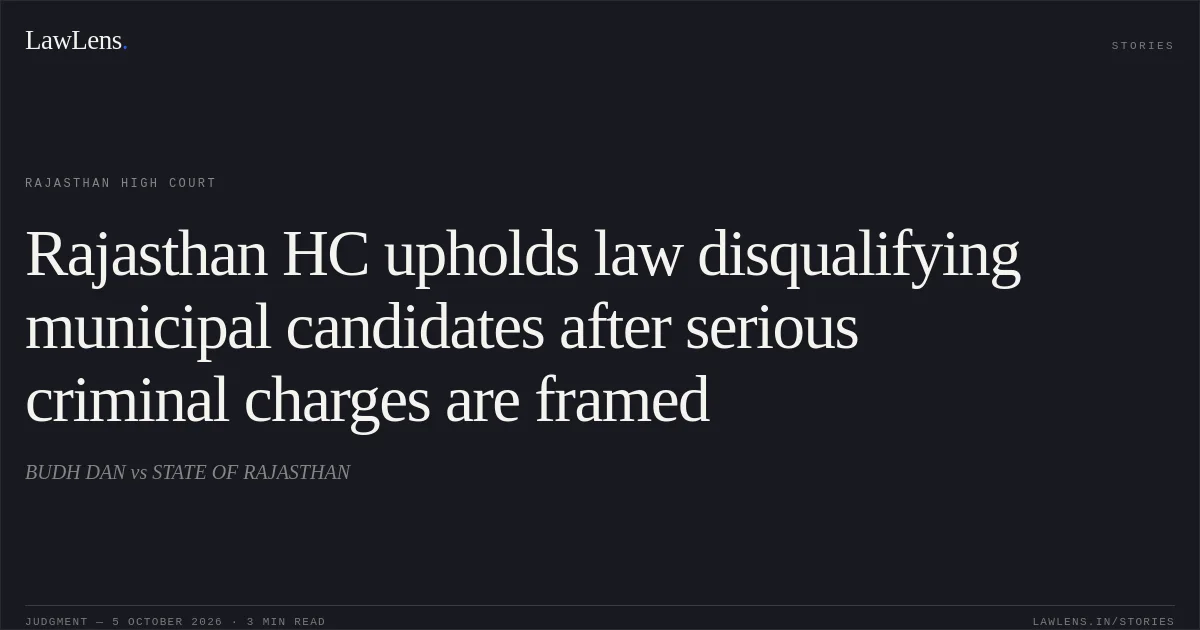
The petitioner challenged the constitutional validity of Section 24(iii) of the Rajasthan Municipalities Act, 2009, which disqualifies a person from contesting a municipal election where a competent court has taken cognizance and framed charges for an offence punishable with imprisonment of five years or more.
Source reference: paras. 2, 5He sought to contest from Ward No. 6, Mathania Nagar Palika, but his nomination was rejected because the required party-authorisation forms were not enclosed; the recorded reason was non-compliance with the Rajasthan Municipalities (Election) Rules, 1994, not the statutory disqualification.
Source reference: paras. 3–4The petitioner argued that Section 24(iii) was arbitrary and discriminatory, including in comparison with the conviction-based disqualification under Section 24(i) and Section 8(3) of the Representation of the People Act, 1951.
Source reference: paras. 5–6Issues
Whether Section 24(iii) of the Rajasthan Municipalities Act, 2009, which disqualifies a person facing trial after cognizance and framing of charges for an offence punishable with imprisonment of five years or more, violates Articles 14 and 21 of the Constitution.
Source reference: para. 9Whether the provision is unconstitutional because it treats an undertrial candidate more onerously than a person disqualified following conviction, or differs from the electoral-disqualification scheme under the Representation of the People Act, 1951.
Source reference: paras. 5–6, 27, 31Law Applied
The Court applied the presumption of constitutionality afforded to legislative enactments, subject to proof of a clear constitutional infirmity.
Source reference: para. 10Under Article 243V(1)(b) of the Constitution, State legislation may prescribe disqualifications for membership of a municipality; the right to contest an election is statutory and subject to legislatively prescribed qualifications and disqualifications.
Source reference: paras. 11–13Section 24(iii) was considered in light of the earlier Rajasthan Municipalities Act, 1959, Section 26(i)(b), and the pari materia disqualification in Section 19(gg) of the Rajasthan Panchayati Raj Act, 1994, upheld in Shiv Ram v. State of Rajasthan, Narayan Lal v. State of Rajasthan, and Yogendra Nandwana v. State of Rajasthan.
Source reference: paras. 13–21The Court also relied on the principles of finality in Delhi Cloth and General Mills Ltd. v. Shambhu Nath Mukherji, Union of India v. Major S.P. Sharma and Kesho Ram & Co. v. Union of India, and on Javed v. State of Haryana concerning comparisons between legislation enacted by different legislatures under different sources of power.
Source reference: paras. 22–27Reasoning
The Court held that the petitioner’s challenge concerned a provision materially equivalent to one previously upheld by Rajasthan High Court decisions, and that the constitutional validity of the provision could not be reopened merely by advancing a new ground of challenge.
Source reference: paras. 13–21, 26Independently, it found that Section 24(iii) does not operate on the basis of an FIR or accusation alone: disqualification follows only after cognizance, framing of charges by a competent court, and where the offence carries a maximum punishment of five years or more.
Source reference: paras. 19–21, 28–30Those criteria were held to provide objective judicial safeguards, bear a rational connection to the aim of protecting local democratic institutions, and avoid manifest arbitrariness.
Source reference: paras. 19–21, 28–30The comparison with Section 24(i) was rejected because the two provisions address distinct stages and purposes; comparison with parliamentary legislation was also not a valid Article 14 basis, given the different legislative sources and constitutional fields.
Source reference: paras. 27, 31The Court additionally noted that the petitioner’s nomination had been rejected for missing authorisation forms, rather than on the ground of Section 24(iii).
Source reference: para. 4Holding
The Court rejected the constitutional challenge to Section 24(iii), holding that it did not violate Articles 14 or 21.
The writ petition was dismissed, without prejudice to the petitioner’s right to challenge the election by filing an election petition in accordance with law.
Source reference: paras. 33–34Acts & Sections Cited
6 provisions across 6 statutes referred to in this judgment. Each provision opens on LawLens.
RAJASTHAN MUNICIPALITIES ACT,20091
Prevention of Corruption Act, 19881
Indian Penal Code, 18601
Representation of the People Act, 19511
Rajasthan Panchayati Raj Act, 19941
Representation of the People Act, 19501
Original Court PDF
BUDH DANvsSTATE OF RAJASTHAN
Click to open original judgment
Original judgment, available to read, download and summarize on LawLens.in