Facts
The petitioner sought a writ of habeas corpus under Article 226 of the Constitution and Section 528 of the Bharatiya Nagarik Suraksha Sanhita, 2023, alleging illegal custody in connection with FIR No. 493/2026 registered at Police Station New Usmanpur, North-East Delhi.
Source reference: p.1, para.3He alleged that he was detained on 20 July 2026 but produced before the learned JMFC only on 23 July 2026.
Source reference: p.2, para.4The JMFC observed that the written grounds of arrest did not disclose the date or time of supply, whether they were furnished two hours before production, or sufficient details of the incident, contrary to the safeguards in Mihir Rajesh Shah v. State of Maharashtra.
Source reference: p.2, para.5The petitioner was consequently directed to be released on a bail bond of ₹10,000 with one surety.
Source reference: p.2, para.6The petitioner was subsequently re-arrested on 21 August 2026 without following the procedure prescribed for re-arrest after an unconstitutional arrest.
Source reference: p.2, para.7His challenge to the re-arrest was rejected by the learned Additional Sessions Judge on 22 August 2026, and he was remanded to police custody for two days.
Source reference: p.2, paras.8–9Before the High Court, the State conceded that the procedure mandated in Mihir Rajesh Shah and reiterated in Jaskaran Jeet Singh Deol v. State of Punjab had not been followed before the re-arrest.
Source reference: p.3, para.13Issues
Whether the petitioner’s re-arrest, after his earlier release for violation of Article 22(1), was illegal because the investigating agency failed to follow the safeguards prescribed in Mihir Rajesh Shah and Jaskaran Jeet Singh Deol.
Source reference: p.3, paras.10–13Whether the petitioner was entitled to immediate release from custody on account of the unconstitutional re-arrest.
Source reference: p.7, paras.15–17Law Applied
The Court applied Article 22(1) of the Constitution, which requires that an arrested person be informed of the grounds of arrest in writing, in a language understood by him, and be furnished a copy of those grounds at the earliest and as a matter of course.
Source reference: pp.3–5, para.14Non-compliance with this constitutional safeguard renders the arrest and consequent custody unconstitutional and requires immediate release; subsequent filing of a charge-sheet or taking of cognizance cannot validate the illegal arrest.
Source reference: pp.4–5, para.14Relying on Mihir Rajesh Shah v. State of Maharashtra and Jaskaran Jeet Singh Deol v. State of Punjab, the Court held that where an accused has been released for breach of Article 22(1), any proposed re-arrest requires: (i) furnishing the grounds of arrest; (ii) an application by the investigating agency to the concerned Magistrate explaining the necessity for re-arrest and the earlier non-supply of grounds; (iii) endorsement by the immediate superior authority; and (iv) judicial permission before re-arrest.
Source reference: pp.5–6, paras.14, 24–25The petition was maintainable under Article 226 of the Constitution read with Section 528 of the BNSS.
Source reference: p.1, para.3Reasoning
The initial arrest had already been found procedurally defective by the JMFC because the grounds of arrest lacked the required particulars regarding their timing, service, and the incident alleged.
Source reference: p.2, para.5Once the petitioner was released on that basis, the investigating agency could not unilaterally re-arrest him merely because offences under the Protection of Children from Sexual Offences Act, 2012 had subsequently been added to the FIR.
Source reference: p.7, para.15The State expressly admitted that it had neither obtained the superior authority’s endorsement nor moved the Magistrate for permission to re-arrest while demonstrating the necessity for custodial interrogation.
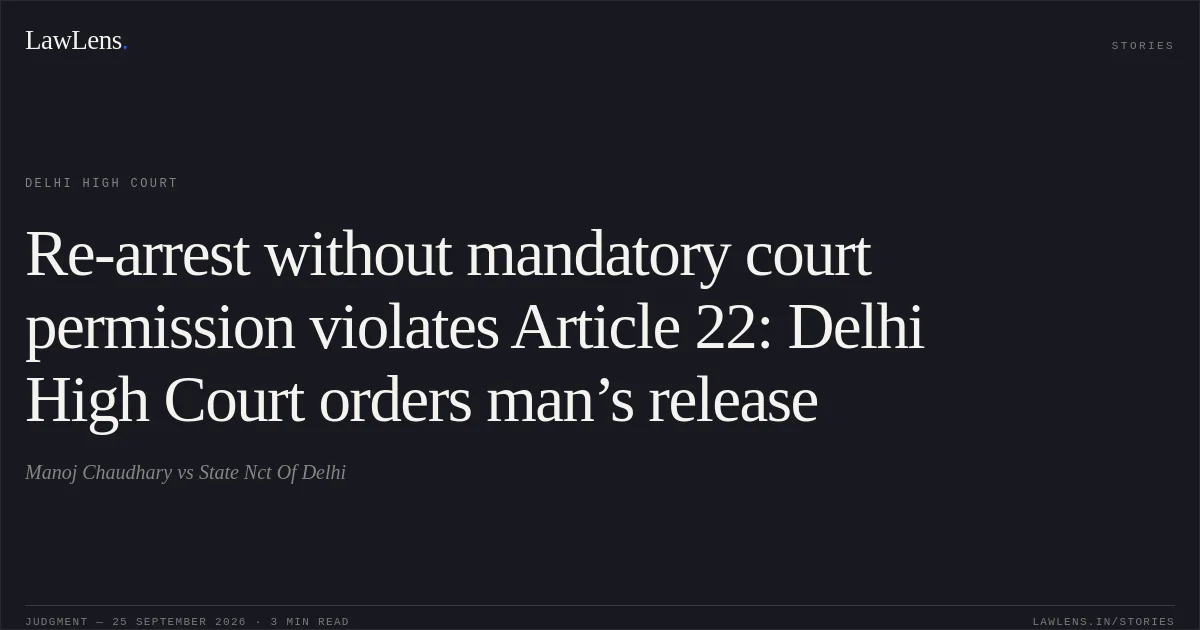
Source reference: p.3, para.13Applying the mandatory safeguards in Mihir Rajesh Shah and Jaskaran Jeet Singh Deol, the Court held that the re-arrest was not legally sustainable and violated the petitioner’s fundamental rights under Article 22.
Source reference: p.7, para.15Holding
The High Court held that the petitioner’s re-arrest was illegal and unconstitutional because the prescribed procedure for re-arrest after release for breach of Article 22 had not been followed.
It directed the petitioner’s forthwith release on the same terms and conditions imposed by the JMFC’s order dated 23 July 2026—namely, a bail bond of ₹10,000 with one surety of the like amount.
Source reference: p.7, para.16The writ petition and pending application were disposed of, with the Court clarifying that it had expressed no opinion on the merits of the prosecution’s case.
Source reference: pp.7–8, paras.17–18Acts & Sections Cited
1 provisions across 1 statute referred to in this judgment. Each provision opens on LawLens.
Bharatiya Nagarik Suraksha Sanhita, 20231
Original Court PDF
Manoj ChaudharyvsState Nct Of Delhi
Click to open original judgment
Original judgment, available to read, download and summarize on LawLens.in