01Facts
The petitioner sought a writ of mandamus under Article 226 directing the Tahsildar, Kalasapakkam Taluk (R3), to remove an encroachment by the fourth respondent on a pathway and to restore the pathway.
p. 2The Special Government Pleader submitted that the authorities had removed the encroachment on 18.02.2026.
¶ 1 · p. 3The petitioner's counsel contended that the Government property was re-encroached in April 2026 after the removal.
¶ 2 · p. 3The fourth respondent did not appear.
p. 2The court did not record any finding on the alleged April 2026 re-encroachment.
02Issues
i.1. Whether the competent authority is bound to register a police complaint and prosecute persons who re-encroach on Government property after an earlier removal of encroachment.
¶ 3 · p. 3ii.2. Whether the respondents should be directed to inspect the site, identify any re-encroachment, and take removal and prosecution action within a fixed period.
¶ 4 · p. 403Law Applied
The court relied on the principle that the competent authority must act against unlawful occupation of Government property. It held that where re-encroachment occurs after removal, the authority is "bound to register a police complaint and prosecute the offenders," and that committing re-encroachment after removal is an offence "liable to be prosecuted."
¶ 3 · p. 3The order cites no statutory provision defining the offence and no precedent.
The writ jurisdiction under Article 226 of the Constitution of India was the procedural basis for the mandamus sought.
p. 204Reasoning
The court accepted the State's position that the original encroachment was removed on 18.02.2026.
¶ 1 · p. 3The court treated the petitioner's assertion of a fresh encroachment in April 2026 as the operative grievance, and did not adjudicate whether that re-encroachment in fact occurred.
¶ 2 · p. 3 · ¶ 4 · p. 4Because the alleged re-encroachment was a new act following removal, the court characterised it as a distinct offence attracting police complaint and prosecution, rather than a continuation of the original encroachment.
¶ 3 · p. 3Given that factual dispute, the court did not grant the relief in its original form. Instead it directed a fact-finding inspection and, if re-encroachment was established, removal and prosecution, which allowed the authorities to address the current position without a merits determination by the court.
¶ 4 · p. 405Holding
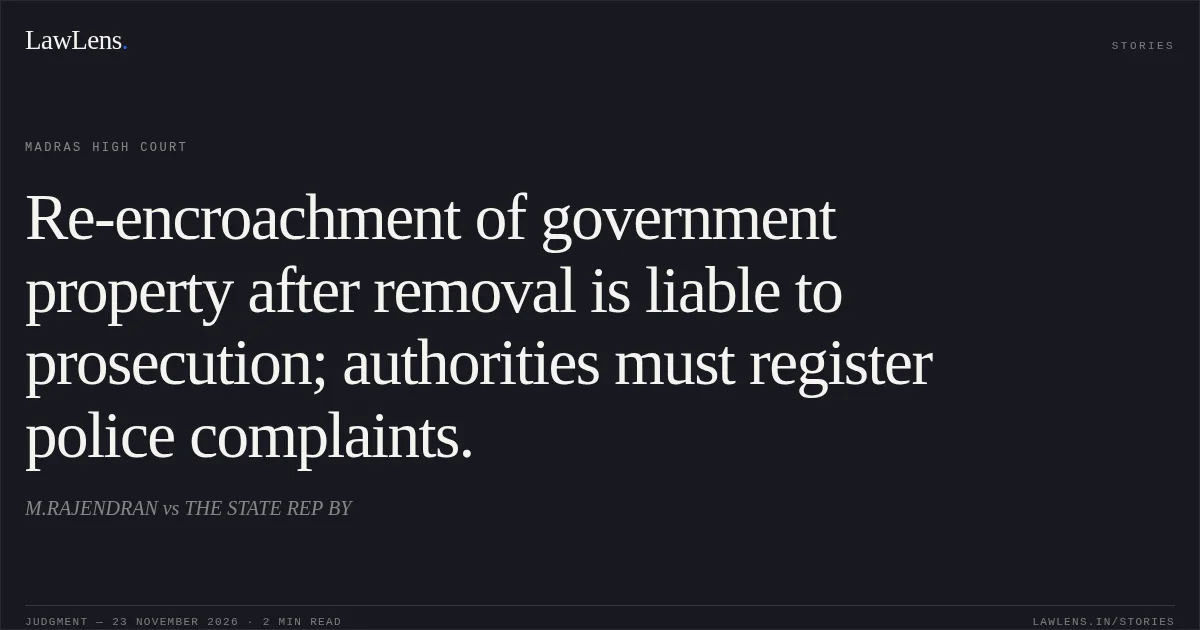
The court's answer is that re-encroachment of Government property after removal must be met with a police complaint and prosecution by the competent authority.
¶ 3 · p. 3The writ petition was disposed of with the following directions: R1 to R3 are to conduct an inspection, identify whether any re-encroachment has occurred, and, if so, initiate appropriate action to remove the encroachment and prosecute the offenders "in the manner known to law," to be completed within eight weeks from receipt of a copy of the order. No costs were awarded.
¶ 4 · p. 4 · ¶ 5 · p. 4Original Court PDF
M.RAJENDRANvsTHE STATE REP BY
Click to open original judgment
Original judgment, available to read, download and summarize on LawLens.in