Facts
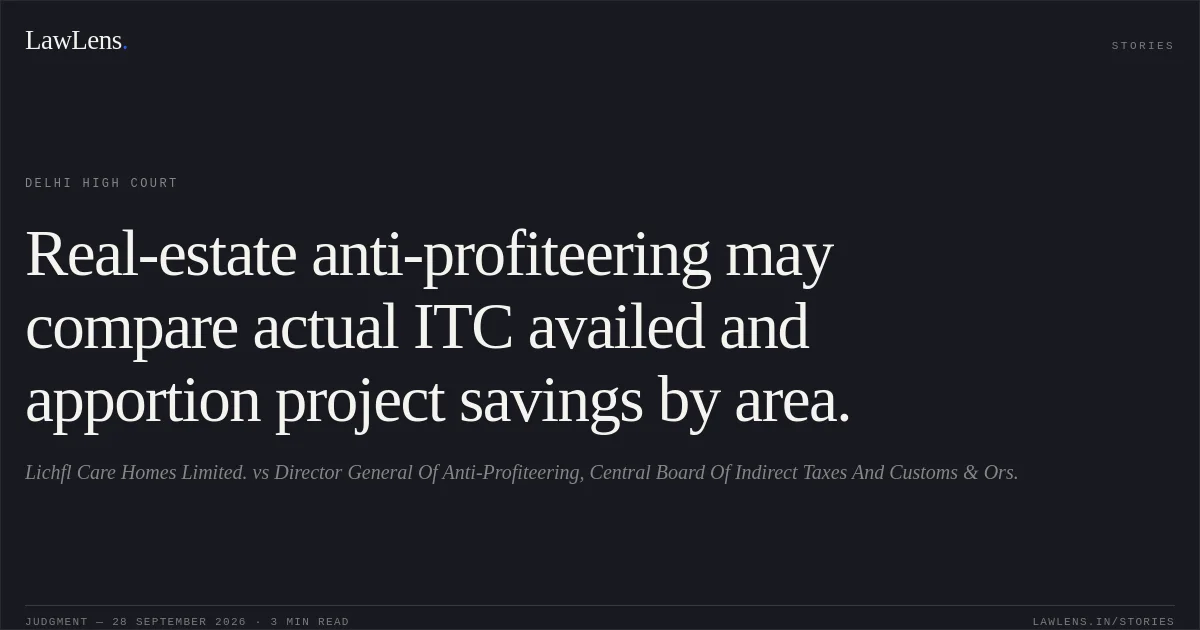
LICHFL Care Homes Limited developed the “Jeewan Anand” residential project in Bhubaneswar. In earlier proceedings under Section 171 of the CGST Act, profiteering was determined against the petitioner. After the Delhi High Court’s decision in Reckitt Benckiser India Pvt. Ltd. v. Union of India, which rejected the general use of an ITC-to-turnover ratio for real estate projects, the matter was remanded for fresh determination.
Source reference: para. 2–5, 8–10On reinvestigation, the DGAP found that the petitioner had availed no pre-GST CENVAT/VAT credit but had availed post-GST ITC of Rs.2,07,76,653. It calculated a project-level saving, allocated it per square foot, and determined profiteering of Rs.2,07,08,131, plus GST, for a total of Rs.2,31,93,107. GSTAT upheld that determination.
Source reference: para. 12–13, 20–21The petitioner challenged its order under Articles 226 and 227, contending, among other things, that the methodology did not comply with Reckitt Benckiser and that legally available but unavailed pre-GST CENVAT credit should be considered.
Source reference: para. 22, 24Issues
1. Whether the DGAP’s revised methodology—using purchase value to quantify additional ITC and distributing the project-level saving by area—complied with the directions in Reckitt Benckiser.
Source reference: para. 5, 30–352. Whether legally available but unavailed pre-GST CENVAT credit could be treated as reducing the petitioner’s pre-GST tax incidence when determining the additional benefit under Section 171.
Source reference: para. 36–423. Whether GSTAT’s order disclosed a legal or jurisdictional error warranting interference under Articles 226 and 227.
Source reference: para. 28, 53, 56, 59–62Law Applied
Section 171 of the CGST Act requires a supplier to pass on the benefit of an actual reduction in tax rate or actual ITC benefit to recipients.
Source reference: no citationUnder Reckitt Benckiser India Pvt. Ltd. v. Union of India, no uniform formula applies to every case; for real estate projects, the total project-level savings attributable to GST should be calculated and divided by the total area to determine the per-square-foot benefit, rather than relying on an ITC-to-turnover ratio that assumes a correlation between turnover and ITC accrual.
Source reference: 2024 (82) G.S.T.L. 344 (Del.), paras. 124, 129; judgment, para. 29In judicial review under Articles 226 and 227, the Court may intervene for, inter alia, jurisdictional error, manifest illegality, or failure to follow a binding direction, but the jurisdiction does not ordinarily permit substitution of the Court’s factual assessment for that of the specialised Tribunal.
Source reference: judgment, para. 28Reckitt Benckiser also supports including GST collected on an additional realisation in the profiteered amount.
Source reference: 2024 (82) G.S.T.L. 344 (Del.), para. 157; judgment, para. 57Reasoning
The Court held that the DGAP had not merely substituted purchase value for turnover in the disapproved ITC-to-turnover method. It used purchase value to quantify additional ITC, then calculated project-level savings and allocated them per square foot—an approach consistent with Reckitt Benckiser’s area-based direction.
Source reference: para. 31–35The petitioner’s proposed pre-GST credit was never actually availed; its returns showed NIL CENVAT credit, while post-GST ITC was in fact availed. The authorities were therefore entitled to assess actual credit enjoyed rather than introduce hypothetical pre-GST credit into the comparison.
Source reference: para. 37–42GSTAT had considered the petitioner’s alternative computation and other submissions, and its decision did not rest solely on treating that computation as an admission.
Source reference: para. 44–47The Court found no basis for writ interference with the Tribunal’s assessment; it also upheld the addition of GST and found no independent jurisdictional infirmity in the interest direction.
Source reference: para. 53, 57–62Holding
The Court answered the principal issues against the petitioner. It held that the revised methodology was not contrary to Reckitt Benckiser and that unavailed pre-GST CENVAT credit could not be treated as an actual benefit received by the petitioner.
Finding no patent jurisdictional error, manifest illegality, or failure to comply with the remand directions, the Court dismissed the writ petition and pending applications, leaving GSTAT’s order—including the profiteered amount, GST, and interest directions—undisturbed.
Source reference: para. 63–64Acts & Sections Cited
1 provisions across 1 statute referred to in this judgment. Each provision opens on LawLens.
Central Goods and Services Tax Act, 20171
Original Court PDF
Lichfl Care Homes Limited.vsDirector General Of Anti-Profiteering, Central Board Of Indirect Taxes And Customs & Ors.
Click to open original judgment
Original judgment, available to read, download and summarize on LawLens.in