Facts
The petitioner-company filed its return for A.Y. 2012–13 declaring total income of ₹1,64,59,510.
Source reference: no citationAfter scrutiny under Section 143(3) of the Income Tax Act, 1961 (“the Act”), an assessment order was passed on 23 March 2015.
Source reference: p.2On 29 March 2019, nearly four years after the original assessment, the Assessing Officer issued a notice under Section 148 proposing to reopen the assessment on the basis that a common shareholder, Pushpak Realities Private Limited, allegedly held 90% of the petitioner’s shares and 49.88% of Amber Enclaves Private Limited, thereby attracting the deemed-dividend provisions of Section 2(22)(e).
Source reference: p.3The petitioner clarified that Pushpak Realities held only 4.60% of its shares and that the petitioner was not a registered shareholder of Amber Enclaves Private Limited.
Source reference: p.3It also relied on CIT v. Ankitech (P.) Ltd. and CIT v. Daisy Packers (P.) Ltd. in its objections.
Source reference: pp.3–4Despite these objections, the Assessing Officer passed an assessment order under Sections 143(3) read with 147 and issued a demand notice under Section 156 on 10 December 2019.
Source reference: p.1The petitioner challenged the reopening and consequential orders under Article 226 of the Constitution.
Source reference: no citationIssues
1. Whether the High Court should entertain the writ petition despite the petitioner having an alternative statutory remedy of appeal under Section 246A of the Act?
Source reference: pp.6–82. Whether the reopening of the assessment after four years was invalid in the absence of any failure by the petitioner to fully and truly disclose material facts, as required by the first proviso to Section 147 of the Act?
Source reference: pp.6–83. Whether the alleged loan or advance attracted Section 2(22)(e) of the Act when Pushpak Realities held only 4.60% of the petitioner’s shares and the petitioner was not a registered shareholder of Amber Enclaves Private Limited?
Source reference: pp.7, 9–12Law Applied
The Court applied Section 147 and its first proviso, under which an assessment completed under Section 143(3) cannot be reopened after four years from the end of the relevant assessment year unless the assessee failed to disclose fully and truly all material facts.
Source reference: p.7Section 2(22)(e) treats certain loans or advances by closely held companies as deemed dividends where the statutory shareholding, substantial-interest, accumulated-profit and other conditions are satisfied.
Source reference: pp.9–11Relying on CIT v. Ankitech (P.) Ltd., 340 ITR 14 (Delhi) and CIT v. Daisy Packers (P.) Ltd., (2014) 220 Taxman 331 (Guj.), the Court held that the legal fiction under Section 2(22)(e) enlarges the meaning of “dividend” but does not deem the recipient concern to be a shareholder or member of the payer company.
Source reference: pp.8–12The Court also applied the exceptions to the alternative-remedy rule recognised in CIT v. Chhabil Dass Agarwal, (2013) 36 taxmann.com 36 (SC), particularly where the impugned action is contrary to statutory provisions, settled legal principles, or principles of judicial procedure.
Source reference: p.6Reasoning
The Court held that the writ petition was maintainable notwithstanding the appellate remedy because the assessment order ignored the binding legal principles cited by the petitioner and proceeded on materially incorrect shareholding facts.
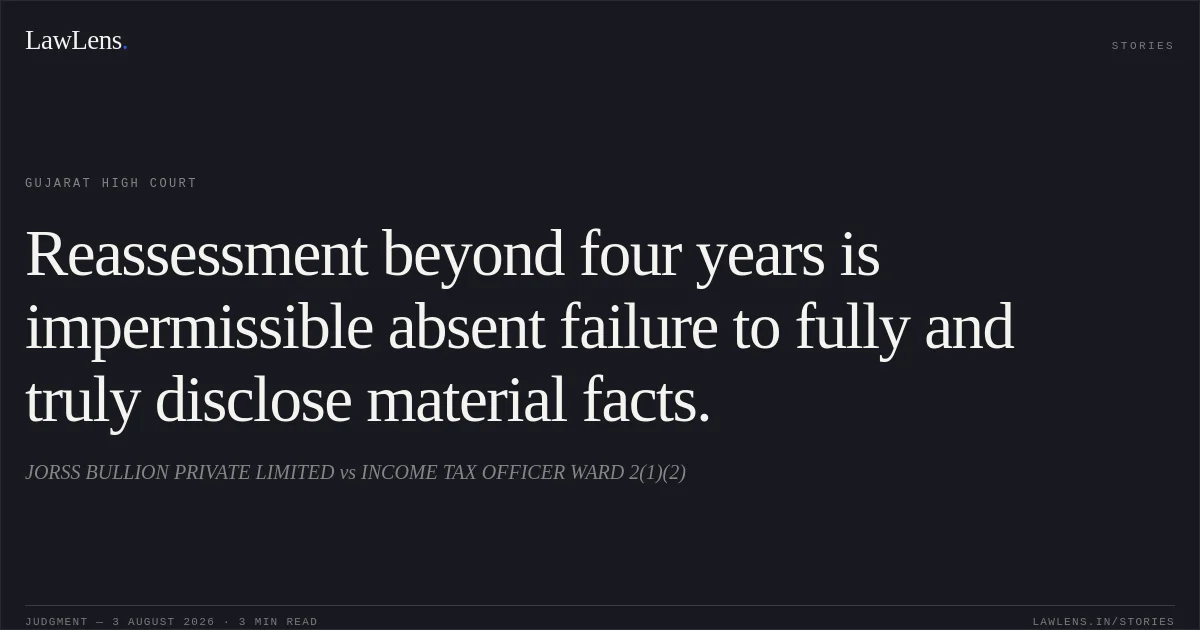
Source reference: pp.6–8The reopening was beyond four years from the end of A.Y. 2012–13, while the Revenue did not allege or establish any failure by the petitioner to disclose material facts.
Source reference: p.7The petitioner had furnished its computation, audited balance sheet, audit report, shareholding details and relevant information during the original scrutiny assessment.
Source reference: p.7On the merits, the alleged common shareholder held only 4.60% in the petitioner-company, which was below the statutory threshold relied upon by the Revenue.
Source reference: p.11Further, the petitioner was not a registered shareholder of Amber Enclaves Private Limited; therefore, under Ankitech and Daisy Packers, a loan or advance to the petitioner could not be treated as deemed dividend merely through an extended legal fiction under Section 2(22)(e).
Source reference: pp.7–12The conditions for invoking Section 2(22)(e) were consequently not satisfied.
Source reference: no citationHolding
The Court answered the issues in favour of the petitioner.
It held that the reopening was impermissible under the first proviso to Section 147 because it occurred beyond four years without any failure of full and true disclosure, and that Section 2(22)(e) was inapplicable on the established shareholding and shareholder status facts.
Source reference: pp.7, 9–12The writ petition was allowed, and the notice under Section 148, the consequential assessment order dated 10 December 2019, and the demand notice under Section 156 were quashed and set aside.
Source reference: p.13Acts & Sections Cited
6 provisions across 1 statute referred to in this judgment. Linked provisions open on LawLens.
Income Tax Act, 19616
Original Court PDF
JORSS BULLION PRIVATE LIMITEDvsINCOME TAX OFFICER WARD 2(1)(2)
Click to open original judgment
Original judgment, available to read, download and summarize on LawLens.in