Facts
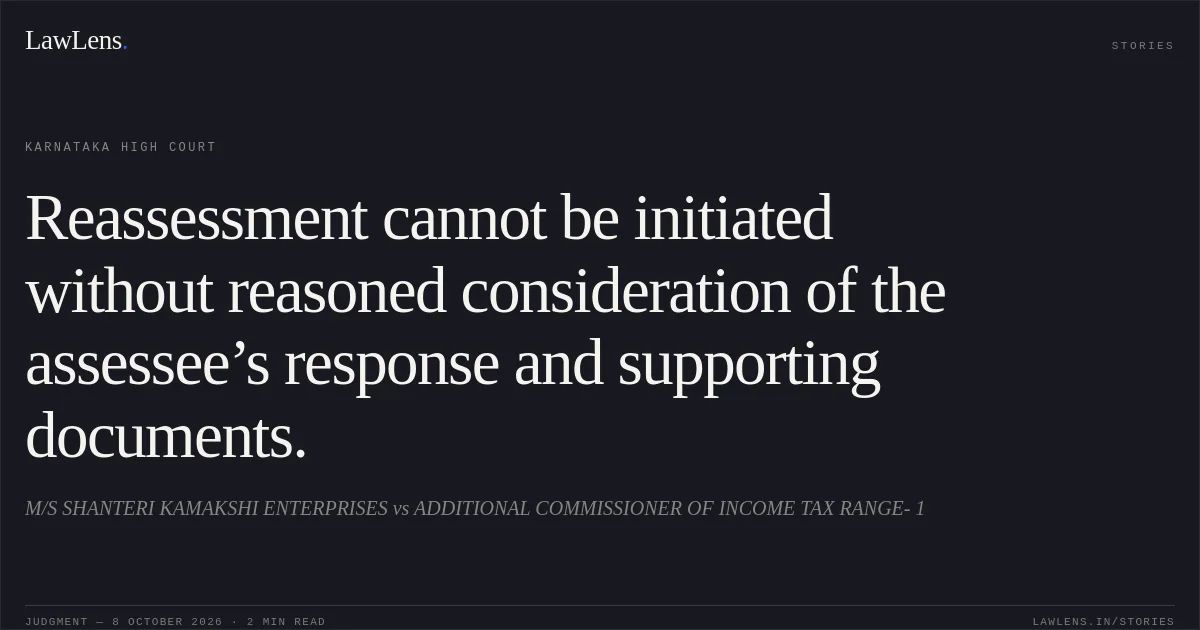
The petitioner challenged the order dated 16 June 2026 under Section 148A(3) of the Income Tax Act, 1961, the notice under Section 148, and a subsequent notice under Section 142(1), concerning assessment year 2020–21.
Source reference: p. 3After receiving a show-cause notice under Section 148A(1), the petitioner explained that bank credits of ₹60,05,132 were not undisclosed business turnover but included contra entries, advances towards LPG sales, loans and advances, receipts from partnership firms, reversals and similar transactions, and referred to its bank statements.
Source reference: pp. 4, 7The Assessing Officer found the explanation unsatisfactory, citing the absence of supporting documentary evidence or a reconciliation statement, and concluded that income had escaped assessment.
Source reference: pp. 7–8The petitioner also alleged that the approval was pre-dated; the respondents stated that it was digitally signed on 12 June 2026.
Source reference: pp. 5–6Issues
1. Whether the order under Section 148A(3) and consequential notice under Section 148 could stand when the Assessing Officer had not adequately examined the petitioner’s explanation and supporting material concerning the bank credits.
Source reference: pp. 4–5, 7–92. Whether the alleged pre-dating of the approval warranted setting aside the reassessment proceedings.
Source reference: pp. 5–6, 9Law Applied
Sections 147, 148 and 148A of the Income Tax Act, 1961 govern reassessment and require the authority, before issuing a notice under Section 148, to consider the assessee’s response to the show-cause notice under Section 148A(1) and determine under Section 148A(3) whether the case is fit for reassessment, giving cogent reasons.
Source reference: pp. 4–5, 8–9Section 142(1) concerns the subsequent assessment inquiry.
Source reference: pp. 4–5, 8–9The Court applied the principle that the statutory decision to initiate reassessment must reflect meaningful consideration of the assessee’s explanation and relevant material; it cited no precedent.
Source reference: pp. 4–5, 8–9Reasoning
The petitioner had identified specific categories of transactions and referred to its bank statements, but the Assessing Officer rejected the explanation principally because supporting evidence or a reconciliation statement had not been provided.
Source reference: pp. 7–8The Court held that, before concluding the case was fit for a Section 148 notice, the Assessing Officer should have examined the documents to determine whether the credits could properly be classified as business turnover and provided cogent reasons for the reassessment decision.
Source reference: p. 8The Court also observed that the approval process should address the circumstances giving rise to the pre-determination allegation, including any possible technical glitch, but did not set aside the proceedings on that ground alone.
Source reference: p. 9Holding
The petition was allowed in part. The Court quashed the Section 148A(3) order, the Section 148 notice and the consequential Section 142(1) notice; the prior approval was to stand dissolved upon the quashing of the Section 148A(3) order.
The matter was restored to the second respondent for reconsideration. The petitioner was directed to appear before that respondent on 30 October 2026, without further notice, and the respondent was required to consider the petitioner’s explanation in light of the Court’s observations.
Source reference: p. 10Acts & Sections Cited
6 provisions across 1 statute referred to in this judgment. Linked provisions open on LawLens.
Income Tax Act, 19616
Original Court PDF
M/S SHANTERI KAMAKSHI ENTERPRISESvsADDITIONAL COMMISSIONER OF INCOME TAX RANGE- 1
Click to open original judgment
Original judgment, available to read, download and summarize on LawLens.in