Facts
The petitioner filed his return for A.Y. 2016–17 declaring total income of ₹11,22,23,090.
Source reference: paras. 2.1–2.2; p. 2The return was scrutinised and an assessment was completed under Section 143(3) of the Income-tax Act, 1961, after the petitioner was asked to explain long-term capital gains.
Source reference: paras. 2.1–2.2; p. 2The Assessing Officer later issued a notice under Section 148A(b), alleging that the petitioner had set off short-term capital loss from mutual-fund redemptions against long-term capital gains.
Source reference: paras. 2.3–2.4; p. 2The information arose from a survey of JM Financial Asset Management Limited concerning alleged manipulation of the distributable surplus of a JM fund.
Source reference: paras. 2.3–2.4; pp. 2–3After considering the petitioner’s objections, the Assessing Officer passed an order under Section 148A(d) and issued a notice under Section 148, both dated 28 March 2023.
Source reference: para. 2.5; p. 3The petitioner challenged those actions by writ petition.
Source reference: para. 2.5; p. 3Issues
1. Whether the Assessing Officer had a sufficient, assessee-specific basis to reopen the assessment where the alleged manipulation concerned JM Financial and no material showed that the petitioner knowingly participated in a sham transaction.
Source reference: paras. 7, 9–11; pp. 5, 15–162. Whether reopening was impermissible as a change of opinion because the short-term capital-loss issue had already been examined during the scrutiny assessment and no fresh tangible material was shown.
Source reference: para. 7; pp. 14–15Law Applied
Sections 148A and 148 of the Income-tax Act govern the pre-reopening procedure and issuance of a reassessment notice.
Source reference: paras. 7–9; pp. 5–15Reopening must rest on relevant material having a rational connection or live link to the belief that the assessee’s income escaped assessment; vague or remote material, or mere suspicion, is insufficient.
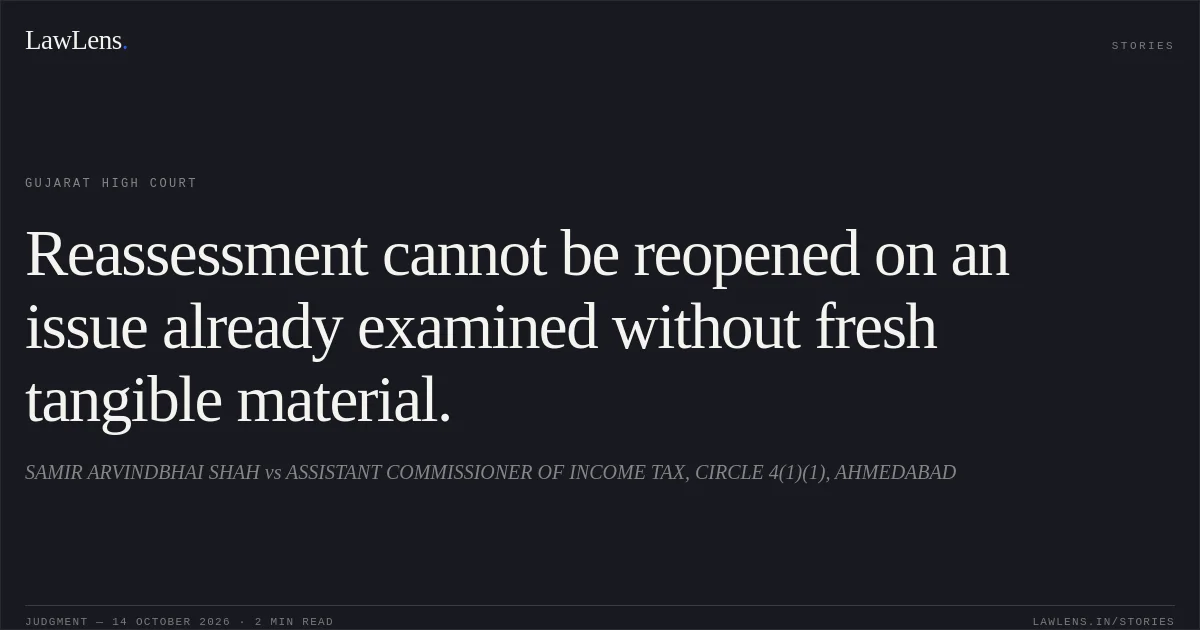
Source reference: paras. 7–9; pp. 5–15An assessment cannot be reopened on a change of opinion absent fresh tangible material.
Source reference: para. 7; pp. 14–15The Court relied on Pranav Ramesh Parikh v. Deputy Commissioner of Income Tax and Karan Maheshwari v. Assistant Commissioner of Income Tax for the principle that allegations against JM Financial do not, without material linking the assessee to knowing participation in a sham transaction, justify reopening.
Source reference: paras. 7–9; pp. 5–15It also referred to Commissioner of Income-tax v. Walfort Share & Stock Brokers (P) Ltd. and Income Tax Officer v. Lakhmani Mewal Das on dividend-stripping transactions and the required nexus between material and the belief of escapement.
Source reference: paras. 7, 10; pp. 8–12, 15The Court distinguished SEBI v. Rakhi Trading Private Limited as concerning synchronised trading under SEBI regulations, rather than the issue before it.
Source reference: para. 10; p. 15Reasoning
The reassessment was founded on allegations that JM Financial had manipulated its accounting methodology and that investors had claimed fictitious short-term capital losses.
Source reference: paras. 9–11; pp. 14–16The Court found no material or recorded finding establishing that this petitioner knowingly participated in a sham transaction or otherwise earned income that had escaped assessment.
Source reference: paras. 9–11; pp. 14–16Further, the petitioner’s short-term capital-loss claim had been examined during the earlier scrutiny assessment, and the Revenue had not demonstrated possession of fresh tangible material.
Source reference: para. 7; pp. 14–15Reopening therefore amounted to a change of opinion and lacked the necessary assessee-specific nexus to escaped income.
Source reference: para. 7; pp. 14–15Holding
The Court allowed the petition and quashed and set aside the order under Section 148A(d) dated 28 March 2023 and the consequential notice under Section 148 dated the same day.
The Rule was made absolute.
Source reference: para. 12; p. 16Acts & Sections Cited
9 provisions across 2 statutes referred to in this judgment. Linked provisions open on LawLens.
Income Tax Act, 19618
Indian Income-tax Act, 19221
Original Court PDF
SAMIR ARVINDBHAI SHAHvsASSISTANT COMMISSIONER OF INCOME TAX, CIRCLE 4(1)(1), AHMEDABAD
Click to open original judgment
Original judgment, available to read, download and summarize on LawLens.in


