Facts
The petitioner, an investment and portfolio-management company, was subjected to reassessment proceedings for Assessment Year 2019–20 on the basis of information allegedly received from the Directorate of Income Tax (Investigation) and the Directorate of Intelligence and Criminal Investigation.
Source reference: p.2; para. 8The Revenue alleged that the petitioner had, in connivance with J.M. Financial Asset Management Ltd., claimed a fictitious loss of ₹65,13,535 and dividend income of ₹1,39,33,690, resulting in alleged escapement of income amounting to ₹2,04,47,225.
Source reference: p.2; para. 8A notice under Section 148A(a) of the Income-tax Act, 1961 was issued on 4 March 2023. The petitioner responded on 7 March 2023 and furnished details concerning its investments in mutual funds managed by J.M. Financial Asset Management Ltd.
Source reference: p.2; paras. 3–5Despite the petitioner’s response, the Assessing Officer passed an order under Section 148A(d) and issued a notice under Section 148 of the Act on 30 March 2023.
Source reference: p.11; para. 10Issues
Whether the notice issued under Section 148 and the order passed under Section 148A(d) of the Income-tax Act, 1961 were legally sustainable when they were based on allegations of manipulation by J.M. Financial Asset Management Ltd. without specific material implicating the petitioner in any sham or collusive transaction.
Source reference: pp.10–11; paras. 9–10Whether the information relied upon by the Assessing Officer disclosed a rational connection or live link with the alleged escapement of the petitioner’s income so as to validly assume jurisdiction for reassessment.
Source reference: pp.8–10; para. 9Whether the reassessment proceedings were vitiated by non-application of mind and by reliance on material that did not establish that the petitioner’s claimed loss was fictitious or that the relevant transactions were not genuine.
Source reference: pp.5–10; para. 9Law Applied
The Court applied Sections 148A(d) and 148 of the Income-tax Act, 1961, which require the Assessing Officer to have legally relevant material indicating that income has escaped assessment before passing an order under Section 148A(d) and issuing a notice under Section 148.
Source reference: pp.3–10; para. 9The Court relied on Pranav Ramesh Parikh v. Deputy Commissioner of Income Tax, which followed Karan Maheshwari v. [Revenue authority], holding that allegations of misconduct by J.M. Financial Asset Management Ltd. do not, without specific material, establish that an investor participated in a sham transaction.
Source reference: pp.3–10; para. 9It further relied on Income Tax Officer v. Lakhmani Mewal Das, which requires a direct nexus or “live link” between the information available to the Assessing Officer and the belief that income escaped assessment.
Source reference: pp.8–10; para. 9The Court also referred to CIT v. Walfort Share & Stock Brokers (P.) Ltd., which recognised that a genuine purchase, receipt of dividend and subsequent sale at a loss cannot automatically be treated as sham merely because the transaction has tax consequences; Section 94(7), where applicable, addresses dividend-stripping losses to the extent prescribed by law.
Source reference: pp.6–8; para. 9Reasoning
The Court found that the reassessment proceedings were founded primarily on allegations that J.M. Financial Asset Management Ltd. had manipulated its accounting methodology and violated SEBI-related requirements.
Source reference: pp.5–7, 10; para. 9However, those allegations did not specifically demonstrate that the petitioner had knowingly participated in any sham arrangement or had fabricated its loss claim.
Source reference: pp.5–7, 10; para. 9The petitioner had disclosed its investments and furnished the relevant details in response to the Section 148A proceedings.
Source reference: p.2; paras. 3–5Following Lakhmani Mewal Das, the Court held that general information concerning alleged wrongdoing by the mutual-fund manager was insufficient unless it had a rational and proximate connection with the petitioner’s alleged escapement of income.
Source reference: pp.8–10; para. 9The reasoning adopted by the Assessing Officer was materially identical to the reasoning already rejected in Pranav Ramesh Parikh and the Bombay High Court decision followed therein.
Source reference: p.11; para. 10Since the Revenue could not distinguish those decisions or identify petitioner-specific material establishing a fictitious loss or collusion, the assumption of reassessment jurisdiction was unsustainable.
Source reference: p.11; para. 10Holding
The High Court answered the issues in favour of the petitioner.
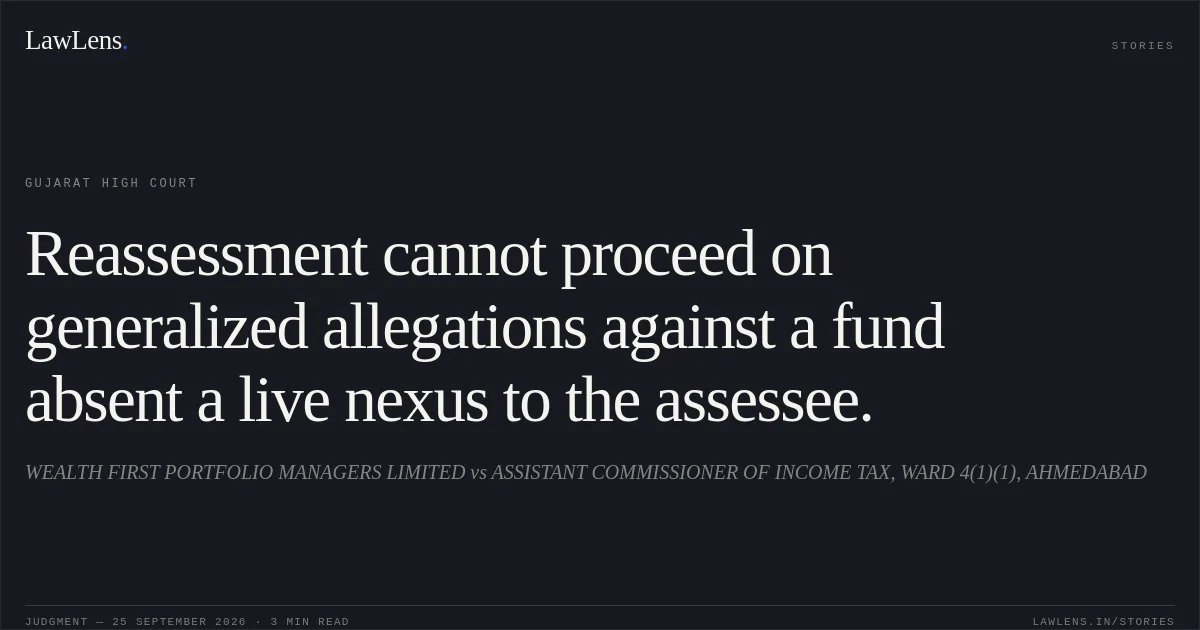
It held that the notice under Section 148 and the order under Section 148A(d) were unsustainable because the material relied upon did not establish a sufficient live link between the petitioner and the alleged manipulation by J.M. Financial Asset Management Ltd.
Source reference: p.11; para. 10Accordingly, the Court quashed and set aside the notice dated 30 March 2023 issued under Section 148 and the order of the same date passed under Section 148A(d) of the Income-tax Act, 1961.
Source reference: p.11; para. 10The rule was made absolute, with no separate order as to costs.
Source reference: p.11; para. 10Acts & Sections Cited
8 provisions across 2 statutes referred to in this judgment. Linked provisions open on LawLens.
Income Tax Act, 19617
Indian Income-tax Act, 19221
Original Court PDF
WEALTH FIRST PORTFOLIO MANAGERS LIMITEDvsASSISTANT COMMISSIONER OF INCOME TAX, WARD 4(1)(1), AHMEDABAD
Click to open original judgment
Original judgment, available to read, download and summarize on LawLens.in