Facts
The petitioner, a private limited company engaged in trading and supplying gold and silver jewellery, filed its return for A.Y. 2021–22 declaring income of ₹29,62,190.
Source reference: paras. 3, 7–7.1; pp. 2, 5The return was selected for complete scrutiny concerning purchases from “high-risk billers”. During the scrutiny proceedings, the petitioner furnished audited financial statements, GST data and reconciliations, purchase and sales ledgers, supplier confirmations, bank statements, details of loans and trade payables, stock summaries and other documents.
Source reference: paras. 3, 7–7.1; pp. 2, 5By assessment order dated 27 December 2022 under Sections 143(3) and 144B of the Income Tax Act, 1961, the Assessing Officer rejected the books of account, estimated profit at 10% of total sales, and determined total income at ₹28,43,18,984, raising a demand of ₹12,61,31,080.
Source reference: paras. 3.1–3.3, 7.1; pp. 2–3, 5The petitioner’s appeal against that assessment remained pending. Subsequently, based on information uploaded on the Insight Portal and alleged GST intelligence regarding bogus purchases and fake input tax credit involving entities including S.B. Jewels and Prestine Jewels, proceedings were initiated under Section 148A.
Source reference: paras. 3.4; p. 4By order dated 4 June 2025 under Section 148A(3), the Assessing Officer concluded that income of ₹30,79,44,723 had escaped assessment and issued a notice under Section 148.
Source reference: para. 3.4; p. 4The petitioner challenged both the Section 148A(3) order and the Section 148 notice on the ground that the same transactions had already been examined in the original scrutiny assessment and that the reopening constituted a mere change of opinion.
Source reference: para. 4; p. 4Issues
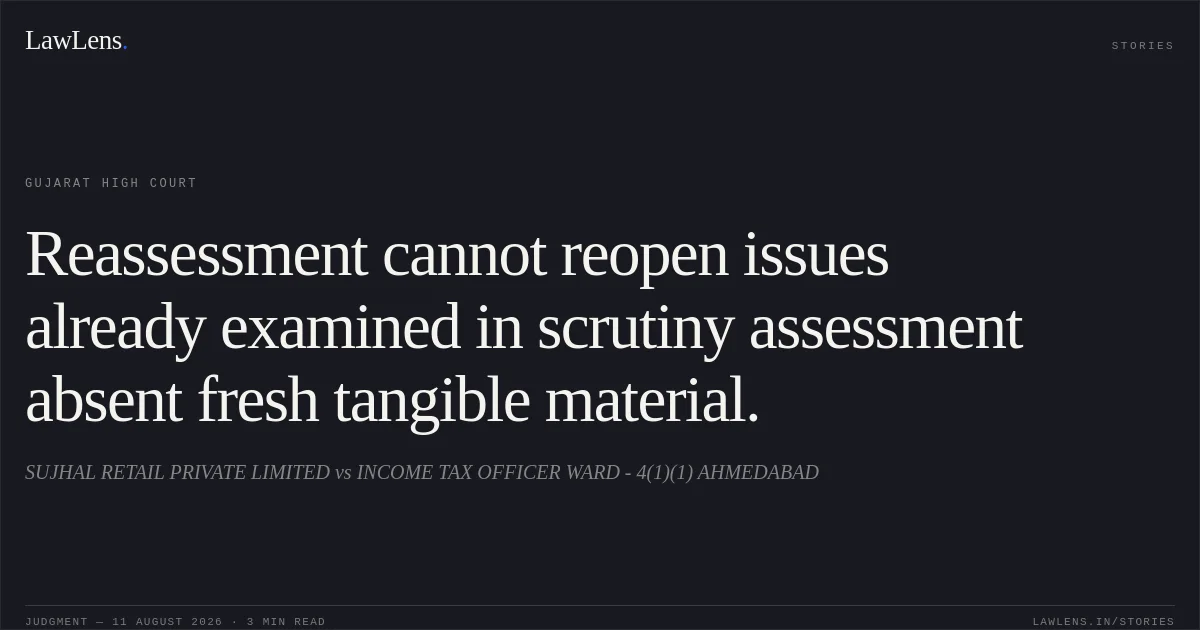
Whether the reassessment proceedings initiated under Sections 148A(3) and 148 of the Income Tax Act were valid when the alleged escapement of income was based on transactions and material already examined during the earlier scrutiny assessment.
Source reference: paras. 4, 8–9; pp. 4, 6–7Whether the impugned reopening of assessment amounted to an impermissible change of opinion.
Source reference: paras. 4, 9; pp. 4, 7Law Applied
The Court applied Sections 143(3) and 144B of the Income Tax Act, which govern scrutiny assessment and faceless assessment procedures; Sections 148A(3) and 148, which empower the Assessing Officer to decide whether reassessment proceedings should be initiated and to issue a reassessment notice where income is believed to have escaped assessment; and the settled principle that reassessment cannot be undertaken merely on a change of opinion on issues that were examined and considered in the original assessment proceedings.
Source reference: paras. 2, 3.2, 9; pp. 1–3, 7Where the original assessment has considered the relevant transactions and material, a subsequent attempt to reopen the assessment on the same factual basis is impermissible as a change of opinion.
Source reference: para. 9; p. 7Reasoning
The Court found that the original scrutiny was specifically undertaken to examine purchases from high-risk billers and that the petitioner had supplied extensive documentary material, including GST reconciliations, purchase records, supplier confirmations, bank-payment proofs and details relating to the concerned entities.
Source reference: paras. 3, 7–8.1; pp. 2, 5–6The Assessing Officer had thereafter rejected the books of account and made a substantial addition by estimating profit at 10% of the total sales.
Source reference: no citationAccording to the Court, the alleged bogus purchases and related transactions formed part of the very material and sales turnover considered in the original assessment.
Source reference: no citationThe respondents did not dispute that the alleged escaped income was already subsumed in the assessment order dated 27 December 2022.
Source reference: para. 9; p. 7Consequently, the subsequent reliance on Insight Portal and GST-related information did not constitute a legally distinct basis for reopening; it amounted to reconsideration of the same subject matter and therefore represented a change of opinion.
Source reference: paras. 8–9; pp. 6–7Holding
The Court answered the issues in favour of the petitioner, holding that the reopening of assessment was impermissible because the alleged escapement of income had already been examined and incorporated into the original scrutiny assessment, making the reassessment proceedings a change of opinion.
The order dated 4 June 2025 passed under Section 148A(3) and the notice of the same date issued under Section 148 were quashed and set aside.
Source reference: para. 10; p. 7The writ petition was allowed and the Rule was made absolute.
Source reference: para. 10; p. 7Acts & Sections Cited
9 provisions across 1 statute referred to in this judgment. Linked provisions open on LawLens.
Income Tax Act, 1961
Original Court PDF
SUJHAL RETAIL PRIVATE LIMITEDvsINCOME TAX OFFICER WARD - 4(1)(1) AHMEDABAD
Click to open original judgment
Original judgment, available to read, download and summarize on LawLens.in