Facts
The petitioner was a partner of M/s. My Home Developers, a partnership firm engaged in developing housing projects.
Source reference: pp. 2–3, paras. 5, 20–21The partnership deeds initially contained enabling provisions regarding payment of interest on partners’ capital and remuneration; however, with effect from 1 April 2009, the partners agreed that no interest would be payable, and no remuneration was in fact paid to the partners thereafter.
Source reference: pp. 2–3, paras. 5, 20–21The firm filed its returns for A.Ys. 2012–13 and 2013–14 claiming deduction under Section 80IB(10) of the Income-tax Act, 1961, and assessments were completed under Section 143(3) at nil income after allowing the deduction.
Source reference: p. 3, para. 8Subsequently, the Assessing Officer issued notices under Section 148 to the petitioner for reopening the assessments on the ground that interest and remuneration allegedly payable by the firm had not been offered as income by the petitioner.
Source reference: pp. 4–5, paras. 11–13, 17–19The petitioner challenged the notices, relying on the Coordinate Bench’s decision in Myhome Developers v. Assistant Commissioner of Income Tax, which had quashed similar reopening proceedings against the partnership firm.
Source reference: pp. 4, 6, paras. 14, 22Issues
Whether the notices issued under Section 148 of the Income-tax Act, 1961, for reopening the petitioner’s assessments for A.Ys. 2012–13 and 2013–14 were without jurisdiction because they were based merely on enabling clauses in the partnership deeds concerning interest and remuneration.
Source reference: pp. 5–6, paras. 17–20Whether the existence of such clauses established that the petitioner had actually received, or was mandatorily entitled to receive, taxable interest or remuneration from the partnership firm, resulting in income escaping assessment.
Source reference: pp. 8–9, paras. 17–19Whether the reopening was sustainable when the relevant assessments had already been completed under Section 143(3), particularly in the absence of any failure by the petitioner to disclose fully and truly all material facts.
Source reference: pp. 6–9, para. 22Law Applied
Section 147 of the Income-tax Act permits reassessment only where the Assessing Officer has reason to believe that income chargeable to tax has escaped assessment; where the original assessment is under Section 143(3), reopening after four years additionally requires failure by the assessee to disclose fully and truly all material facts necessary for assessment.
Source reference: pp. 6–7, para. 22Section 148 governs issuance of notice for such reassessment, while Section 80IB(10) concerns deduction available in respect of eligible housing projects.
Source reference: pp. 3–4, paras. 8, 11The Court relied on Alidhara Taxspin (P.) Ltd., holding that clauses in a partnership deed providing for interest on capital or remuneration do not, by themselves, make such payments mandatory where the partnership arrangement shows that the partners did not intend to pay or receive them.
Source reference: pp. 8–9, para. 22It also followed the Coordinate Bench’s decision in Myhome Developers v. Assistant Commissioner of Income Tax, which held that reopening based solely on such enabling clauses, without evidence of actual payment or receipt, was contrary to law and without jurisdiction.
Source reference: pp. 6–9, para. 22Reasoning
The Court examined the partnership deeds and found that the provisions concerning interest and remuneration were enabling provisions subject to mutual agreement, not mandatory obligations.
Source reference: pp. 7–9, para. 22The deed dated 1 April 2009 expressly recorded that no interest would be payable on the partners’ capital or current accounts, and there was no material showing that the petitioner had actually received either interest or remuneration during the relevant years.
Source reference: pp. 7–9, paras. 21–22The firm had also not claimed deduction for such payments, and its claim under Section 80IB(10) had been accepted in scrutiny proceedings.
Source reference: pp. 3, 8–9, paras. 8, 22Therefore, the Revenue’s inference that the petitioner was entitled to taxable income merely because earlier partnership deeds contained such clauses was unsupported.
Source reference: pp. 8–9, paras. 22–23Applying Alidhara Taxspin and Myhome Developers, the Court held that the statutory preconditions for reopening were not satisfied and that the notices could not be sustained.
Source reference: pp. 8–9, paras. 22–23Holding
The Court answered the issues in favour of the petitioner.
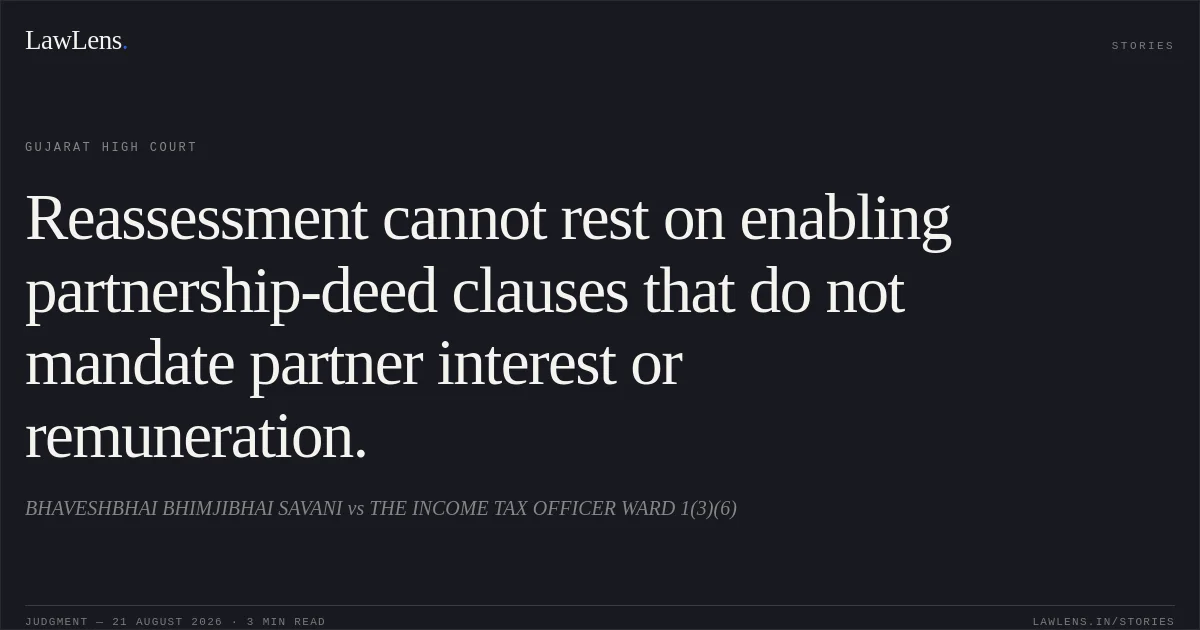
It held that the mere incorporation of provisions for interest on capital and partner remuneration did not establish that such amounts were payable or received, and the reopening proceedings were therefore unjustified.
Source reference: p. 9, paras. 19–20The writ petitions were allowed; the impugned notices under Section 148 and all consequential proceedings were quashed and set aside. Rule was made absolute.
Source reference: p. 10, para. 24Acts & Sections Cited
9 provisions across 1 statute referred to in this judgment. Linked provisions open on LawLens.
Income Tax Act, 1961
Original Court PDF
BHAVESHBHAI BHIMJIBHAI SAVANIvsTHE INCOME TAX OFFICER WARD 1(3)(6)
Click to open original judgment
Original judgment, available to read, download and summarize on LawLens.in