Facts
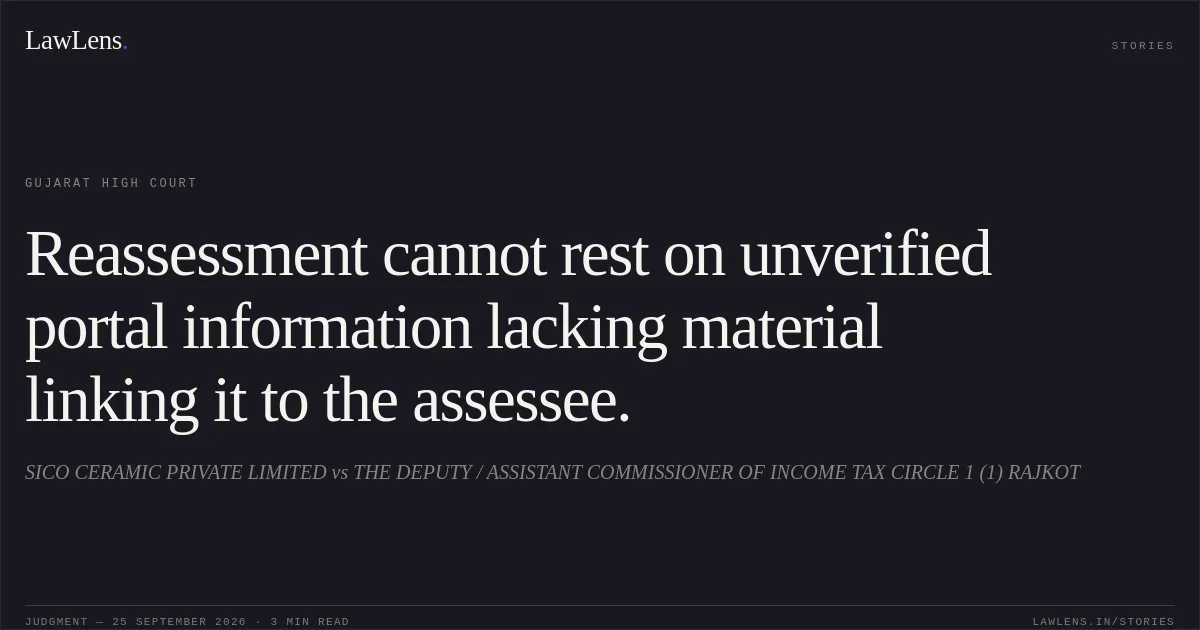
The petitioner, a ceramic-business company, challenged the notice issued under Section 148 of the Income-tax Act, 1961, and the order passed under Section 148A(3) for Assessment Year 2019–20, alleging escapement of income of ₹2,14,42,208 on the basis of information available on the Insight portal and an alleged transaction involving Angadiya Shri Nilesh Pranjivan Bhatia.
Source reference: pp.2, paras. 2–4The petitioner contended that the notice and order contained no material linking it to the alleged transaction and that several similarly situated ceramic dealers had received notices mentioning the identical alleged escaped-income amount.
Source reference: pp.2–4, paras. 3–4Although the petitioner sought the underlying material and transaction details, the Assessing Officer did not supply them and passed the order under Section 148A(3).
Source reference: p.4, para. 6The Revenue maintained that the Insight portal information and the Angadiya’s recorded statement established that the petitioner had entered into transactions aggregating to ₹2,14,42,208, and urged the Court to decline interference at the reopening stage.
Source reference: p.3, para. 5Issues
Whether the notice issued under Section 148A(1) and the consequential notice under Section 148 of the Income-tax Act were legally sustainable when they did not disclose material linking the petitioner to the alleged transaction or specify the petitioner-wise amount of escaped income.
Source reference: p.4, para. 6Whether the Assessing Officer could rely solely on unverified information from the Insight portal and the alleged statement of the Angadiya without supplying supporting material and demonstrating independent application of mind.
Source reference: pp.4–5, paras. 6–8Whether the High Court should exercise writ jurisdiction at the reassessment stage or relegate the petitioner to the assessment proceedings.
Source reference: p.3, para. 5Law Applied
The Court applied Sections 148 and 148A of the Income-tax Act, 1961, which require the Assessing Officer to possess relevant information suggesting escapement of income, provide the assessee an opportunity to respond, and pass a reasoned order based on due consideration of the available material.
Source reference: pp.2, 4–5, paras. 2, 6, 8The Court reiterated that reassessment proceedings cannot be initiated on the basis of a roving or fishing inquiry and that the Assessing Officer must independently examine and verify the information before forming the requisite opinion.
Source reference: p.5, paras. 7–8It relied on Vasuki Global Industrial Limited v. Principal Chief Commissioner of Income Tax, [2025] 180 taxmann.com 16 (Gujarat), for the principle that information available on the Insight portal cannot be blindly relied upon without verification and application of mind.
Source reference: p.3, para. 4Reasoning
The Court found that the notice and the order under Section 148A(3) merely referred generally to an alleged transaction with the Angadiya and an identical amount of ₹2,14,42,208, but contained no material connecting that transaction to the petitioner.
Source reference: p.4, para. 6The order referred to a chart of beneficiaries, yet did not identify the petitioner’s specific transaction or amount.
Source reference: p.4, para. 6The Assessing Officer also failed to supply the requested material or verify the genuineness and petitioner-wise relevance of the Insight portal information.
Source reference: p.4, para. 6The fact that similarly situated ceramic dealers were issued substantially identical notices, while another jurisdictional Assessing Officer had not proceeded against comparable assessees in the absence of exact co-relatable amounts, further demonstrated the absence of individualized application of mind.
Source reference: p.4, para. 6Applying the principles governing Sections 148 and 148A and the rule against roving inquiries, the Court held that the Revenue’s objection concerning the availability of an alternative assessment remedy could not sustain proceedings founded on legally deficient and unsubstantiated reasons.
Source reference: pp.3–5, paras. 5–8Holding
The Court answered the issues in favour of the petitioner.
It held that the impugned proceedings were unsupported by material linking the petitioner to the alleged transaction, lacked adequate disclosure and verification, and did not reflect the Assessing Officer’s proper application of mind.
Source reference: pp.4–5, paras. 6–8The writ petition was allowed, and the notice dated 29 June 2025 issued under Section 148 and the order dated 29 June 2025 passed under Section 148A(3) of the Income-tax Act were quashed and set aside.
Source reference: p.5, para. 8Acts & Sections Cited
2 provisions across 1 statute referred to in this judgment. Linked provisions open on LawLens.
Income Tax Act, 19612
Original Court PDF
SICO CERAMIC PRIVATE LIMITEDvsTHE DEPUTY / ASSISTANT COMMISSIONER OF INCOME TAX CIRCLE 1 (1) RAJKOT
Click to open original judgment
Original judgment, available to read, download and summarize on LawLens.in