Facts
The petitioner filed his return for A.Y. 2022–23 declaring total income of ₹30,06,140.
Source reference: pp. 1–4, paras. 2–4After a search of the Avirat Group and Brahma Finance Group—not the petitioner—a notice under Section 148 was issued on 30 March 2026, relying on a digital “confirmation of accounts” found on a third party’s mobile phone.
Source reference: pp. 1–4, paras. 2–4It recorded an opening balance of ₹49,31,250 as at 1 April 2021.
Source reference: pp. 1–4, paras. 2–4The petitioner objected that the amount was an opening balance from an earlier period and that the unsigned, unverified document had no demonstrated connection to his income.
Source reference: pp. 1–4, paras. 2–4The Revenue rejected the objections, and the petitioner challenged the notice.
Source reference: pp. 1–4, paras. 2–4The Court noted that the document was unsigned and lacked a stamp, PAN, or acknowledgment on the petitioner’s behalf.
Source reference: p. 5, para. 8Issues
1. Whether the Revenue could rely on an opening balance of ₹49,31,250 as a credit pertaining to A.Y. 2022–23 when the material identified it as outstanding as at 1 April 2021.
Source reference: pp. 3–5, paras. 5–72. Whether the notice under Section 148 could stand when it was based on an unverified document that did not reliably establish a connection to the petitioner.
Source reference: p. 5, para. 8Law Applied
The Court considered Sections 147 and 148 of the Income-tax Act, 1961, governing reassessment and the issue of reassessment notices, and noted the related procedural framework under Sections 148A and 151.
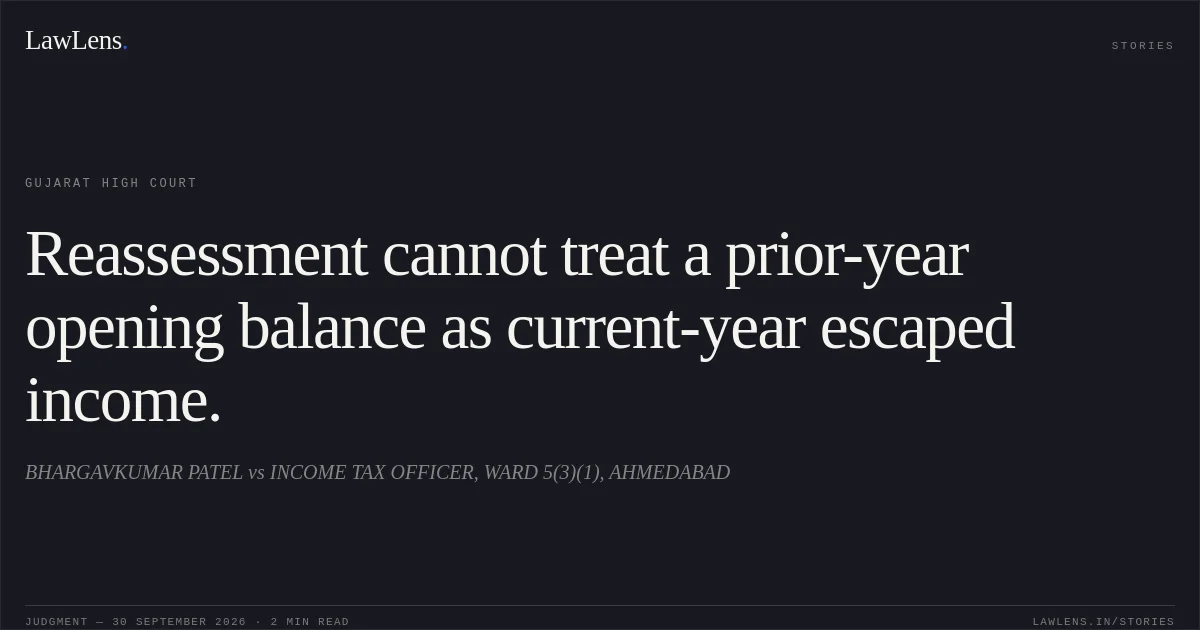
Source reference: pp. 1–2, para. 2The judgment’s operative principle was that reassessment must rest on material properly connected to the relevant assessment year and the assessee; an opening balance from an earlier date, supported only by an unverified document, could not sustain the impugned reopening on the facts before the Court.
Source reference: pp. 4–5, paras. 7–9Reasoning
The document relied on by the Revenue recorded ₹49,31,250 as an opening balance on 1 April 2021, while the reassessment concerned A.Y. 2022–23.
Source reference: p. 4, para. 7The Court found no material relating to the relevant financial year that supported treating that opening balance as a credit for the year in question.
Source reference: p. 4, para. 7Further, the document was a single digital PDF recovered from a third party’s phone, was unsigned, and contained no stamp, PAN, or acknowledgment identifying the petitioner; the Revenue had not independently verified its contents.
Source reference: p. 5, para. 8The Court therefore held that the notice rested on an erroneous assessment of the material.
Source reference: p. 5, para. 9Holding
The Court answered the issues in the petitioner’s favour and quashed and set aside the notice dated 30 March 2026 under Section 148, holding that it was premised on erroneous consideration of the documents.
The petition was allowed accordingly.
Source reference: p. 5, para. 9Acts & Sections Cited
7 provisions across 1 statute referred to in this judgment. Linked provisions open on LawLens.
Income Tax Act, 19617
Original Court PDF
BHARGAVKUMAR PATELvsINCOME TAX OFFICER, WARD 5(3)(1), AHMEDABAD
Click to open original judgment
Original judgment, available to read, download and summarize on LawLens.in