Facts
The petitioner, a trader in gold, silver, and diamonds, filed a Return of Income for AY 2021-22
Source reference: para 3.1On 26.03.2025, Respondent No. 1 issued a notice under Section 148A(1) of the Income Tax Act, 1961 ("the Act"), alleging that income exceeding Rs. 1.48 crore had escaped assessment due to ineligible Input Tax Credit (ITC) and suspicious transactions flagged by GST data
Source reference: para 3.2The allegation was primarily based on a GST registration cancellation order dated 12.07.2023
Source reference: para 3.3, 3.4However, on 29.03.2025, the GST Appellate Authority reversed the cancellation, restoring the petitioner’s registration and holding that no fraud under Section 73 or 74 of the CGST Act was established
Source reference: para 3.5Despite the petitioner submitting this appellate order and supporting evidence in response to the Section 148A notice, Respondent No. 1 passed an order under Section 148A(3) and issued a reassessment notice under Section 148 on 29.06.2025
Source reference: para 3.6, 3.8Issues
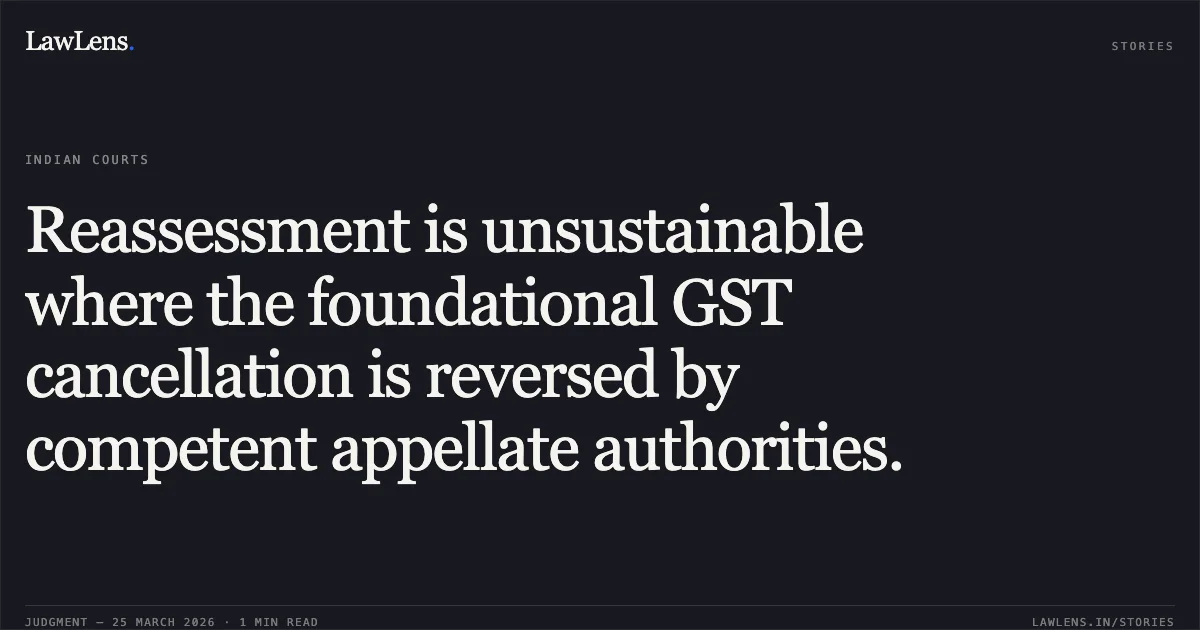
1. Whether the Revenue can sustain reassessment proceedings under Sections 148A and 148 of the Act when the foundational material (GST cancellation) has been conclusively set aside by a competent Appellate Authority.
Source reference: para 4.1, 6.12. Whether the impugned order under Section 148A(3) was valid given the failure of the Assessing Officer to consider the findings of the GST Appellate Authority.
Source reference: para 6.1, 6.2Law Applied
The procedural requirements of Section 148A of the Income Tax Act, 1961, which necessitates an inquiry and consideration of the assessee’s reply before issuing a notice for escaped assessment under Section 148.
Source reference: para 3.8, 4.1Sections 73, 74, and 107 of the Central Goods and Services Tax (CGST) Act, 2017, regarding the adjudication of fraudulent ITC and appellate remedies.
Source reference: para 3.5, 6.1The core legal principle applied is that reassessment cannot be initiated on unverified suspicion or on a foundation that has been legally extinguished by a superior authority.
Source reference: para 3.5, 6.1Reasoning
The Court observed that the entire basis for the Income Tax Department's reassessment proceedings was the GST department’s allegation of non-genuine purchases and bogus ITC.
Source reference: para 6The GST Appellate Authority’s order dated 29.03.2025 explicitly found that the petitioner had not claimed fraudulent ITC and that business activities were supported by genuine records.
Source reference: para 6.1The Court found that Respondent No. 1 possessed no independent material other than the discredited GST data to suggest escapement of income.
Source reference: para 6.1The Court criticized the respondent for passing a non-speaking order that failed to acknowledge the vital fact that the petitioner’s GST registration had been restored and the allegations of fraud disproved.
Source reference: para 4.2, 6.2Consequently, the Court determined that the very foundation of the reassessment was non-existent.
Source reference: para 6.2Holding
It held that the reopening of the assessment was "uncalled for" in light of the categorical findings by the GST Appellate Authority.
The High Court allowed the writ petition, made the Rule absolute, and quashed and set aside the impugned order dated 29.06.2025 passed under Section 148A(3) and the consequential notice dated 29.06.2025 issued under Section 148 of the Act for AY 2021-22.
Source reference: para 7Acts & Sections Cited
4 provisions across 1 statute referred to in this judgment. Each provision opens on LawLens.
Central Goods and Services Tax Act, 20174
Original Court PDF
PIYUSH MAFATLAL SHAHvsINCOME TAX OFFICER, WARD 3(2)(1), SURAT
Click to open original judgment
Original judgment, available to read, download and summarize on LawLens.in