Facts
The Respondent, a senior citizen, initiated proceedings under the Maintenance and Welfare of Parents and Senior Citizens Act, 2007, concerning her alleged occupation of an uninhabitable basement in property bearing No. A-99/2, Shaheen Bagh, New Delhi (“Subject Property”).
Source reference: para. 8The District Magistrate directed her to shift to the upper ground floor, but the Appellate Authority set aside that direction until construction or repairs were completed.
Source reference: para. 9The Respondent then filed a writ petition seeking, inter alia, possession and eviction of the occupants.
Source reference: para. 10During its pendency, a Local Commissioner reported that the basement and upper ground floor were uninhabitable, the Appellant’s son occupied the first floor, and the Appellant had leased out the fourth-floor flat for ₹13,500 per month.
Source reference: paras. 10–11By order dated 19 February 2024, the learned Single Judge declined eviction but directed the Appellant and her son to pay ₹10,000 each per month as maintenance to the Respondent, having regard to her advanced age and circumstances.
Source reference: para. 11Appeals against that order were dismissed, including the Appellant’s challenge to the maintenance direction.
Source reference: para. 12The Appellant subsequently filed a recall application under Section 151 of the Code of Civil Procedure, 1908, alleging that the Respondent had suppressed property transfers and had sold four flats for ₹1.25 crore.
Source reference: para. 13The Respondent denied the allegations and stated that only 50 sq. yds. had been sold for ₹12.50 lakh to meet medical and legal expenses.
Source reference: para. 14The learned Single Judge dismissed the recall application, holding that the original order was based on equitable considerations.
Source reference: para. 15The present intra-court appeal challenged that dismissal.
Source reference: no citationIssues
1. Whether the Appellant could invoke the recall jurisdiction under Section 151 CPC to reopen the final order on allegations of fraud, suppression, and subsequent discovery of property transactions.
Source reference: paras. 16–192. Whether disputed allegations concerning property transfers and financial consideration, raised after final adjudication and after dismissal of appeals, warranted recall of the original maintenance order.
Source reference: paras. 18–203. Whether the learned Single Judge erred in declining to interfere with the equitable maintenance directions issued in favour of the approximately 90-year-old Respondent.
Source reference: paras. 19–21Law Applied
The Court applied Section 151 of the Code of Civil Procedure, 1908, which preserves the court’s inherent power to make orders necessary to secure the ends of justice, but does not permit recall applications to be used as a substitute for rehearing or appeal.
Source reference: paras. 18–19Recall is permissible only on legally recognised grounds, such as an error apparent on the face of the record or established fraud affecting the judgment; allegations of fraud must be pleaded with specific particulars.
Source reference: paras. 18–19A party seeking reopening on the basis of newly discovered facts must also demonstrate that, despite due diligence, those facts could not have been discovered earlier.
Source reference: paras. 18–19Disputed factual issues cannot ordinarily be adjudicated in a recall application after final adjudication.
Source reference: paras. 18–19The Court also recognised the equitable nature of the original directions, which had been issued in favour of a senior citizen having regard to her age and circumstances.
Source reference: paras. 6, 11, 20Reasoning
The Court held that the Appellant’s allegations regarding the Gift Deed, General Power of Attorney, Affidavit, sale of flats, and receipt of consideration involved disputed questions of fact raised after disposal of the writ petition.
Source reference: paras. 13, 18Such allegations could not be determined through a recall application, particularly when the Appellant had already availed appellate remedies against the original order and those challenges had failed.
Source reference: paras. 12, 19The Appellant neither pleaded specific particulars establishing fraud nor showed that the alleged facts could not have been discovered earlier despite due diligence.
Source reference: para. 19In the absence of an error apparent on the face of the record or a properly established ground for recall, the application amounted to an attempt to re-agitate issues that had attained finality.
Source reference: no citationThe Court therefore found no basis to disturb the equitable maintenance directions made for the benefit of the Respondent, a senior citizen aged about 90 years.
Source reference: paras. 19–20Holding
The Delhi High Court dismissed the appeal and upheld the learned Single Judge’s refusal to recall the order dated 19 February 2024.
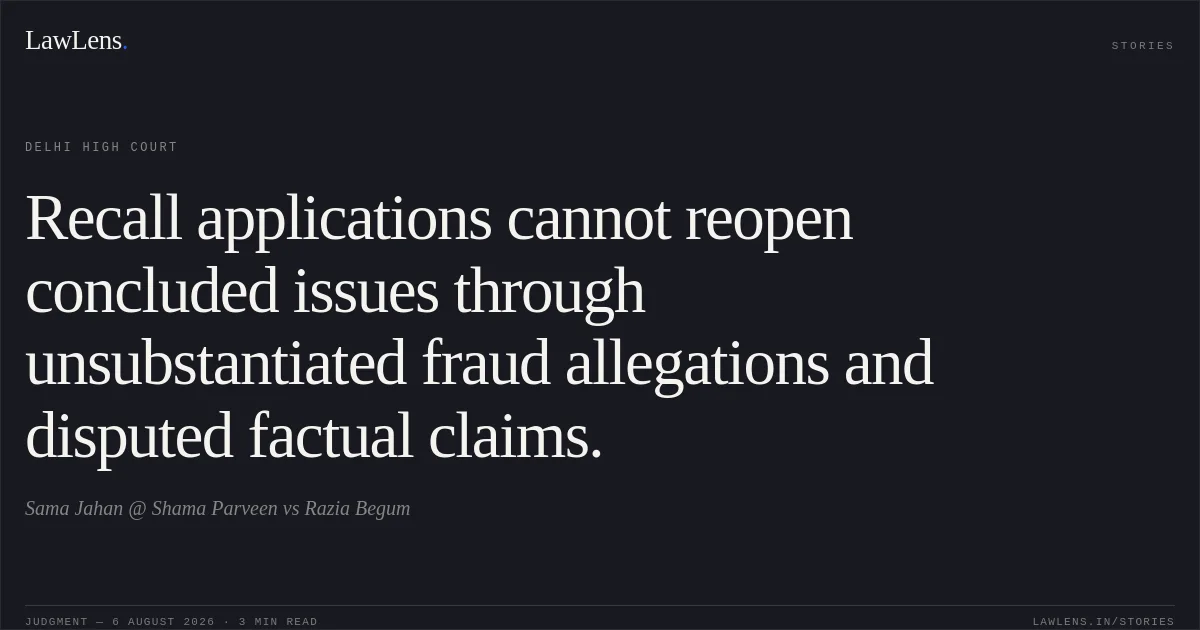
It held that the recall application was not maintainable as a device to reopen concluded issues or introduce disputed factual allegations concerning fraud and property transactions.
Source reference: para. 21The equitable directions in favour of the Respondent were left undisturbed.
Source reference: no citationPending applications were also disposed of, with no order as to costs.
Source reference: para. 21Original Court PDF
Sama Jahan @ Shama ParveenvsRazia Begum
Click to open original judgment
Original judgment, available to read, download and summarize on LawLens.in