Facts
The Respondent was accused of rape and criminal intimidation under Sections 342, 376(1), and 506 of the IPC following a complaint by the prosecutrix (PW-1).
Source reference: p.2During the trial, PW-1 was examined and cross-examined in 2018. Upon a prior Section 311 CrPC application by the prosecution, she was recalled and further cross-examined in 2019.
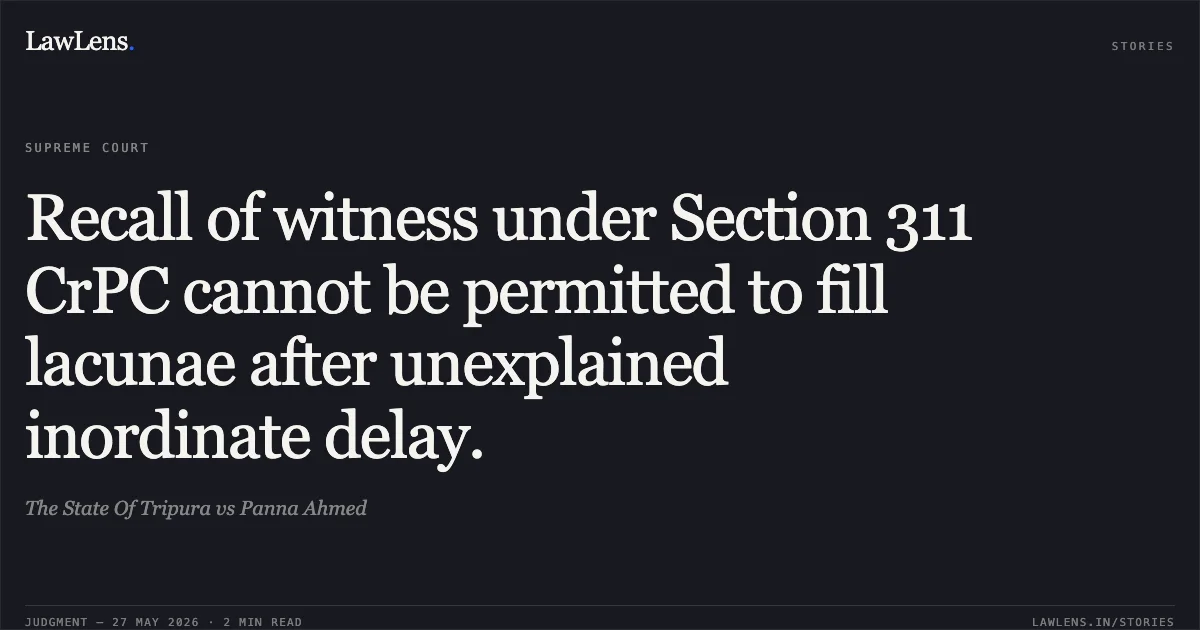
Source reference: p.3Four years later, in 2023, the Respondent filed an application under Section 311 CrPC to recall PW-1 for further cross-examination on 94 questions regarding Call Detail Records (CDRs).
Source reference: p.3-4The Trial Court rejected the plea due to the four-year delay and the fact that the trial had been pending for seven years.
Source reference: p.4The High Court of Tripura set aside that order, allowing the recall in the interest of justice.
Source reference: p.5Issues
1. Whether the High Court was justified in exercising its discretion under Section 311 of the CrPC to recall a witness after a prolonged delay of four years.
Source reference: p.6, 92. Whether the "oversight" of the defence in failing to cross-examine a witness on material (CDRs) already available on record constitutes a valid ground for recall.
Source reference: p.11Law Applied
The Court applied Section 311 of the CrPC, which grants courts wide discretionary power to summon or recall witnesses if their evidence is essential to a "just decision".
Source reference: p.6The Court relied on Natasha Singh v. CBI, emphasizing that power must be used judiciously, not to fill lacunae or cause prejudice.
Source reference: p.7Swapan Kumar Chatterjee v. CBI, which held that the power must be exercised with "great caution" and "strong and valid reasons".
Source reference: p.7-8State (NCT of Delhi) v. Shiv Kumar Yadav, which established that recall is not a matter of course and must balance fair trial requirements against the hardship caused to witnesses by repeated appearances.
Source reference: p.9Reasoning
The Court reasoned that Section 311 is not an absolute right and must be exercised sparingly.
Source reference: p.10In this case, PW-1 had already been subjected to extensive cross-examination across four separate dates. The Respondent's four-year delay in filing the application remained unexplained, and the trial had already progressed significantly with 19 other witnesses examined.
Source reference: p.10-11Crucially, the CDRs used as the basis for the recall were part of the original chargesheet and were within the defence's knowledge throughout the trial; thus, the failure to ask questions previously was a result of negligence rather than new evidence.
Source reference: p.11The Court emphasized that victims of heinous crimes should not be subjected to the ordeal of appearing in court repeatedly for multiple cross-examinations without tangible reasons.
Source reference: p.11Holding
The Supreme Court allowed the appeal and set aside the High Court’s judgment, restoring the Trial Court’s order.
The Court held that the recall application was an attempt to fill lacunae in the defence and would cause undue hardship to the victim. The High Court erred by not considering the inordinate delay and the fact that the defence had ample prior opportunity to examine the witness on the CDRs.
Source reference: p.10-11The Trial Court was directed to conclude the proceedings by the end of 2026.
Source reference: p.12Acts & Sections Cited
6 provisions across 2 statutes referred to in this judgment. Each provision opens on LawLens.
Code of Criminal Procedure, 19733
Indian Penal Code, 18603
Original Court PDF
The State Of TripuravsPanna Ahmed
Click to open original judgment
Original judgment, available to read, download and summarize on LawLens.in