Facts
The petitioners were members of an Internal Complaints Committee (ICC) constituted on July 28, 2025, to investigate a sexual harassment complaint against a delinquent officer.
Source reference: para 4Despite instructions to submit a report within one day, the ICC conducted proceedings, recorded testimonies (including a Joint Commissioner's statement), and submitted a report on July 31, 2025, exonerating the delinquent.
Source reference: para 4, 9Following the report, the complainant submitted an audio recording alleging the ICC was hostile and partisan.
Source reference: para 10Subsequently, the delinquent was suspended on August 3, 2025, and the petitioners (ICC members) were also suspended via impugned orders dated August 5 and 6, 2025, pending departmental inquiries for allegedly making a concerted effort to shield the delinquent.
Source reference: para 3-4, 43Issues
1. Whether recommendations of the Internal Complaint Committee made in terms of Section 13(3) of the Sexual Harassment of Women at Workplace Act, 2013, are mandatory or directory?
Source reference: para 15(A)2. Whether the impugned orders of suspension from service are in consonance with Rule 4 of the U.P. Government Servants (Discipline and Appeal) Rules, 1999?
Source reference: para 15(B)Law Applied
The Court applied Sections 11, 13, 18, and 26 of the Sexual Harassment of Women at Workplace (Prevention, Prohibition and Redressal) Act, 2013 (Act of 2013) along with Rules 7 and 9 of the 2013 Rules, noting that the ICC’s findings on misconduct are conclusive for the employer.
Source reference: para 25It relied on May George v. Special Tehsildar for the test of mandatory vs. directory provisions [para 29] and Vivek Narayan Sharma v. Union of India for purposive statutory interpretation.
Source reference: para 30Regarding disciplinary action against quasi-judicial authorities, the Court followed Union of India v. K.K. Dhawan [para 49], Zunjarrao Bhikaji Nagarkar v. Union of India [para 50], and Nirbhay Singh Suliya v. State of M.P. [para 53], which establish that such officers cannot be punished for erroneous decisions unless there is prima facie evidence of "culpable negligence," "extraneous considerations," or "corrupt motive."
Source reference: para 49, 50, 53Rule 4 of the U.P. Government Servants Rules, 1999, was applied, requiring suspension only for charges warranting a major penalty.
Source reference: para 44-45Reasoning
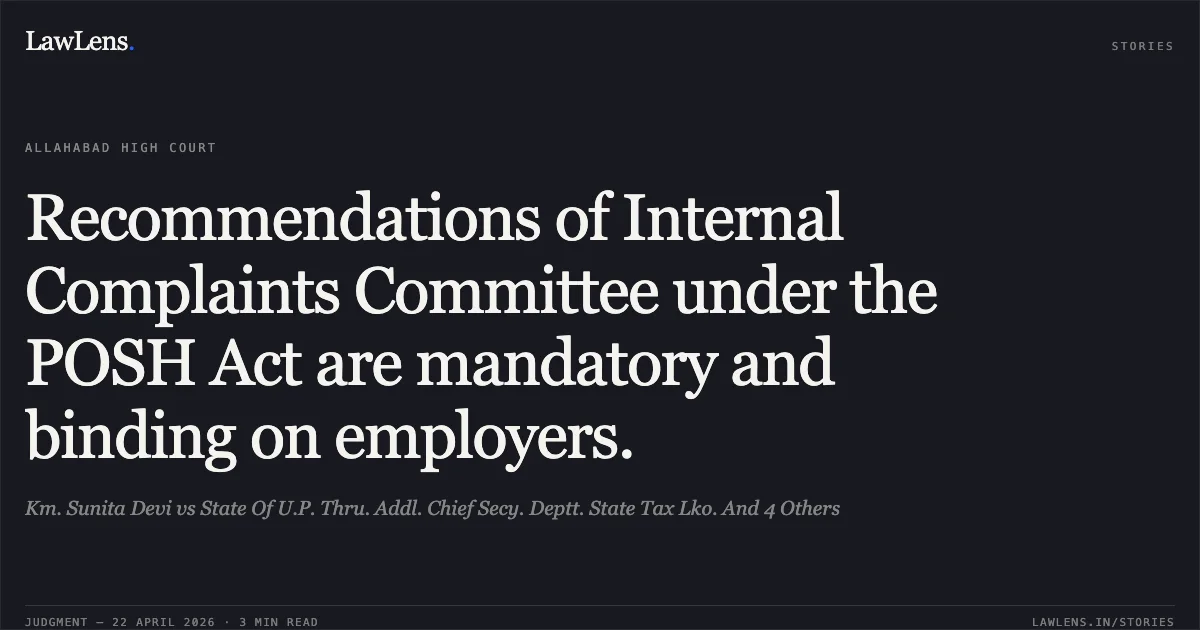
Regarding Issue A, the Court held that since the Act of 2013 provides for an appeal specifically against ICC recommendations (Section 18) and penalizes employers for non-implementation (Section 26), the recommendations are mandatory and not merely directory.
Source reference: para 32-35Regarding Issue B, the Court observed that an ICC acts in a quasi-judicial capacity. Citing K.K. Dhawan, the Court reasoned that the disciplinary authority must distinguish between the "correctness" of a decision and the "conduct" of the officer.
Source reference: para 54, 55, 57The Court found that the State exerted undue pressure by demanding a report within 24 hours while the law grants 90 days.
Source reference: para 7, 66The Court analyzed the impugned suspension orders and found them "cursory," lacking any recorded "subjective satisfaction" or prima facie finding that the petitioners acted with extraneous motives rather than just making an error in judgment.
Source reference: para 63-65, 67Holding
The Court answered Issue A in favor of the State, holding ICC recommendations to be mandatory.
However, it answered Issue B in favor of the petitioners, ruling that the suspension was improper.
Source reference: para 68The Court quashed the suspension orders dated August 5 and 6, 2025, via a writ of Certiorari, granting the State liberty to pass fresh orders only if they record a specific prima facie satisfaction regarding the petitioners' conduct/motives as distinct from the legality of their report. The writ petitions were allowed.
Source reference: para 67, 69Acts & Sections Cited
10 provisions across 2 statutes referred to in this judgment. Each provision opens on LawLens.
Sexual Harassment of Women at Workplace (Prevention, Prohibition and Redressal) Act, 2013
Indian Penal Code, 18601
Original Court PDF
Km. Sunita DevivsState Of U.P. Thru. Addl. Chief Secy. Deptt. State Tax Lko. And 4 Others
Click to open original judgment
Original judgment, available to read, download and summarize on LawLens.in