Facts
The petitioner was an accused in Marafari P.S. Case No. 66 of 2019 involving serious offences under Sections 307, 326, 120B, and 34 of the Indian Penal Code and Section 27 of the Arms Act
Source reference: para. 4On 21.09.2020, the learned S.D.J.M., Bokaro, issued a non-bailable warrant (NBW) against the petitioner upon an application by the Investigating Officer, noting that supplementary investigation was ongoing against the petitioner while a charge-sheet had been filed against co-accused
Source reference: para. 3The petitioner challenged this order via Criminal Revision No. 172 of 2025, which was dismissed by the Additional Sessions Judge-IV, Bokaro, on 17.12.2025
Source reference: para. 4The Revisional Court affirmed the NBW citing the "serious nature of offences"
Source reference: para. 4The petitioner subsequently moved the High Court under Section 528 of the Bharatiya Nagarik Suraksha Sanhita (BNSS), 2023, seeking to quash both orders
Source reference: para. 2Issues
1. Whether the Magistrate is empowered to issue a non-bailable warrant of arrest without recording a specific satisfaction that the accused is evading arrest
Source reference: para. 5, 82. Whether the seriousness of the alleged offence alone is a sufficient ground to sustain an order for the issuance of a non-bailable warrant
Source reference: para. 4, 10Law Applied
Section 73(1) of the Code of Criminal Procedure (CrPC), which stipulates that a Magistrate may direct a warrant to any person within their jurisdiction if they are an escaped convict, a proclaimed offender, or an accused of a non-bailable offence who is "evading arrest"
Source reference: para. 7The recording of satisfaction regarding the evasion of arrest is a mandatory condition precedent for the exercise of this power
Source reference: para. 8, 10Reasoning
The High Court observed that while the petitioner was indeed accused of non-bailable offences under Sections 307 and 326 of the IPC, the learned S.D.J.M. failed to record any satisfaction in the order dated 21.09.2020 that the petitioner was actively evading arrest
Source reference: para. 8The court reasoned that under Section 73 of the CrPC, the mere status of being an accused in a non-bailable case is insufficient; there must be a judicial finding of evasion
Source reference: para. 7-8The court found that the Revisional Court committed a gross illegality by affirming the NBW based solely on the gravity of the offences, while ignoring the Magistrate's failure to satisfy the statutory requirements of Section 73
Source reference: para. 10Consequently, the lack of recorded satisfaction rendered the orders legally unsustainable
Source reference: para. 8, 11Holding
The High Court allowed the petition and quashed the order dated 21.09.2020 passed by the S.D.J.M., Bokaro, and the revisional order dated 17.12.2025 passed by the Additional Sessions Judge-IV, Bokaro, qua the petitioner
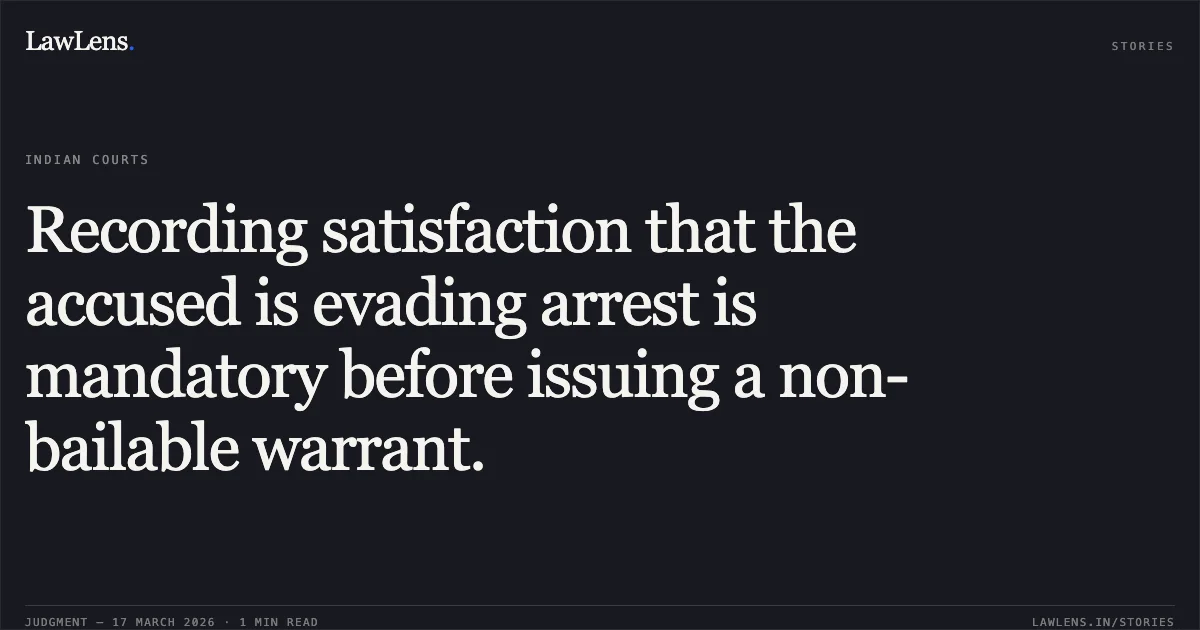
The court held that a non-bailable warrant cannot be issued without a specific finding that the accused is evading arrest
Source reference: para. 8, 10The S.D.J.M. was directed to pass a fresh order in accordance with the law
Source reference: para. 12Acts & Sections Cited
5 provisions across 3 statutes referred to in this judgment. Each provision opens on LawLens.
Bharatiya Nagarik Suraksha Sanhita, 20231
Indian Penal Code, 18603
Arms Act, 19591
Original Court PDF
JITU KUMAR ALIAS JITUvsTHE STATE OF JHARKHAND
Click to open original judgment
Original judgment, available to read, download and summarize on LawLens.in


