Facts
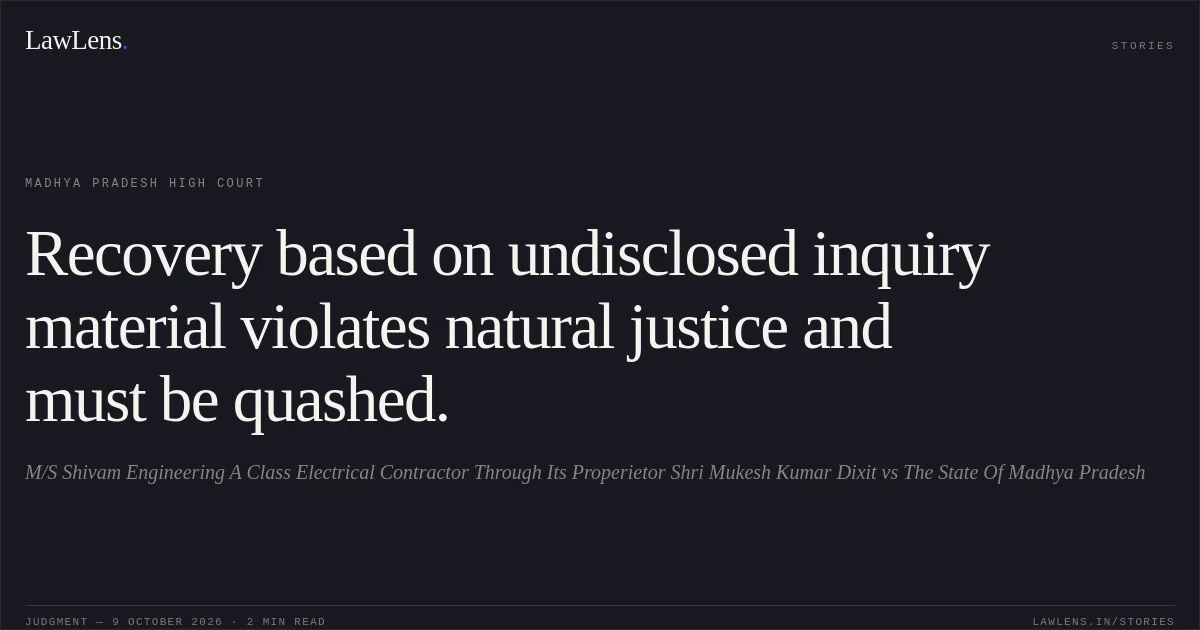
The petitioner, an electrical contractor engaged for works under the Sobhagya Yojna, challenged a recovery order dated 10 December 2021 for ₹48,62,501.
Source reference: para. 1–6, 11The petitioner asserted that the work had been completed, jointly inspected, and handed over, and that the defect-liability period had expired.
Source reference: para. 1–6, 11The respondents alleged irregularities including billing for connections not established, use of non-prescribed or substandard materials, and duplicate billing.
Source reference: para. 1–6, 11The petitioner contended that the inquiry was conducted behind its back and that neither the relied-upon material nor the inquiry report had been supplied.
Source reference: para. 1–6, 11The respondents offered to reconsider the matter after providing an opportunity to respond and be heard.
Source reference: para. 1–6, 11Issues
Whether the recovery order could stand when it was passed without supplying the petitioner with the inquiry material or providing an effective opportunity to respond
Source reference: para. 3–5, 9–11Whether the matter should be remitted to the respondents for reconsideration after disclosure of the relied-upon material and a hearing
Source reference: para. 5–6, 13–14Law Applied
The Court applied the principles of natural justice and fair play, requiring a person affected by an adverse quasi-judicial decision to have a reasonable opportunity to explain and respond to the case against them.
Source reference: para. 7, 9Relying on Kranti Associates (P) Ltd. v. Masood Ahmed Khan, (2010) 9 SCC 496, it reiterated that quasi-judicial authorities must give cogent reasons, which promote fairness, constrain arbitrary decision-making, and facilitate judicial review.
Source reference: para. 8The Court also referred to Techno Prints v. Chhattisgarh Textbook Corporation, 2025 SCC OnLine SC 343, concerning the need for a meaningful—not merely formal—opportunity before an adverse order is made.
Source reference: para. 10Reasoning
The respondents did not establish that the petitioner had been given the complaint, the material relied upon in the inquiry, or a copy of the inquiry report.
Source reference: para. 5, 9, 11–13The recovery order was therefore made without enabling the petitioner to address the allegations on which it rested.
Source reference: para. 5, 9, 11–13In those circumstances, the Court held that the order violated natural justice and fair play; the respondents’ proposal to reconsider the case supported remand rather than sustaining the order.
Source reference: para. 5, 9, 11–13Holding
The Court quashed the recovery order dated 10 December 2021 and remanded the matter to respondents 2 and 3 for reconsideration.
The respondents were directed to supply the complaint and relied-upon material within seven days; the petitioner was to submit a detailed representation within seven days of receiving those documents; and the respondents were then to provide a personal hearing, pass a fresh order, and communicate it within 30 days thereafter.
Source reference: para. 14Any existing interim order was to continue until the authorities made their decision, and the petition was disposed of.
Source reference: para. 15–16Original Court PDF
M/S Shivam Engineering A Class Electrical Contractor Through Its Properietor Shri Mukesh Kumar DixitvsThe State Of Madhya Pradesh
Click to open original judgment
Original judgment, available to read, download and summarize on LawLens.in