Facts
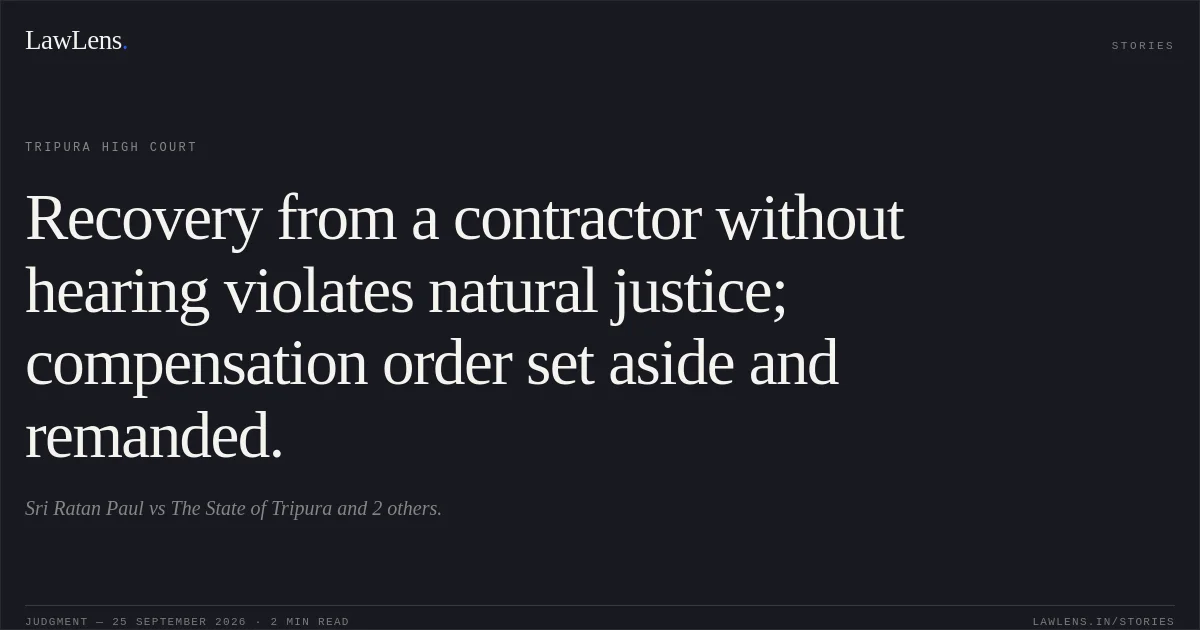
The petitioner challenged the deduction of ₹56,74,091 from his bill for work executed under the PM-JANAMAN Scheme. The deduction was made by the Tripura State Electricity Corporation Ltd. (“TSECL”) towards recovery of compensation paid to workers in proceedings relating to a separate contract under the RE-DDUGJY Scheme.
Source reference: p.2, para.2In proceedings numbered TS(EC) 01 of 2020 before the Commissioner, Employees’ Compensation, Dhalai Judicial District, Ambassa, an order dated 29 April 2023 directed payment of compensation to the claimants.
Source reference: p.3, para.3Although the petitioner’s bill was used for recovery, he was not impleaded in those proceedings and was not given an opportunity to present his case.
Source reference: p.3, paras.3–4The petitioner therefore invoked Article 226 of the Constitution seeking quashing of the deduction and repayment of the deducted amount with interest.
Source reference: p.2, para.2Issues
Whether the recovery of ₹56,74,091 from the petitioner’s PM-JANAMAN contract bill, pursuant to compensation proceedings concerning the separate RE-DDUGJY contract, was lawful when the petitioner was not impleaded or heard in those proceedings.
Source reference: p.2, para.2; p.3, paras.3–4Whether the order dated 29 April 2023 passed by the Commissioner, Employees’ Compensation, was liable to be set aside and the matter remanded for fresh adjudication after impleading and hearing the petitioner.
Source reference: p.3, para.4Law Applied
The Court exercised its jurisdiction under Article 226 of the Constitution of India.
Source reference: p.2, para.2It applied the principles of natural justice, particularly the requirement that a person directly affected by an adjudicatory order or recovery action must be impleaded and afforded a meaningful opportunity of hearing.
Source reference: p.3, para.4The Court further applied the procedural principle that a necessary party must be joined in proceedings where the decision may affect that party’s rights or financial interests; failure to do so vitiates the proceeding and requires reconsideration after proper notice and hearing.
Source reference: p.3, para.4No determination on the underlying entitlement to compensation or the legality of the deduction was made on merits.
Source reference: p.3, para.4Reasoning
The petitioner’s financial liability arose from the use of the compensation order to recover money from his bill, yet he had neither been made a party to the compensation proceedings nor given an opportunity to contest the claim.
Source reference: p.3, paras.3–4Since the order directly affected his financial interests, the absence of notice and hearing constituted a clear violation of natural justice.
Source reference: p.3, para.4The Court consequently declined to adjudicate the substantive merits of the compensation claim or the deduction in the writ petition.
Source reference: p.3, para.4Instead, it set aside the order and directed fresh adjudication after bringing the petitioner on record and permitting the parties to file pleadings and adduce documentary and oral evidence.
Source reference: p.3, para.4; p.4, para.5Holding
The Court held that the order dated 29 April 2023 could not stand because the petitioner, a person affected by the consequent recovery, had not been impleaded or heard.
The order was set aside, and the matter was remanded to the Commissioner, Employees’ Compensation, Dhalai Judicial District, Ambassa, for fresh adjudication in accordance with law after impleadment of the petitioner and completion of pleadings and evidence.
Source reference: p.3, para.4; p.4, para.5The writ petition was disposed of without deciding the merits of the petitioner’s claim for repayment, and any pending miscellaneous applications were closed.
Source reference: p.4, para.5Original Court PDF
Sri Ratan PaulvsThe State of Tripura and 2 others.
Click to open original judgment
Original judgment, available to read, download and summarize on LawLens.in