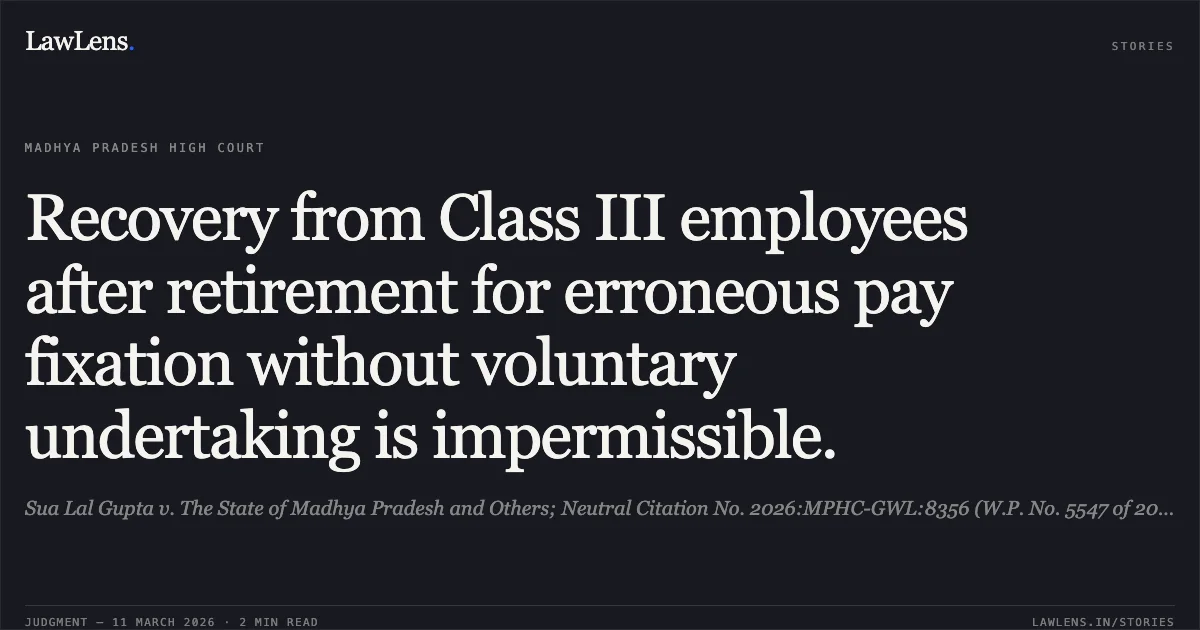
Facts
The petitioner was appointed as an Assistant Teacher in 1972 and retired on September 30, 2010, from the post of Upper Division Teacher (Class III).
Source reference: p. 2Following retirement, the Treasury Department objected to his pay fixation, asserting he was ineligible for the Second Kramonnati benefit granted in 1999 because he had already received two promotions.
Source reference: p. 2Consequently, the respondents ordered a recovery of ₹44,440/- based on alleged wrong fixation spanning from 1987 to 2005.
Source reference: p. 2The petitioner challenged this recovery on the grounds that it was initiated post-retirement without notice, and as a Class III employee, he was protected from recovery for administrative errors not attributed to him.
Source reference: p. 2Issues
1. Whether the recovery of excess payments made due to erroneous pay fixation is permissible from a Class III employee after their retirement.
Source reference: p. 32. Whether an undertaking given by an employee at the time of pay fixation or retirement justifies recovery if such undertaking was not voluntary.
Source reference: p. 5-6Law Applied
The court relied on the Supreme Court’s decision in *State of Punjab v. Rafiq Masih (White Washer)*, which prohibits recovery from Class III/IV employees or retired employees when excess payment was made for over five years.
Source reference: p. 4It applied the Full Bench decision of the Madhya Pradesh High Court in *State of M.P. v. Jagdish Prasad Dubey*, which held that recoveries cannot be enforced based on "forced" undertakings given at the time of pay fixation or retirement.
Source reference: p. 3-4, 6The court also cited *Jogeswar Sahoo v. District Judge, Cuttack*, affirming that recovery from ministerial staff after retirement without due process is unsustainable.
Source reference: p. 5Reasoning
The court found that the petitioner was a Class III employee and the alleged excess payments resulted from administrative errors in pay fixation dating back to 1987, for which the petitioner was not responsible.
Source reference: p. 2, 6Applying the *Rafiq Masih* criteria, the court noted that recovery from a retired Group C employee for payments made more than five years prior is legally impermissible.
Source reference: p. 4-5Furthermore, the court observed that the respondents failed to produce any evidence of a voluntary undertaking given by the petitioner at the time of the 1987 fixation.
Source reference: p. 6Following the *Jagdish Prasad Dubey* precedent, the court reasoned that any undertaking obtained under the pressure of receiving terminal benefits is considered "forced" and unenforceable.
Source reference: p. 6Since the recovery was initiated post-retirement without a show-cause notice, it violated the principles of natural justice and established legal protections for retired low-tier employees.
Source reference: p. 6-7Holding
The court allowed the petition in part, quashing the impugned recovery order.
The court held that recovery from a retired Class III employee for an old administrative error is unsustainable in law.
Source reference: p. 7The respondents were directed to refund the recovered amount of ₹44,440/- with 6% interest per annum from the date of retirement until the date of actual payment.
Source reference: p. 7Regarding the relief for pay revision under FR-22-D, the court directed the petitioner to submit a fresh representation, which the respondents must decide via a reasoned order within 90 days.
Source reference: p. 7Original Court PDF
Sua Lal Gupta v. The State of Madhya Pradesh and Others; Neutral Citation No. 2026:MPHC-GWL:8356 (W.P. No. 5547 of 2014)
Click to open original judgment
Original judgment, available to read, download and summarize on LawLens.in


