01Facts
The petitioners were appointed as Forest Guards (Class-III) in 2008.
¶ 2Following a 2014 amendment to the recruitment rules and a subsequent 2016 notification, the respondents notionally re-fixed the petitioners' pay scale to Rs. 5200-20200 with a Grade Pay of Rs. 1900.
¶ 2Asserting that excess payments had been made due to erroneous fixation between 2008 and 2015, the respondents issued a recovery order dated 30.07.2019 for Rs. 98,933/-.
¶ 2-3The petitioners challenged this recovery, alleging it was ordered without a show-cause notice and violated established legal protections for low-paid employees.
¶ 3The State contended recovery was valid based on an undertaking (Annexure R-1) signed by the petitioners in 2017.
¶ 4, 1002Issues
i.1. Whether the recovery of excess salary from Class-III employees is permissible when the payment was made more than five years prior to the recovery order and without any misrepresentation by the employee.
¶ 3, 7ii.2. Whether an undertaking signed years after the initial pay fixation constitutes a "voluntary" waiver that permits the State to bypass protections against iniquitous recovery.
¶ 6, 9, 1003Law Applied
The Court primarily applied the Five-Point Test from *State of Punjab v. Rafiq Masih (White Washer)*, which prohibits recovery from Class-III/IV employees or when excess payment exceeds five years.
¶ 3, 7It further relied on the Full Bench decision in *State of M.P. v. Jagdish Prasad Dubey*, which clarifies that recovery based on an undertaking is only valid if the undertaking was given voluntarily at the time of the benefit, rather than being "forced".
¶ 6The Court also cited *Central Inland Water Transport Corp. Ltd. v. Brojo Nath Ganguly* regarding the unenforceability of unequal/forced contracts.
¶ 6, 9The Court also cited *Jogeswar Sahoo v. District Judge, Cuttack* regarding the necessity of principles of natural justice (show-cause notice) before recovery.
¶ 804Reasoning
The Court found that the petitioners are Class-III employees and the recovery pertained to a period (2008-2015) exceeding five years from the date of the recovery order (2019), squarely falling under the prohibitions set in *Rafiq Masih*.
¶ 3, 7, 11Regarding the State's reliance on the undertaking, the Court noted the pay fixation occurred in 2014-15, but the undertaking was only obtained in 2017.
¶ 10Following the *Jagdish Prasad Dubey* precedent, the Court reasoned that since the State failed to prove the undertaking was voluntary and not a "forced" condition of service, it was unenforceable.
¶ 9-10Furthermore, the Court observed that the respondents violated natural justice by failing to provide a show-cause notice or a hearing before initiating recovery.
¶ 3, 1105Holding
The Court answered that the recovery was impermissible as it was iniquitous, time-barred (exceeding 5 years), and directed against Class-III employees.
¶ 11The Court held that the 2017 undertaking did not validate the recovery of payments made in 2014-15.
¶ 10Consequently, the Court quashed the recovery order, directed the respondents to refund the recovered amount of Rs. 98,933/- with 6% annual interest from the date of recovery until payment, and ordered the exercise to be completed within 90 days.
¶ 11-13Original Court PDF
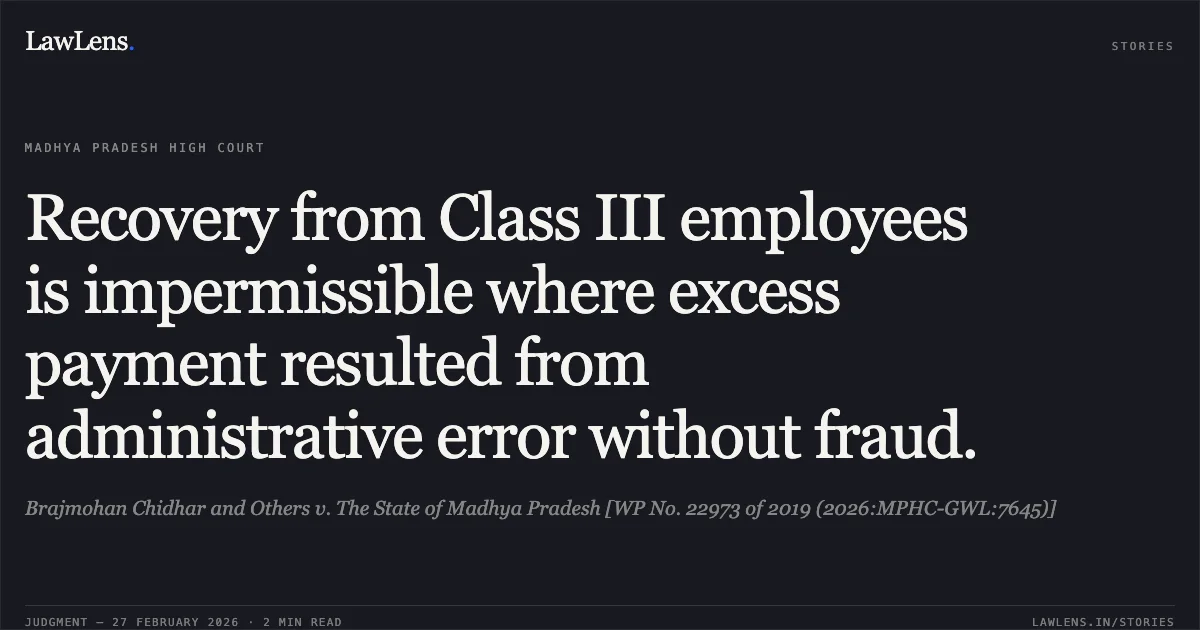
Brajmohan Chidhar and Others v. The State of Madhya Pradesh [WP No. 22973 of 2019 (2026:MPHC-GWL:7645)]
Click to open original judgment
Original judgment, available to read, download and summarize on LawLens.in