Facts
The appellants, parents of Pardeep Kumar, challenged the Railway Claims Tribunal’s order dated 14.03.2014 dismissing their claim for compensation under Section 16 of the Railway Claims Tribunal Act, 1987, arising from their son’s death.
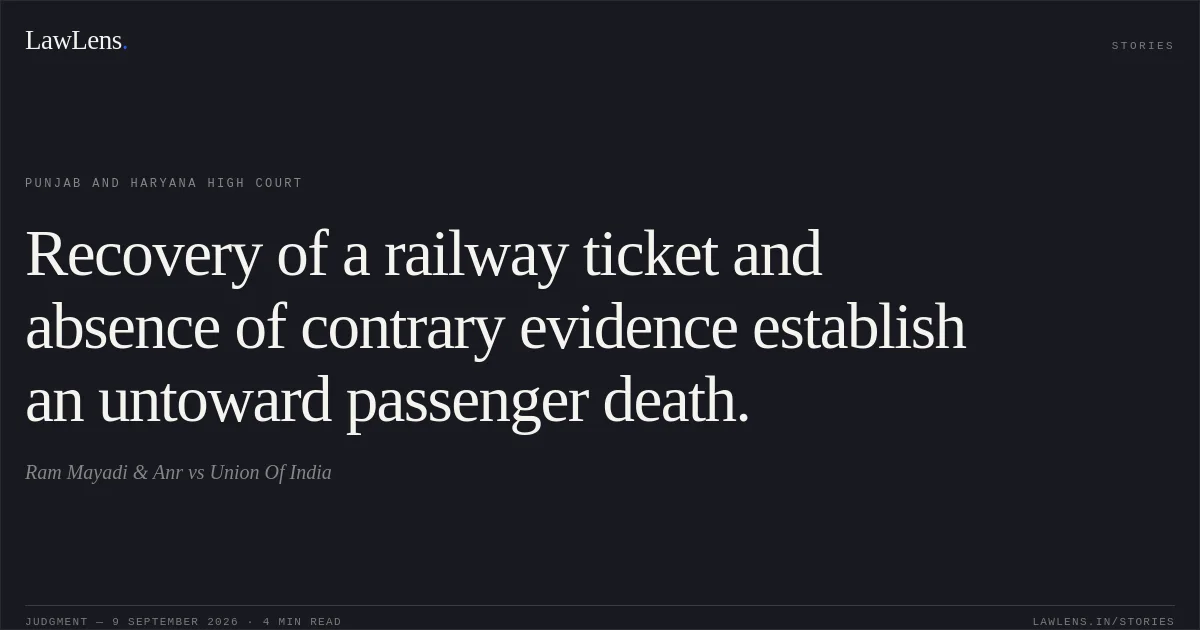
Source reference: p.1The deceased had travelled from Sirhind to Jagadhri on 22.09.2011. A journey ticket bearing No. 57174711, dated 22.09.2011, for that route was recovered from his person during the GRP’s proceedings.
Source reference: p.2His dead body was found the next morning near the railway track between Jagadhri Workshop and Jagadhri.
Source reference: p.2The Railway contended that the deceased had completed his journey and was subsequently struck by a train while crossing the track, amounting to a self-inflicted injury or criminal act.
Source reference: p.2The Tribunal accepted this theory, relying principally on the date of the ticket, the absence of an eyewitness, and certain alleged contradictions in the parents’ evidence.
Source reference: p.2Issues
Whether the deceased was a bona fide railway passenger and whether his death resulted from an “untoward incident” under Sections 123(c)(2) and 124-A of the Railways Act, 1989.
Source reference: pp.3–5 / paras. 6–6.2Whether the Railway established that the deceased deliberately crossed the railway track or suffered a self-inflicted injury or death through a criminal act so as to attract an exception under Section 124-A.
Source reference: pp.3–5 / paras. 6–6.2Whether the appellants were sufficiently established as the deceased’s parents despite the non-mention of his name in the ration card.
Source reference: p.5 / para. 7What amount of compensation and interest were payable to the appellants.
Source reference: pp.5–6 / paras. 8–9Law Applied
The Court applied Sections 123(c)(2) and 124-A of the Railways Act, 1989, under which an accidental fall from a train constitutes an “untoward incident” attracting statutory compensation, subject to the prescribed exceptions, including suicide, self-inflicted injury, and a criminal act.
Source reference: no citationThe Court held that the claimant’s status as a bona fide passenger may be established through the surrounding circumstances and recovery of a valid journey ticket; the absence of an eyewitness is not, by itself, fatal to the claim.
Source reference: p.3Relying on Jameela v. Union of India, (2010) 12 SCC 443, the Court reiterated that passenger negligence in falling from a running train does not, by itself, defeat a claim under Section 124-A, and negligence cannot be equated with the “criminal act” contemplated by the statutory proviso.
Source reference: p.4On quantum, the Court applied Rina Devi and Radha Yadav v. Union of India, (2019) 3 SCC 410, holding that the compensation applicable on the date of the accident, with reasonable interest, must be compared with the compensation prescribed on the date of the award, and the higher amount should be granted.
Source reference: pp.5–6Reasoning
The recovery of the journey ticket from the deceased’s person, coupled with the Railway’s own evidence, established on a preponderance of probabilities that he was a bona fide passenger.
Source reference: p.3The Railway failed to prove its alternative theory that he had deliberately entered upon or crossed the track.
Source reference: p.3The keyman’s evidence indicated that a person could fall from a passing train at the location where the body was found, while the RPF message, the prima facie injury assessment, and the gangman’s statement supported death due to a fall from a train.
Source reference: pp.3–4The Railway’s evidence regarding the precise location and circumstances of the incident was materially inconsistent, and the Tribunal’s finding of a self-inflicted injury was therefore based on conjecture.
Source reference: p.4Applying Jameela, the Court held that even if the deceased had been negligent, such negligence would not amount to the statutory exclusion of a criminal act.
Source reference: p.4The parents’ consistent assertion of their relationship and their participation in identifying the body outweighed the evidentiary significance of the deceased’s name not appearing in the ration card.
Source reference: p.5For quantum, the Court compared the pre-existing compensation of Rs.4,00,000, with interest, against the later prescribed amount of Rs.8,00,000 and directed payment of whichever was higher.
Source reference: pp.5–6Holding
The appeal was allowed and the Tribunal’s order dated 14.03.2014 was set aside.
The Court held that Pardeep Kumar was a bona fide passenger and that his death resulted from an untoward incident under Sections 123(c)(2) and 124-A of the Railways Act, 1989.
Source reference: pp.4–5 / paras. 6.2–7The appellants were awarded Rs.4,00,000 with interest at 9% per annum from the date of filing of the claim application until realization, or Rs.8,00,000, whichever was higher.
Source reference: p.6 / para. 9The Railway was directed to deposit the amount with the Tribunal within three months of receiving the certified copy of the judgment.
Source reference: p.6 / para. 9In case of default, interest at 12% per annum would apply from expiry of the three-month period until actual realization.
Source reference: p.6 / para. 9Pending miscellaneous applications, if any, were disposed of.
Source reference: p.6 / para. 10Acts & Sections Cited
2 provisions across 2 statutes referred to in this judgment. Each provision opens on LawLens.
Railway Claims Tribunal Act, 19871
Railways Act, 19891
Original Court PDF
Ram Mayadi & AnrvsUnion Of India
Click to open original judgment
Original judgment, available to read, download and summarize on LawLens.in