Facts
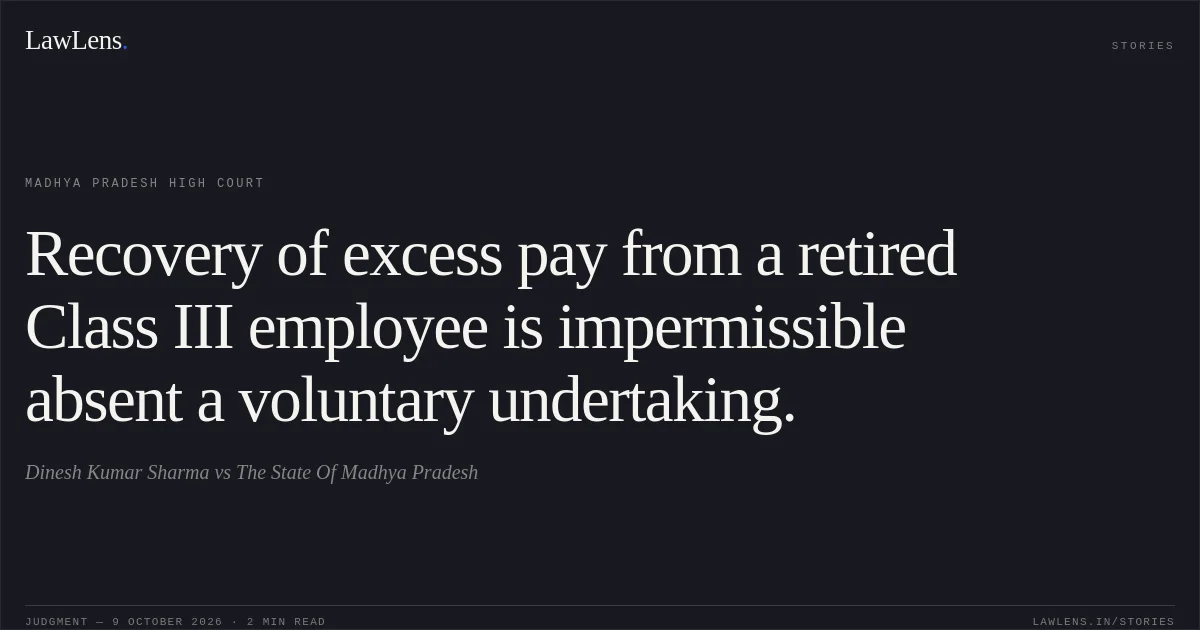
The petitioner, appointed as a Chaukidar in 1988, retired as Assistant Grade-III on 31 December 2024.
Source reference: para. 2On review of his service book, the authorities concluded that his pay had been wrongly fixed and ordered recovery of ₹18,00,877.
Source reference: para. 2The recovery followed an order concerning pay fixation and was issued without a show-cause notice or hearing.
Source reference: para. 3The State relied on an undertaking by the petitioner to repay excess payments.
Source reference: para. 4The petitioner challenged the orders, contending that recovery from a retired Class III employee was impermissible and that he had not caused the alleged overpayment.
Source reference: para. 10–11Issues
1. Whether recovery of alleged excess pay could be made from the petitioner, a retired Class III employee, where the excess payment arose from pay fixation extending over several decades and no hearing was afforded before recovery.
Source reference: para. 2–3, 10–112. Whether the undertaking relied on by the State permitted recovery in the circumstances of the case.
Source reference: para. 4, 9–10Law Applied
Under State of Punjab v. Rafiq Masih (White Washer), recovery is generally impermissible from Class III/IV employees, retired employees, and in other circumstances where recovery would be inequitable or harsh.
Source reference: para. 7The Full Bench in State of Madhya Pradesh v. Jagdish Prasad Dubey held that recovery based on an undertaking may be made in specified circumstances, but an undertaking given at the time of payment of retiral dues for pay or increments fixed decades earlier cannot be enforced; an undertaking given when financial benefits are granted is not enforceable unless voluntary.
Source reference: para. 6The Court also relied on Ravindra Kumar Joshi v. State of Madhya Pradesh, under which the State must establish that the undertaking was voluntary.
Source reference: para. 9The decision in Jogeswar Sahoo v. District Judge, Cuttack supports the conclusion that recovery without a hearing from retired ministerial employees, absent fraud or misrepresentation, is unsustainable.
Source reference: para. 8The Court further treated notice and an opportunity of hearing as necessary before the authorities take further action.
Source reference: para. 3, 11Reasoning
The alleged excess arose from pay fixation dating back to 1988, and the record disclosed no undertaking given when the relevant fixation or payment was made.
Source reference: para. 10The State did not establish that the later undertaking was voluntary; accordingly, it could not justify recovery.
Source reference: para. 9–10The petitioner was a Class III employee, had retired before the recovery order, and had received no notice or opportunity to be heard.
Source reference: para. 10–11Applying Rafiq Masih and the cited authorities, the Court held the recovery impermissible in the circumstances.
Source reference: para. 10–11Holding
The Court set aside the recovery order and quashed the pay-fixation order.
It directed the respondents to refund ₹18,00,877 with interest at 6% per annum from the date of entitlement until payment, failing which interest would be payable at 12% per annum for that period.
Source reference: para. 11–13The respondents were permitted to take further action in accordance with law after issuing a show-cause notice and providing a personal hearing; the exercise was to be completed within 90 days of submission of a certified copy of the order.
Source reference: para. 11–13Original Court PDF
Dinesh Kumar SharmavsThe State Of Madhya Pradesh
Click to open original judgment
Original judgment, available to read, download and summarize on LawLens.in