Facts
The applicant, Narayanappa Chitragar, was appointed as Turner Skilled in the 3rd respondent workshop on November 19, 1989.
Source reference: p.2He was promoted to Turner Highly Skilled (HS) with effect from May 20, 2003.
Source reference: p.2Subsequently, he was placed in Highly Skilled Grade I in Turner trade with effect from January 1, 2006.
Source reference: p.5, p.6Following directions from the Hon'ble High Court of Karnataka in Writ Petition Nos. 31240/2015 and 53718/2016, which allowed respondents to review promotions after the SRO 29/2006 came into force, the applicant's promotion was reviewed.
Source reference: p.2-3His date of placement as Turner HS I from January 1, 2006, was revised, and he was placed at Machinist HS II with effect from February 18, 2006, and Machinist HS I with effect from March 11, 2016.
Source reference: p.3, p.6The applicant retired voluntarily on February 14, 2025.
Source reference: p.3The respondents calculated an excess payment of Rs. 7,52,101/- from January 1, 2006, until July 2024, and proposed to deduct this amount from his retirement gratuity.
Source reference: p.3The applicant's counsel argued that the High Court judgment was not applicable as the applicant was appointed under SRO 1/1988, not SRO 29/2006, and that the recovery was illegal per Supreme Court rulings.
Source reference: p.3-4The respondents' counsel stated that the recovery was based on the High Court's directions for promotions on a unified list after the merger of trades effective February 18, 2006, and that the applicant had shown willingness for the recovery.
Source reference: p.4-5Issues
1. Whether the proposed recovery of Rs. 7,52,101/- from the applicant's retirement gratuity, a Group ‘C’ employee, constitutes an arbitrary, unjust, and illegal act?
Source reference: p.22. Whether the undertaking/willingness for recovery obtained from the applicant at the verge of his retirement is valid and enforceable?
Source reference: p.9Law Applied
The court primarily applied the principles laid down by the Hon'ble Apex Court in State of Punjab & Ors vs. Rafiq Masih (White Washer) and Ors., reported in (2015) 4 SCC 334, and Thomas Daniel v. State of Kerala, reported in 2022 SCC OnLine SC 536, regarding the impermissibility of recovering excess payments from employees in certain situations.
Source reference: p.4, p.7Specifically, it relied on the Department of Personnel and Training (DoPT) Office Memorandum dated March 2, 2016, which summarized situations where recoveries by employers would be impermissible, including from Group 'C' and Group 'D' service employees, from retired employees or those due to retire within one year, and where excess payment was made for a period exceeding five years before the recovery order was issued.
Source reference: p.7-8Additionally, the court cited Subhash Nimba Chavan vs the State of Maharashtra in Writ Petition No. 6440/2024 (DD: July 1, 2024), which held that undertakings extracted at the stroke of retirement are invalid due to the employer taking advantage of the employee's helplessness.
Source reference: p.8-9Reasoning
The court noted that the factual aspects were not in dispute and acknowledged that the re-fixation of pay was a consequence of the Hon'ble High Court of Karnataka's directions for review of promotions, which the Tribunal had upheld in a similar case (Shri Tazimulla Shariff S.D. and Ors. v. Union of India and Ors.).
Source reference: p.6, p.7, p.10However, the court found that the recovery proceedings were initiated against a Group 'C' employee, the applicant, who retired voluntarily, and there was no evidence of misrepresentation or fraud on his part in securing the excess payment.
Source reference: p.7, p.9Relying on the DoPT OM of March 02, 2016, which codifies the Rafiq Masih principles, the court emphasized that recovery from Group 'C' employees, especially at the time of retirement benefits, after a lapse of more than 18 years (excess payment from 2006 for retirement in 2025) and without fraud, is impermissible.
Source reference: p.3, p.7, p.8, p.9Furthermore, the court held that any "willingness" or undertaking for recovery extracted from an employee at the point of retirement, under coercive circumstances, does not hold sanctity and cannot exonerate the employer from their liability, as per the Bombay High Court's ruling in Subhash Nimba Chavan.
Source reference: p.9Therefore, while the re-fixation of pay was deemed valid, the recovery itself was found to be unjustifiable based on the established legal precedents against recovery from certain classes of employees, particularly when nearing retirement and in the absence of fraud.
Source reference: p.9, p.10Holding
The Tribunal upheld the re-fixation of the applicant's pay as per the impugned Order dated July 27, 2022 (Annexure A5).
However, it declared the initiated recovery proceedings for Rs. 7,52,101/- from the applicant's retirement gratuity as wholly unjustifiable.
Source reference: p.10The Communications dated December 5, 2024 (Annexure A7) and December 12, 2024 (Annexure A8), pertaining to the recovery aspect, were quashed and set aside.
Source reference: p.10The respondents were directed to refund Rs. 7,52,101/- to the applicant if already recovered, within eight weeks from the date of receipt of the certified copy of the order.
Source reference: p.10The OA was disposed of accordingly, with no order as to costs.
Source reference: p.11Acts & Sections Cited
1 provisions across 1 statute referred to in this judgment. Each provision opens on LawLens.
Administrative Tribunals Act, 19851
Original Court PDF
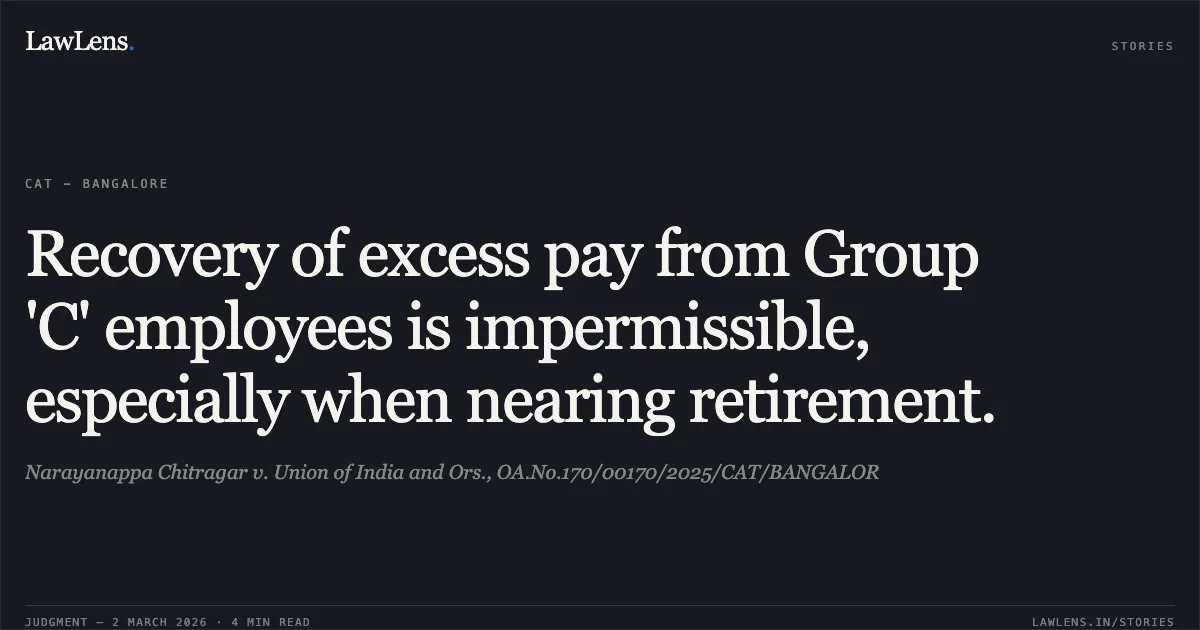
Narayanappa Chitragar v. Union of India and Ors., OA.No.170/00170/2025/CAT/BANGALOR
Click to open original judgment
Original judgment, available to read, download and summarize on LawLens.in