Facts
The petitioner, a retired Class-III employee (Health Visitor/TB Treatment Organizer), superannuated on August 31, 2022.
Source reference: para. 2Following retirement, his gratuity was fixed at Rs. 13,86,297/-. However, on September 21, 2022, the respondents directed him to provide consent for the recovery of Rs. 7,05,566/- (including interest) on account of alleged excess payments made during his service between 1987 and 2020.
Source reference: para. 2, 10After obtaining this post-retirement consent, the respondents deducted the amount from his gratuity on October 19, 2022.
Source reference: para. 2The petitioner challenged this recovery, asserting it was illegal as a retired Class-III employee and that the consent was obtained under duress.
Source reference: para. 3Issues
1. Whether the recovery of excess payments from a retired Class-III employee is permissible under the law.
Source reference: para. 3, 72. Whether a consent/undertaking given post-retirement for the adjustment of retiral dues has legal sanctity to validate an otherwise impermissible recovery.
Source reference: para. 6, 9Law Applied
The Court primarily applied the principles laid down by the Hon’ble Supreme Court in State of Punjab v. Rafiq Masih (White Washer) (2015), which prohibits recovery from retired employees or those belonging to Class-III/IV service, especially when excess payment was made for a period exceeding five years.
Source reference: para. 7It further relied on the Full Bench decision of the Madhya Pradesh High Court in State of M.P. v. Jagdish Prasad Dubey (2024), which held that undertakings given at the stage of paying retiral dues for decades-old pay refixations are forced and unenforceable.
Source reference: para. 6, 9The Court also cited Jogeswar Sahoo v. District Judge, Cuttack (2025) regarding the necessity of a show-cause notice before recovery.
Source reference: para. 8Reasoning
The Court observed that the petitioner is a retired Class-III employee, placing him squarely within the protective ambit of the Rafiq Masih guidelines.
Source reference: para. 11The alleged excess payments dated back to 1987, but the order for recovery was issued only after retirement in 2022, without any prior show-cause notice or hearing.
Source reference: para. 8, 10, 11Crucially, the Court determined that because no undertaking was furnished by the petitioner at the time the financial benefits were originally granted during his service, the consent obtained post-retirement (during the processing of pension papers) cannot be deemed "voluntary".
Source reference: para. 10Applying the Jagdish Prasad Dubey precedent, the Court held such "forced" undertakings to be legally invalid, thereby nullifying the respondents' justification for the deduction.
Source reference: para. 9, 10Holding
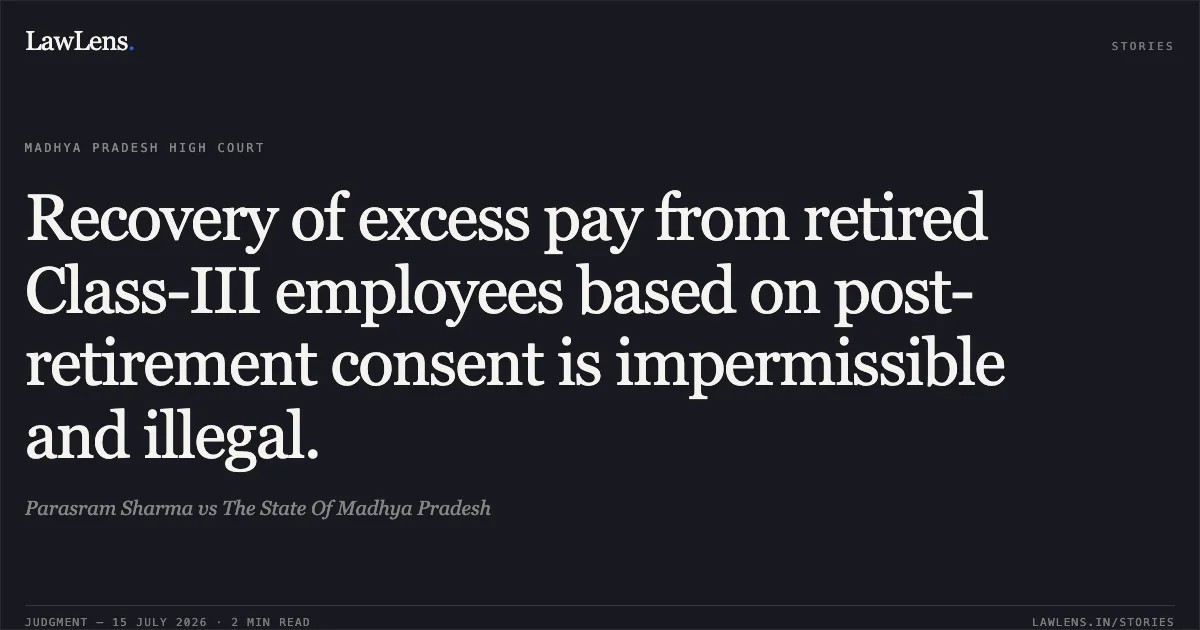
The Court allowed the petition and set aside the recovery of Rs. 7,05,566/-.
It held that recovery from a retired Class-III employee without a voluntary undertaking given at the time of pay-fixation is illegal.
Source reference: para. 10, 11The respondents were directed to refund the recovered amount of Rs. 7,05,566/- with 6% annual interest from the date of retirement (August 31, 2022) within 90 days, failing which the interest rate would increase to 12% per annum.
Source reference: para. 12, 13Acts & Sections Cited
2 provisions across 1 statute referred to in this judgment. Linked provisions open on LawLens.
M.P. Civil Services (Pension) Rules, 19762
Original Court PDF
Parasram SharmavsThe State Of Madhya Pradesh
Click to open original judgment
Original judgment, available to read, download and summarize on LawLens.in


![Subsequent exoneration does not retrospectively invalidate a finalized promotion select list.. UNNIKRISHNAN M vs M/o Environment And Forests. CAT - ['Ernakulam']. LawLens](/stories/thumbnails/subsequent-exoneration-does-not-retrospectively-invalidate-a-finalized-promotion-select-li-ce80a0e84f2f4887857271e8b4341c42.webp)