Facts
The petitioners were employees of the Public Works Department, Dehradun, serving respectively as a Helper and Compressor Operator, both falling within Class IV/Group D service. They superannuated on 31 March 2021
Source reference: p.2, para. 3After their retirement, the respondents issued recovery orders dated 17 May 2021 and 4 June 2021, seeking to recover alleged excess payments said to have resulted from erroneous pay fixation following implementation of the Sixth Pay Commission.
Source reference: pp.2–4, paras. 3, 7The State alleged that ₹4,31,367 had been paid in excess to Petitioner No. 1 and ₹1,64,634 to Petitioner No. 2, and deducted those amounts from their retiral dues.
Source reference: p.4, para. 7The petitioners challenged the recoveries, contending that they were Class IV employees, had not committed fraud or misrepresentation, and that the recoveries were impermissible under State of Punjab v. Rafiq Masih.
Source reference: pp.2–3, paras. 4–6Issues
Whether recovery of alleged excess salary payments from retired Class IV/Group D employees, absent fraud or misrepresentation on their part, is legally permissible?
Source reference: pp.2–4, paras. 3–8Whether the impugned recovery orders and deductions from the petitioners’ retiral dues were liable to be quashed under the principles laid down in State of Punjab v. Rafiq Masih?
Source reference: pp.3–5, paras. 5, 8–9Whether the petitioners were entitled to restitution of the recovered amounts with interest?
Source reference: p.5, para. 9Law Applied
The Court applied the principle in State of Punjab v. Rafiq Masih, (2015) 4 SCC 334, particularly paragraph 12, which identifies circumstances in which recovery of excess payments is impermissible, including recovery from Class III and Class IV employees, recovery from retired employees or employees due to retire within one year, and recovery where the excess payment was made over a period exceeding five years.
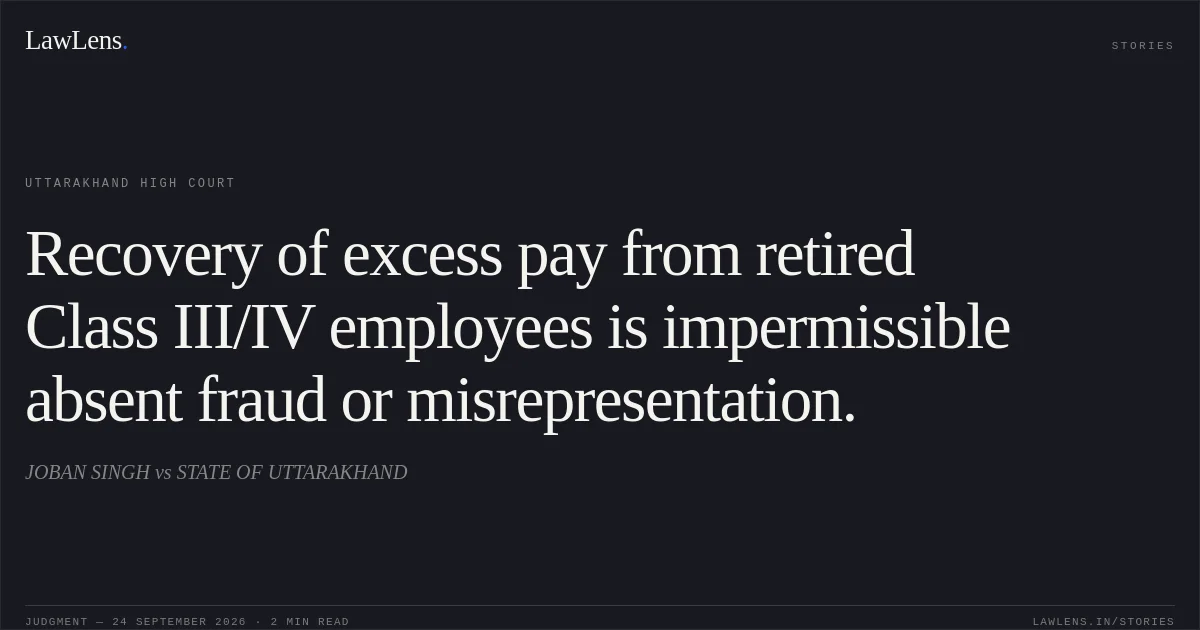
Source reference: p.3, para. 5The controlling rule is that excess payments cannot ordinarily be recovered from Class III or Class IV employees where the employee obtained the payment without fraud or misrepresentation.
Source reference: p.3, para. 5The Court also considered the Department of Personnel and Training guidelines and the State Government’s Government Order dated 14 August 2019 concerning recovery of excess payments.
Source reference: pp.2–3, paras. 3–4Reasoning
The Court found that both petitioners were Class IV employees and that the recoveries were initiated after their retirement, in respect of alleged excess payments made over a period beginning in 2006.
Source reference: pp.2–4, paras. 3, 7Although the State attributed the excess payments to erroneous pay fixation, it did not allege or establish that either petitioner had committed fraud or misrepresentation.
Source reference: p.4, para. 8Applying the categorical protection recognised in Rafiq Masih for Class III and Class IV employees, the Court held that the respondents could not recover the alleged excess salary from the petitioners’ retiral benefits merely because the department had incorrectly fixed their pay.
Source reference: p.4, para. 8The recoveries were therefore held to be contrary to the governing legal principles.
Source reference: pp.4–5, paras. 8–9Holding
The writ petition was allowed.
The recovery order dated 17 May 2021 and the recovery orders dated 4 June 2021 were quashed to the extent they directed recovery of ₹4,31,367 from Petitioner No. 1 and ₹1,64,634 from Petitioner No. 2.
Source reference: p.5, para. 9The respondents were directed to repay the recovered amounts, together with interest at 5% per annum from the date of recovery until actual payment, within ten weeks from presentation of a certified copy of the judgment.
Source reference: p.5, para. 9Original Court PDF
JOBAN SINGHvsSTATE OF UTTARAKHAND
Click to open original judgment
Original judgment, available to read, download and summarize on LawLens.in
![Subsequent criminal proceedings do not warrant review absent an error apparent on the record.. M/o Finance vs R C BAKSHI. CAT - ['Delhi']. LawLens](/stories/thumbnails/subsequent-criminal-proceedings-do-not-warrant-review-absent-an-error-apparent-on-the-reco-1686b1e451684d1590db13b17e36a8d2.webp)
![Transfer-policy tenure guidelines create no indefeasible right; interference requires statutory violation or established mala fides.. PRIYADARSHI PARIMAL AROHI vs BSNL. CAT - ['Patna']. LawLens](/stories/thumbnails/transfer-policy-tenure-guidelines-create-no-indefeasible-right-interference-requires-statu-110afbbb489a444f8a39741589297e68.webp)
![Recovery of excess pay from a retired employee is impermissible absent fraud or misrepresentation.. RAVI KANT vs Bharat Sanchar Nigam Ltd. CAT - ['Patna']. LawLens](/stories/thumbnails/recovery-of-excess-pay-from-a-retired-employee-is-impermissible-absent-fraud-or-misreprese-074b3b610aa14d1799eeaee490035275.webp)