01Facts
The petitioner, a Ward Boy serving at District Hospital, Morar, Gwalior, was subjected to recovery of ₹2,20,920 by order dated 09.06.2023 on the ground that his pay had been wrongly fixed.
p. 2 · ¶ 3The alleged excess payment related to the period from 01.01.2006 to 31.03.2023. The petitioner contended that the pay fixation had been carried out and approved by the competent authorities, that he had neither committed fraud nor misrepresentation, and that the recovery order was issued without notice or an opportunity of hearing.
p. 2 · ¶ 3He further asserted that, being a Class IV employee, recovery was impermissible under the principles laid down in State of Punjab v. Rafiq Masih.
p. 2 · ¶ 3The State argued that the recovery was valid because the petitioner was still in service when the order was passed.
p. 2 · ¶ 402Issues
i.1. Whether recovery of alleged excess salary paid due to erroneous pay fixation could be made from the petitioner, a Class IV employee, when the excess payment related to a period exceeding five years before the recovery order.
pp. 6–7 · ¶ 10–13ii.2. Whether the recovery order was sustainable when it was issued without a show-cause notice or opportunity of hearing.
p. 2, 7 · ¶ 3, 13iii.3. Whether the absence of a specific undertaking furnished by the petitioner at the time of the original pay fixation permitted recovery of the excess amount.
pp. 5–6, 9–10 · ¶ 9–1003Law Applied
The Court applied the principles in State of Punjab v. Rafiq Masih (White Washer), (2015) 4 SCC 334, under which recovery is ordinarily impermissible from Class III and Class IV employees, where the excess payment was made for a period exceeding five years before the recovery order, or where recovery would be harsh, inequitable or arbitrary.
p. 6 · ¶ 7The Court relied on the Full Bench decision in State of Madhya Pradesh v. Jagdish Prasad Dubey, (2024) 2 M.P.L.J. 198, which held that recovery may be made on the basis of a valid undertaking or indemnity bond, subject to considerations of hardship and the principles in Rafiq Masih; however, an undertaking obtained as a condition for grant of pay refixation is ordinarily treated as forced and is unenforceable unless shown to have been given voluntarily.
pp. 3–4 · ¶ 6The Court also noted that recovery based on Rules 65 and 66 of the 1976 Rules requires compliance with the prescribed procedure.
p. 3 · ¶ 6The principles of natural justice require notice and an opportunity of hearing before an adverse recovery order is made.
p. 2, 7 · ¶ 3, 13The Court further referred to Jogeswar Sahoo v. District Judge, Cuttack, 2025 (3) M.P.L.J. (S.C.) 25, where recovery was held unsustainable in the absence of fraud or misrepresentation, hearing, and where the employees were non-gazetted and had retired.
pp. 4–5 · ¶ 804Reasoning
The Court found that the petitioner was a Ward Boy and therefore a Class IV employee, bringing his case directly within the first category identified in Rafiq Masih.
p. 7 · ¶ 11, 13The alleged wrong fixation and excess payment extended from 01.01.2006 to 31.03.2023, whereas recovery was ordered on 09.06.2023; thus, the payment had continued for approximately seventeen years and substantially exceeded the five-year period contemplated in Rafiq Masih.
p. 7 · ¶ 12The State’s argument that Rafiq Masih was inapplicable merely because the petitioner remained in service was rejected, since the categories identified by the Supreme Court were independent and the petitioner independently satisfied the Class IV and five-year criteria.
p. 7 · ¶ 12The recovery was also procedurally defective because no show-cause notice or hearing had been given.
p. 2, 7 · ¶ 3, 13Further, no specific undertaking furnished at the time of the 01.01.2006 pay fixation was placed on record. Consequently, the respondents could not rely on an undertaking to justify recovery under Jagdish Prasad Dubey.
pp. 5–6, 9–10 · ¶ 9–1005Holding
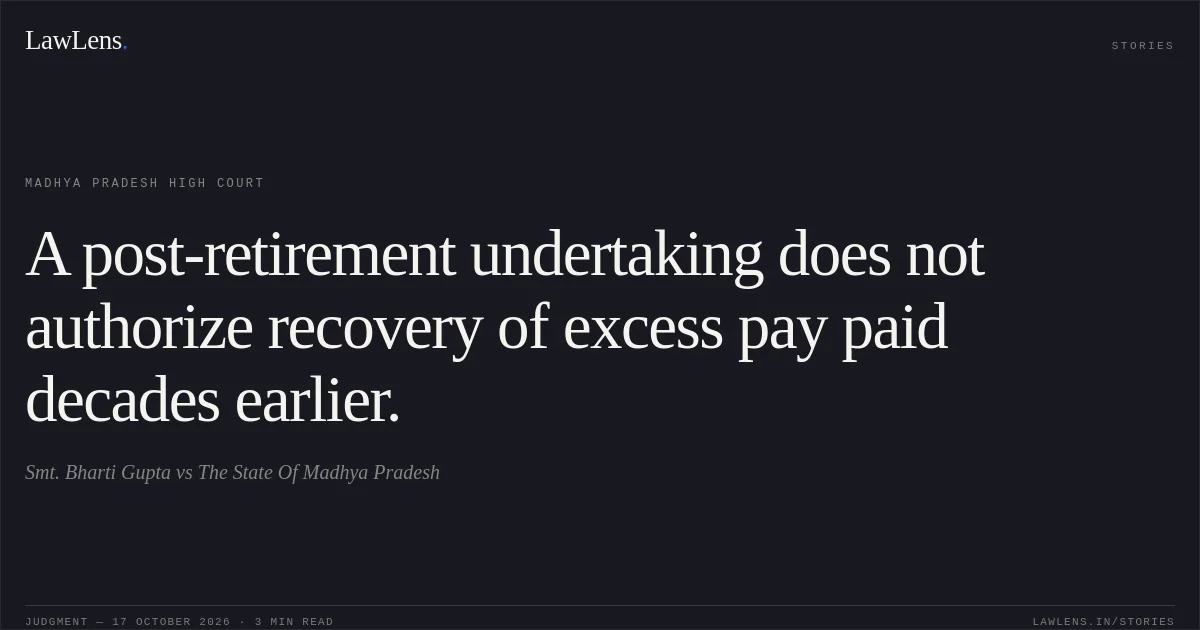
The High Court held that recovery of ₹2,20,920 from the petitioner was impermissible because he was a Class IV employee, the alleged excess payment had continued for more than five years, the recovery was ordered without notice or hearing, and no valid undertaking given at the time of pay fixation was established.
p. 7 · ¶ 13The impugned recovery order dated 09.06.2023 was set aside, and the respondents were directed to refund ₹2,20,920 to the petitioner with interest at 6% per annum from the date of entitlement until actual payment.
p. 8 · ¶ 13–14The exercise was directed to be completed within 90 days from submission of a certified copy of the order.
p. 8 · ¶ 13–14The writ petition was accordingly disposed of.
p. 8 · ¶ 15Original Court PDF
Kamlakar NashikkarvsThe State Of Madhya Pradesh
Click to open original judgment
Original judgment, available to read, download and summarize on LawLens.in