Facts
The petitioner was appointed as a Lower Division Clerk (LDC) Grade-III in 1994.
Source reference: para. 2Following recommendations from the Pay Fixation Committee, he was granted the first time pay scale in 2006 (after 10 years of service) and the second time pay scale in 2014 (after 20 years of service).
Source reference: para. 2In 2017, the respondents issued impugned orders dated 17.10.2017 and 13.12.2017, withdrawing the first pay scale and directing a recovery of Rs. 75,705/- for excess payments made between 2006 and 2017.
Source reference: para. 2The petitioner challenged these orders, asserting that the benefits were granted by competent authorities without any fraud or misrepresentation on his part.
Source reference: para. 3Issues
1. Whether the recovery of excess pay from a Class-III employee, paid over a period of eleven years without any fault of the employee, is legally sustainable.
Source reference: para. 52. Whether the impugned recovery orders violated the principles of natural justice and the guidelines established by the Supreme Court.
Source reference: para. 3 & 6Law Applied
The Court primarily applied the legal principles established by the Supreme Court of India in State of Punjab & Ors. v. Rafiq Masih (White Washer), (2015) 4 SCC 334.
Source reference: para. 5This precedent postualtes that recovery by employers is impermissible in specific situations of hardship, notably: (i) from employees belonging to Class III and Class IV service; and (ii) when the excess payment has been made for a period in excess of five years before the order of recovery is issued.
Source reference: para. 5Reasoning
The Court examined the petitioner’s status and the timeline of the disputed payments. It noted that the petitioner is a Class-III employee.
Source reference: para. 6The Court found that the pay scales were granted by the competent authority based on the Pay Fixation Committee's recommendations, and no allegations of fraud or misrepresentation were leveled against the petitioner.
Source reference: para. 6Since the recovery sought pertained to a period of more than eleven years (2006–2017), the Court determined that the case fell squarely within the prohibitive categories (i) and (iii) defined in the Rafiq Masih judgment.
Source reference: para. 6Consequently, the Court reasoned that allowing such recovery after a decade would be iniquitous and legally unsustainable.
Source reference: para. 6-7Holding
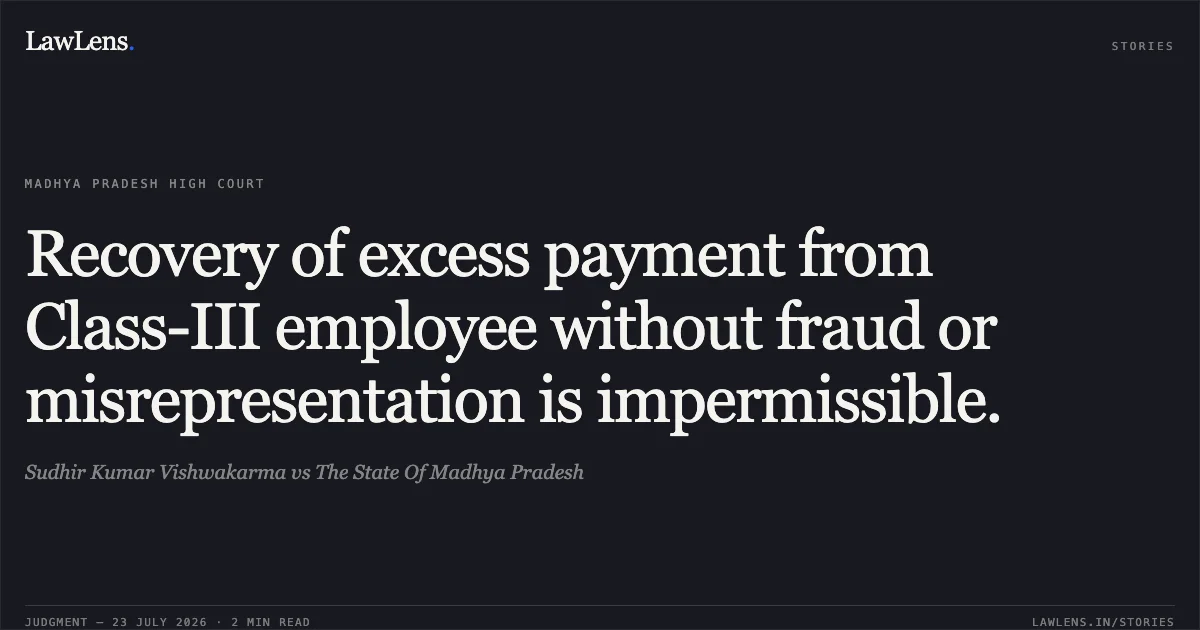
The High Court answered the issues in favour of the petitioner, holding that the recovery was impermissible under the law.
The Court quashed and set aside the impugned orders dated 17.10.2017 and 13.12.2017. The respondents were directed to refund any amount already recovered from the petitioner, along with interest at the rate of 6% per annum, within 60 days.
Source reference: para. 7-9Original Court PDF
Sudhir Kumar VishwakarmavsThe State Of Madhya Pradesh
Click to open original judgment
Original judgment, available to read, download and summarize on LawLens.in


