Facts
The petitioner, a retired Government servant, challenged the recovery of ₹1,50,000/- under a recovery certificate dated 03.04.2013 and ₹1,32,722/- under Voucher No. 16 dated 22.12.1994, both relating to advances allegedly made to him for machinery and other materials. He also challenged recovery of ₹24,578/- towards excess payment allegedly made pursuant to a pay revision in 1986
Source reference: para. 2In an earlier petition, W.P. No. 11477 of 2015, the petitioner had been granted liberty to file a representation before the competent authority; however, in the present proceedings, he did not produce either the representation or the decision thereon
Source reference: para. 3The respondents maintained that the petitioner had not submitted accounts or expenditure details relating to the advances and that the amounts constituted recoverable Government dues under Rule 65 of the Madhya Pradesh Civil Services (Pension) Rules, 1976
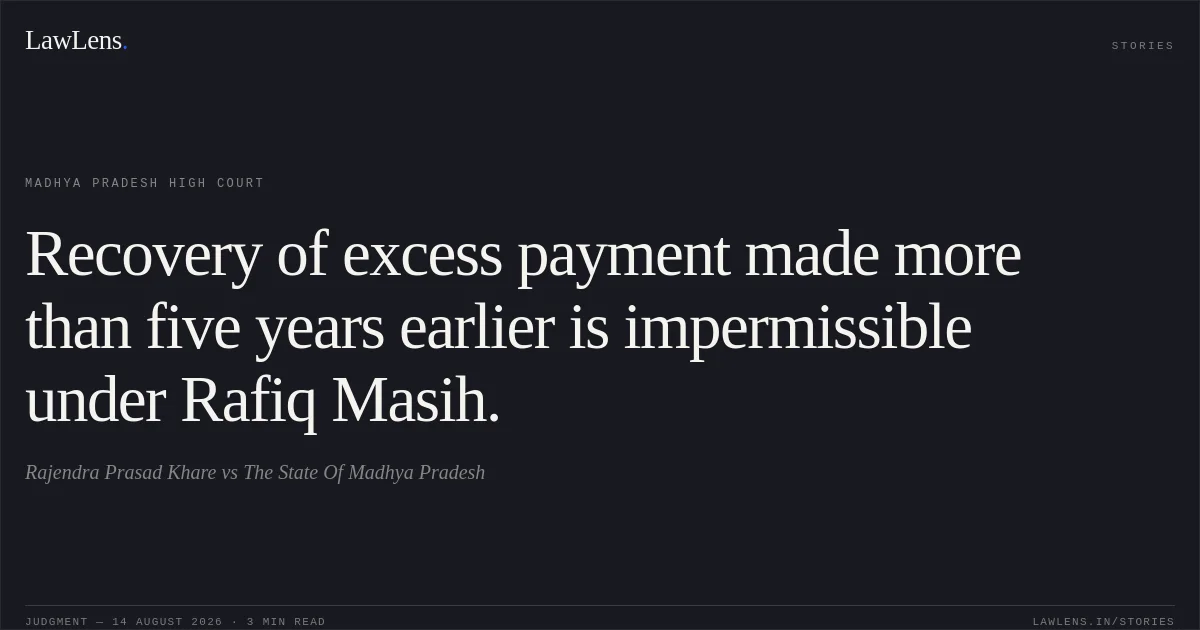
Source reference: para. 4The petitioner relied on State of Punjab v. Rafiq Masih (Whitewasher), (2015) 4 SCC 334, to contend that recovery after retirement and recovery of long-standing excess payments were impermissible
Source reference: para. 3Issues
1. Whether the amounts of ₹1,50,000/- and ₹1,32,722/- advanced to the petitioner and remaining unsupported by accounts or expenditure details constituted “ascertainable Government dues” recoverable from his gratuity under Rule 65 of the Madhya Pradesh Civil Services (Pension) Rules, 1976?
Source reference: paras. 6–72. Whether recovery of ₹24,578/- representing excess payment allegedly made pursuant to the 1986 pay revision was barred under the principles laid down in State of Punjab v. Rafiq Masih?
Source reference: paras. 8–9Law Applied
The Court applied Rule 65 of the Madhya Pradesh Civil Services (Pension) Rules, 1976, which requires a retiring Government servant to clear Government dues and permits deduction from gratuity of amounts representing ascertainable dues; the Explanation expressly includes advances, overpayment of pay and allowances, and other specified Government liabilities
Source reference: para. 6The Court also applied the principles in State of Punjab v. Rafiq Masih (Whitewasher), (2015) 4 SCC 334, particularly that recovery of excess payments is generally impermissible from retired employees and where the excess payment relates to a period exceeding five years before the recovery order, subject to the broader principle against recovery that is inequitable, harsh or arbitrary
Source reference: para. 8Reasoning
The Court distinguished between the outstanding advances and the excess pay revision payment. In respect of the advances, the petitioner had admittedly received the amounts but, despite repeated notices and opportunities, had failed to submit accounts or explain the expenditure incurred
Source reference: paras. 6–7In those circumstances, the amounts were treated as ascertainable Government dues under Rule 65 and were held recoverable.
Source reference: paras. 6–7The Court found Rafiq Masih applicable to the ₹24,578/- excess payment because the alleged overpayment arose from the 1986 pay revision, more than five years before the proposed recovery, and the petitioner was a Class-II employee
Source reference: para. 9Accordingly, the protection against delayed recovery of excess payments applied to that amount, but not to the advances, which represented outstanding Government dues unsupported by accounts.
Source reference: para. 9Holding
The petition was partly allowed.
The recovery of ₹24,578/- relating to the 1986 pay revision was quashed as impermissible under the principles in Rafiq Masih
Source reference: para. 9The Court upheld the respondents’ authority to recover the advance amounts totalling ₹2,82,722/-—₹1,50,000/- and ₹1,32,722/-—as Government dues under Rule 65, and left the respondents at liberty to recover that amount in accordance with law
Source reference: para. 10The petition was accordingly disposed of
Source reference: para. 11Original Court PDF
Rajendra Prasad KharevsThe State Of Madhya Pradesh
Click to open original judgment
Original judgment, available to read, download and summarize on LawLens.in