Facts
The petitioner, initially appointed as a teacher in 1973, retired as a Lecturer on 31 January 2016.
Source reference: p. 2During scrutiny of his service book at retirement, the respondents alleged that his pay had been wrongly fixed and ordered recovery of ₹2,33,697 from his retiral dues.
Source reference: p. 2, para. 5The petitioner contended that the alleged excess payment resulted from an erroneous fixation by the Department, without any fraud or misrepresentation on his part, and that the recovery was ordered without a show-cause notice or opportunity of hearing.
Source reference: p. 2, para. 5The State did not file a reply despite repeated opportunities, and the petition was therefore decided on the basis of the existing record.
Source reference: p. 1, paras. 2–3; p. 6, para. 13Issues
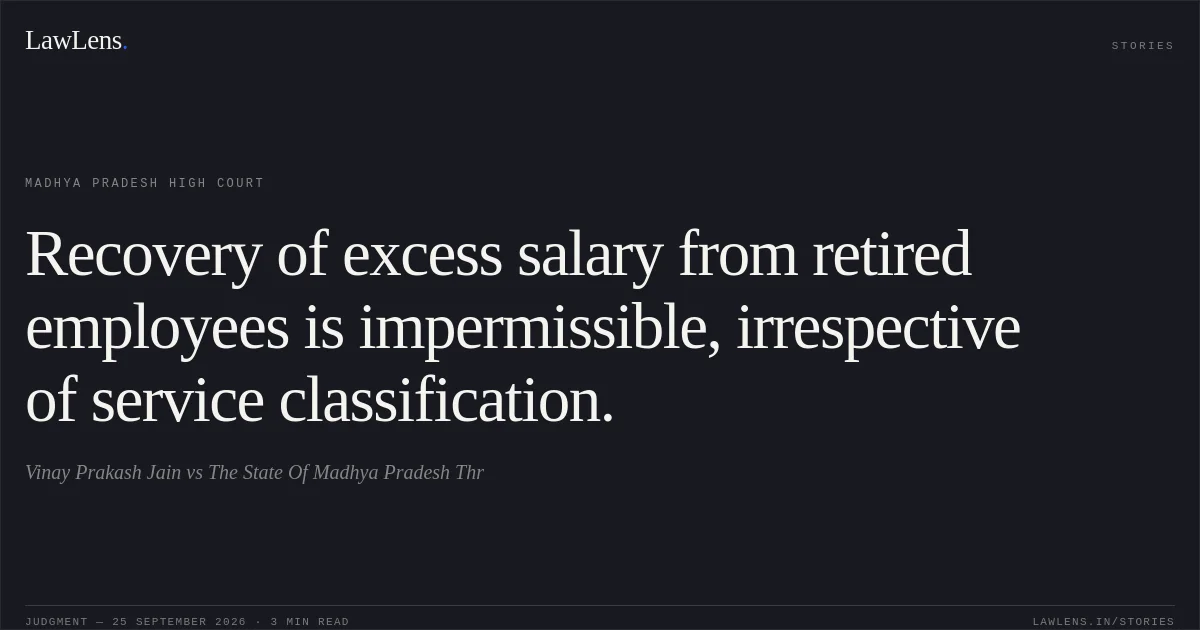
Whether recovery of alleged excess salary paid due to erroneous pay fixation could be effected from the petitioner after his retirement, particularly when the recovery was ordered without notice or hearing.
Source reference: p. 6, para. 14Whether the bar against recovery laid down in State of Punjab v. Rafiq Masih applies to the petitioner despite his being a Class-II employee/Lecturer.
Source reference: p. 6, para. 14Whether any undertaking allegedly given by the petitioner could independently sustain the recovery in the absence of proof that it was voluntarily furnished.
Source reference: p. 3, para. 9; p. 5, para. 12Law Applied
The Court exercised jurisdiction under Article 226 of the Constitution of India.
Source reference: p. 1, para. 4It applied State of Punjab v. Rafiq Masih (White Washer), (2015) 4 SCC 334, particularly the rule that recovery of excess payment from retired employees, or employees due to retire within one year of the recovery order, is ordinarily impermissible, and that recovery may also be barred where it would be inequitable, harsh, or arbitrary.
Source reference: p. 4, paras. 10–11The Court relied on the Full Bench decision in State of Madhya Pradesh v. Jagdish Prasad Dubey, (2024) 2 MPLJ 198, holding that recovery based on an undertaking may be made only in appropriate circumstances; an undertaking given at the stage of retiral benefits concerning an old pay fixation cannot ordinarily be enforced, and an undertaking obtained as a condition for financial benefit is unenforceable unless shown to have been given voluntarily.
Source reference: p. 3, para. 9The Court also relied on Jogeswar Sahoo v. District Judge, Cuttack, 2025 (3) MPLJ (SC) 254, concerning recovery without notice from retired employees where there was no fraud or misrepresentation.
Source reference: p. 4, para. 11Principles of natural justice required prior notice and an opportunity of hearing before recovery was ordered.
Source reference: p. 2, para. 6Reasoning
The Court found that the petitioner had retired on 31 January 2016 and that the recovery was initiated at or after retirement, without issuing a show-cause notice or affording an opportunity of hearing.
Source reference: p. 6, para. 14The State failed to establish any fraud, misrepresentation, or responsibility on the petitioner’s part for the alleged erroneous pay fixation.
Source reference: p. 6, para. 14The State’s argument that Rafiq Masih was inapplicable because the petitioner was a Class-II employee was rejected, since the protection relating to recovery from retired employees under paragraph 18(ii) of that judgment is not confined to Class-III or Class-IV employees.
Source reference: p. 6, para. 14Further, because the State neither filed a reply nor proved that any undertaking was voluntarily furnished, the alleged undertaking could not sustain the recovery under the principles stated in Jagdish Prasad Dubey and Ravindra Kumar Joshi.
Source reference: p. 5, para. 12; p. 6, para. 13Holding
The Court held that the impugned recovery of ₹2,33,697 was legally impermissible and set it aside.
The respondents were directed to refund ₹2,33,697 to the petitioner with interest at 6% per annum from the date of his retirement until actual payment; if payment was not made within the prescribed period, interest at 12% per annum would apply from the date of entitlement until payment.
Source reference: p. 6, para. 14The exercise was directed to be completed within 90 days from submission of the certified copy of the order, and the writ petition was accordingly disposed of.
Source reference: p. 6, paras. 15–16Original Court PDF
Vinay Prakash JainvsThe State Of Madhya Pradesh Thr
Click to open original judgment
Original judgment, available to read, download and summarize on LawLens.in