Facts
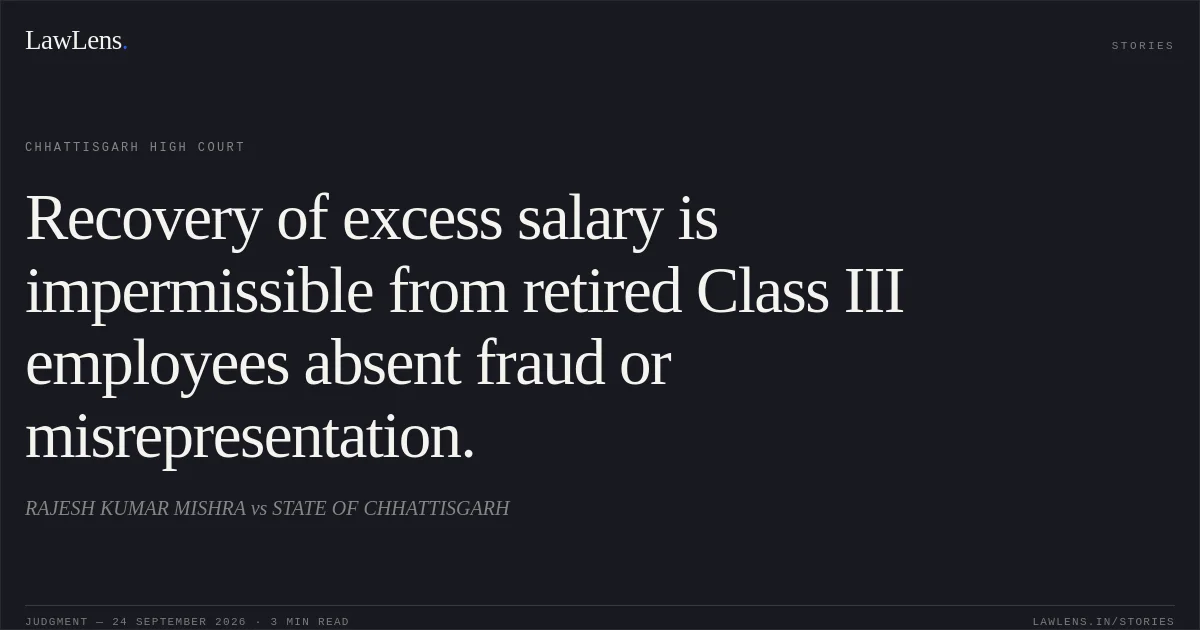
The petitioner, a retired Upper Division Teacher holding a Class-III post, retired on 31.03.2022.
Source reference: paras. 1–4By order dated 07.11.2022, the respondents directed recovery of ₹1,63,477 from him on the ground that his pay had been erroneously fixed, resulting in excess salary payments.
Source reference: paras. 1–4The alleged excess payment related to pay fixation made in 2011 and was attributed to an error by the employer, with no allegation of fraud, misrepresentation, or concealment by the petitioner.
Source reference: paras. 1–4The petitioner challenged the recovery order, contending that it was barred by State of Punjab v. Rafiq Masih and was passed without notice or hearing.
Source reference: paras. 1–4The respondents defended the recovery on the ground that the excess payment had resulted from erroneous pay fixation detected while processing the petitioner’s pension and retiral benefits.
Source reference: paras. 1–4Issues
1. Whether the respondents could revise the petitioner’s pay fixation and recover ₹1,63,477 after his retirement, where the alleged excess payment related to a period commencing in 2011 and was not caused by fraud or misrepresentation on his part.
Source reference: para. 52. Whether recovery could be ordered without issuing a show-cause notice or affording the petitioner an effective opportunity of hearing.
Source reference: paras. 5, 93. Whether the respondents could be permitted to undertake a fresh examination of the petitioner’s pay fixation after quashing the recovery order.
Source reference: paras. 10–11Law Applied
The Court applied the principles laid down by the Supreme Court in State of Punjab v. Rafiq Masih (White Washer), (2015) 4 SCC 334, under which recovery of excess payments is impermissible, inter alia, from Class-III and Class-IV employees, retired employees or employees due to retire within one year, and where the excess payment relates to a period exceeding five years before the recovery order; recovery may also be barred where it would be inequitable, harsh, or arbitrary.
Source reference: para. 6The Court also applied the principles of natural justice, requiring prior notice and an effective opportunity of hearing before an adverse pay re-fixation and recovery order is passed.
Source reference: para. 9At the same time, the Court recognised that the employer may examine the legality of the pay fixation afresh, provided the exercise is conducted in accordance with law and after granting due hearing.
Source reference: para. 10Reasoning
The petitioner fell within multiple protected categories identified in Rafiq Masih: he was a retired employee, had held a Class-III post, and the alleged excess payment related to a period substantially exceeding five years before the recovery order.
Source reference: paras. 7–8The record contained no material showing fraud, misrepresentation, or suppression by the petitioner; rather, the excess payment appeared to have resulted from an employer-side pay-fixation error.
Source reference: paras. 7–8Accordingly, recovery of the amount was legally unsustainable.
Source reference: paras. 7–8Independently, the absence of any show-cause notice or effective hearing rendered the pay re-fixation and consequential recovery order contrary to natural justice.
Source reference: para. 9However, the Court declined to adjudicate the correctness of the original pay fixation on merits and preserved the respondents’ liberty to conduct a fresh, procedurally compliant examination.
Source reference: para. 10Holding
The Court quashed the recovery order dated 07.11.2022 and set aside the consequential recovery of ₹1,63,477.
The respondents were permitted to undertake a fresh examination of the petitioner’s pay fixation only after granting him an adequate opportunity of hearing and passing a reasoned order; any recovery would remain subject to Rafiq Masih.
Source reference: para. 11The respondents were directed to refund any amount recovered or withheld pursuant to the impugned order and to release all remaining admissible retiral dues within 50 days from receipt of the certified copy of the order.
Source reference: para. 12The writ petition was disposed of without an order as to costs.
Source reference: para. 13Original Court PDF
RAJESH KUMAR MISHRAvsSTATE OF CHHATTISGARH
Click to open original judgment
Original judgment, available to read, download and summarize on LawLens.in