Facts
The petitioner, Nand Kumar Chandrakar, was a Constable in the Chhattisgarh Police Department, holding a Class-III post.
Source reference: para. 5, para. 11He retired from service on 30 November 2025.
Source reference: para. 5, para. 11The respondents alleged that he had received excess salary due to an erroneous fixation of pay and initiated recovery of ₹8,41,123.
Source reference: para. 2, para. 8An amount of ₹19,561 per month was deducted from his salary, allegedly under the apprehension that refusal to deposit the amount would affect payment of his retiral benefits.
Source reference: para. 2, para. 8The petitioner contended that the excess payment was not caused by fraud, misrepresentation, or suppression of facts on his part.
Source reference: para. 1–2The State sought time to file a reply but did not file one controverting the petitioner’s submissions.
Source reference: para. 3Issues
Whether recovery of excess salary paid due to erroneous pay fixation could be effected from the petitioner, a retired Class-III employee, in the absence of fraud, misrepresentation, or suppression of facts?
Source reference: paras. 5–7, 11–12Whether any undertaking or alleged consent by the petitioner could validate recovery otherwise impermissible under the principles laid down in Rafiq Masih?
Source reference: paras. 8–10Law Applied
The Court applied the principles laid down by the Supreme Court in State of Punjab v. Rafiq Masih (White Washer), (2015) 4 SCC 334, particularly the rule that recovery of excess payments is generally impermissible where the employee belongs to Class-III or Class-IV service, is retired or due to retire shortly, the excess payment relates to a period exceeding five years, or recovery would be inequitable, harsh, or arbitrary.
Source reference: para. 7The Court also considered High Court of Punjab and Haryana v. Jagdev Singh, (2016) 14 SCC 267, observing that it did not overrule the protection available to Class-III and Class-IV employees under Rafiq Masih.
Source reference: para. 9Reliance was further placed on the Chhattisgarh High Court Division Bench decision in State of Chhattisgarh v. Labha Ram Dhruv, WA No. 264 of 2020, which held that even an undertaking does not permit recovery from an employee belonging to Class-III or Class-IV service where recovery is otherwise impermissible under Rafiq Masih.
Source reference: para. 9–10Reasoning
The Court found that the petitioner was a retired Constable holding a Class-III post and that the alleged excess payment resulted from the respondents’ own erroneous pay fixation.
Source reference: para. 5–6, 11There was no allegation that the petitioner had obtained the excess payment through fraud, misrepresentation, or suppression of facts.
Source reference: para. 6, 11These facts fell squarely within the category identified in Rafiq Masih where recovery from Class-III employees is impermissible.
Source reference: para. 7, 10The Court also accepted that the petitioner had made or permitted payment under pressure arising from the apprehension that his retiral dues might otherwise be withheld.
Source reference: para. 8Any undertaking or alleged consent could not override the substantive protection against recovery available to a Class-III employee under Rafiq Masih, as clarified by Jagdev Singh and Labha Ram Dhruv.
Source reference: para. 9–10Accordingly, the recovery was held unsustainable.
Source reference: para. 12Holding
The writ petition was allowed.
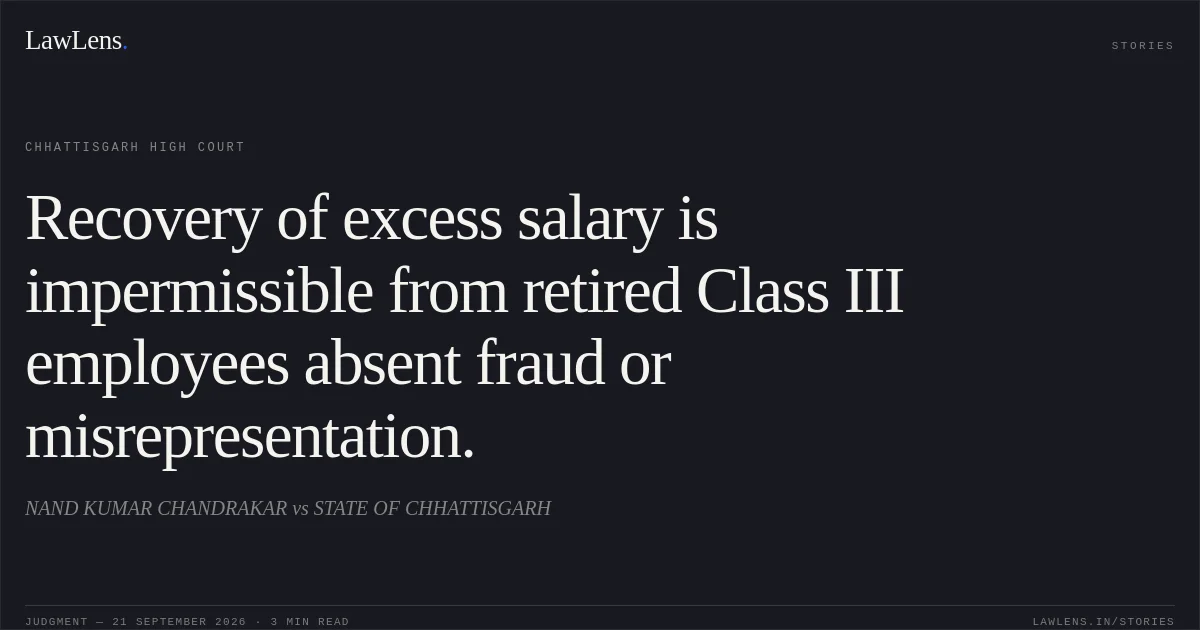
The Court held that the respondents could not recover from the petitioner the excess amount paid due to erroneous pay fixation, since he was a retired Class-III employee and there was no fraud, misrepresentation, or suppression of facts on his part.
Source reference: paras. 11–13The respondents were directed to refund the amount recovered from the petitioner within three months from receipt of the order.
Source reference: para. 13In the event of default, the recovered amount would carry interest at 6% per annum.
Source reference: para. 13Original Court PDF
NAND KUMAR CHANDRAKARvsSTATE OF CHHATTISGARH
Click to open original judgment
Original judgment, available to read, download and summarize on LawLens.in