Facts
The petitioner was appointed as a Copyist in 1999 and subsequently promoted through various posts, eventually serving as Central Nazir at the Sub-Court, Palacode.
Source reference: p. 2On 24.08.2023, the 6th respondent issued an official memorandum asserting that the petitioner's pay had been incorrectly fixed since 14.01.1999.
Source reference: p. 2Despite the petitioner submitting a reply on the same day, an impugned order was passed seeking the recovery of alleged excess salary amounting to Rs. 4,94,326/- from her Death-cum-Retirement Gratuity (D.C.R.G.).
Source reference: pp. 2-3The petitioner challenged this recovery and the revision of pay under Article 226 of the Constitution.
Source reference: no citationIssues
1. Whether the authorities are empowered to rectify errors in pay fixation and implement a revised pay scale in accordance with Pay Rules.
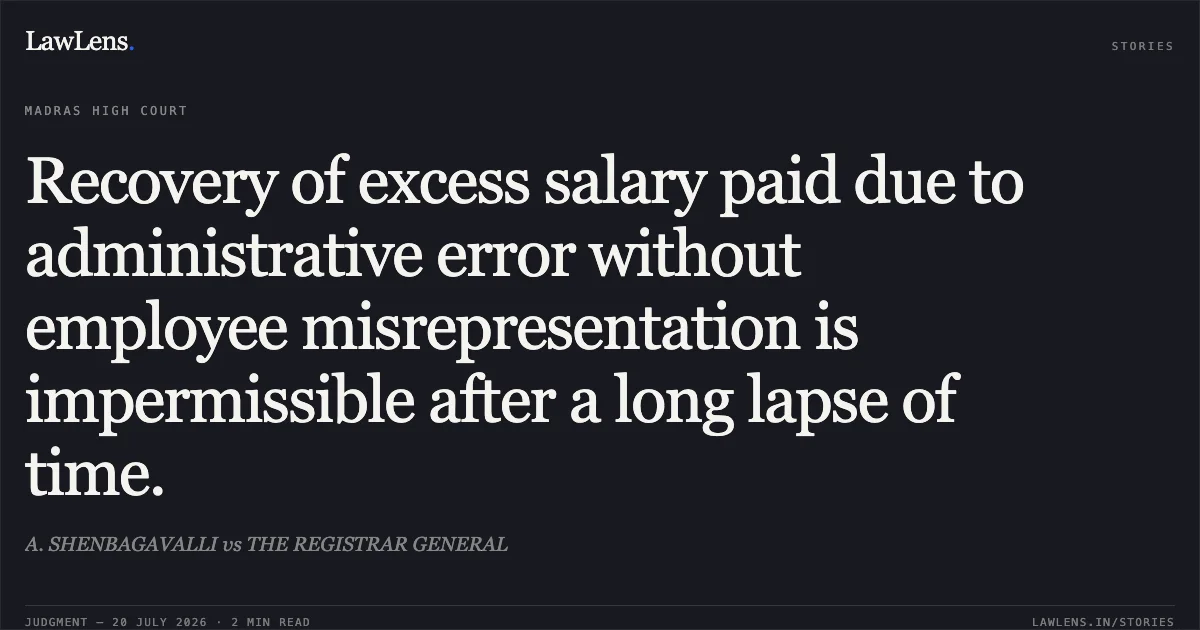
Source reference: p. 3, para. 32. Whether the recovery of excess salary paid over a period of 24 years is permissible in the absence of misrepresentation by the employee.
Source reference: p. 3, para. 4-5Law Applied
Statement identifying that the State has the right to rectify erroneous pay fixations to prevent unjust gain of public money, but such rights are limited by the principles of equity and hardship.
Source reference: p. 3The court primarily relied on the landmark precedent of State of Punjab v. Rafiq Masih, (2015) 4 SCC 334, which prohibits recovery of excess payments from Class III/IV employees, or when the payment was made for over five years, or when recovery would be iniquitous and cause extreme hardship.
Source reference: pp. 3-4, para. 5Reasoning
The court reasoned that the authorities have the inherent power to ensure correct pay fixation according to Government Orders, and thus the downward revision of future pay was sustaintable.
Source reference: p. 3, para. 3Regarding the recovery of past payments, the court found that the respondents failed to establish any misrepresentation or fraud by the petitioner.
Source reference: p. 3, para. 4Since the error was committed by the Establishment and the recovery spanned a period exceeding five years (specifically from 1999 to 2023), the court determined that enforcing recovery after such a long duration would cause "extreme hardship".
Source reference: p. 3, para. 4Applying the specific prohibitions from Rafiq Masih, the court concluded that the recovery was impermissible as it fell under the categories of recovery from long-standing excess payments and would be "iniquitous".
Source reference: p. 5, para. 6Holding
The revision of pay is confirmed and shall continue.
The Court partly allowed the Writ Petition, setting aside the recovery of the excess amount of Rs. 4,94,326/- and directing the respondents to repay any amount already recovered to the petitioner within 12 weeks from the date of receipt of the order.
Source reference: p. 5, para. 6-7Original Court PDF
A. SHENBAGAVALLIvsTHE REGISTRAR GENERAL
Click to open original judgment
Original judgment, available to read, download and summarize on LawLens.in