Facts
On May 27, 2010, a missing complaint was filed regarding 18-year-old Amol Gade.
Source reference: para. 2aHis body was recovered on May 29, 2010, near Palm Beach Road; the post-mortem indicated death due to a head injury caused by a heavy, blunt object.
Source reference: para. 2bThe prosecution alleged that the Appellant murdered the deceased, robbed him of two mobile phones and a gold chain, and subsequently pledged the chain with a finance company.
Source reference: para. 2c, 19The Trial Court (Additional Sessions Judge, Thane) acquitted the Appellant of Section 201 IPC (destruction of evidence) but convicted him under Section 302 IPC (murder) primarily based on the recovery of the gold chain.
Source reference: para. 1, 14The Trial Court explicitly disbelieved other prosecution evidence, including the "last seen" theory, the recovery of cold drink/liquor bottles, and the mobile phone/CDR data due to discrepancies in IMEI numbers.
Source reference: para. 13Issues
1. Whether the prosecution established a complete chain of circumstantial evidence sufficient to sustain a conviction for murder.
Source reference: para. 12, 152. Whether the recovery of the deceased's gold chain at the instance of the Appellant, in the absence of other corroborating links, justifies a presumption of murder under Section 114 of the Evidence Act.
Source reference: para. 28, 313. Whether the defense successfully established its version regarding the ownership of the gold chain on the touchstone of preponderance of probability.
Source reference: para. 24, 25Law Applied
The court applied Section 302 of the IPC regarding murder.
Source reference: para. 1It relied on the foundational principle of circumstantial evidence, which requires a complete chain of events excluding every hypothesis of innocence.
Source reference: para. 12Regarding presumptions, the court followed the three-judge bench decision in Sanwat Khan v. State of Rajasthan, which held that the solitary circumstance of recovery of stolen property is insufficient for a murder conviction.
Source reference: para. 30, 31It further applied Limbaji v. State of Maharashtra, resolving that while Section 114 Illustration (a) of the Evidence Act allows a presumption of theft, it does not automatically extend to murder unless the crimes are proved to be part of the same transaction.
Source reference: para. 31The court also distinguished the burden of proof, noting the prosecution must prove guilt "beyond reasonable doubt," while the accused need only satisfy "preponderance of probability" as per Ramanand @ Nandlal Bharti v. State of Uttar Pradesh.
Source reference: para. 26Reasoning
The High Court observed that the Trial Court had already discarded nearly all incriminating links, including the "last seen" witnesses (PW4, PW7) and technical CDR evidence.
Source reference: para. 13The conviction rested solely on the recovery of a gold chain pledged by the Appellant (PW14).
Source reference: para. 14However, the High Court found that the prosecution failed to cogently prove the deceased’s ownership of said chain; the mother (PW2) provided no purchase receipt, and the Investigating Officer (PW24) failed to exhibit the receipt allegedly collected.
Source reference: para. 18, 21Conversely, the Appellant’s sister (DW1) testified that the chain belonged to her and was pledged to fund her mother’s medical treatment.
Source reference: para. 22The Court held that the defense’s explanation was probable and that the Trial Court erred by requiring the defense to meet the same high standard of proof as the prosecution.
Source reference: para. 24, 25Applying the Sanwat Khan doctrine, the Court reasoned that even if the recovery was valid, it only established the Appellant as a receiver of stolen property or a thief, not a murderer, especially since the "same transaction" link was broken by the failure of other circumstantial evidence.
Source reference: para. 31, 32, 33Holding
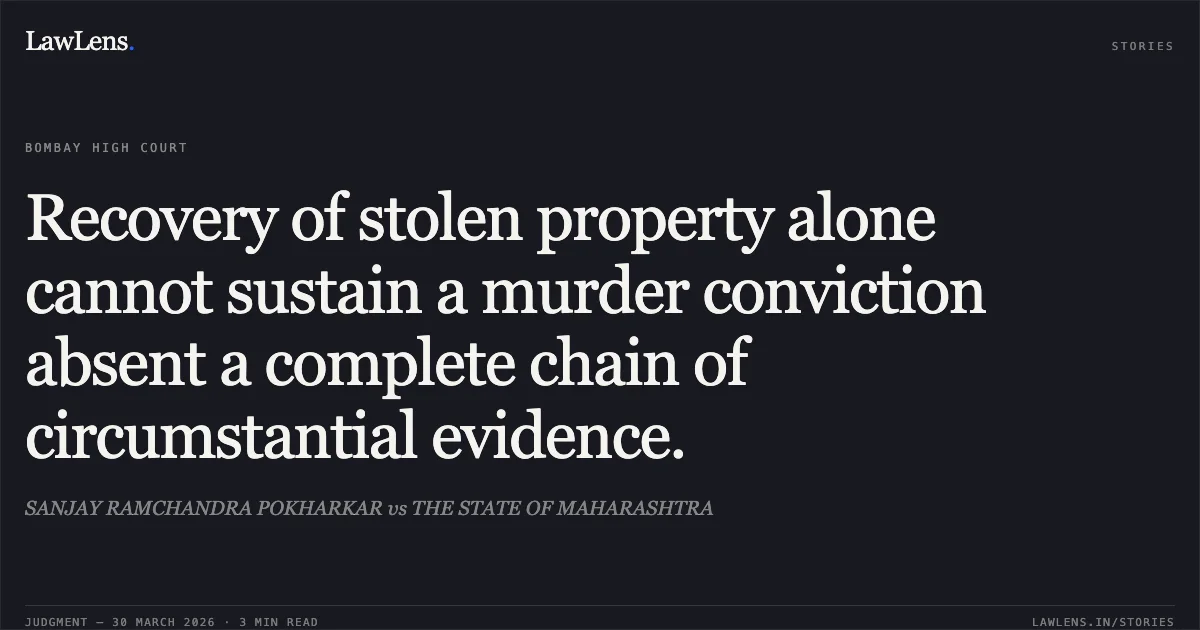
The High Court held that the prosecution failed to establish a complete chain of circumstances and that suspicion, however strong, cannot replace legal proof.
The Court answered the issues in the negative, finding the recovery of the chain insufficient to bridge the "missing links" in the murder charge.
Source reference: para. 37, 38The Appeal was allowed, and the conviction and life imprisonment sentence under Section 302 IPC were quashed and set aside.
Source reference: para. 39The Appellant was acquitted of all charges and his bail bonds were discharged.
Source reference: para. 39ii, 39iiiActs & Sections Cited
9 provisions across 3 statutes referred to in this judgment. Each provision opens on LawLens.
Indian Penal Code, 18606
Code of Criminal Procedure, 19732
Bharatiya Nagarik Suraksha Sanhita, 20231
Original Court PDF
SANJAY RAMCHANDRA POKHARKARvsTHE STATE OF MAHARASHTRA
Click to open original judgment
Original judgment, available to read, download and summarize on LawLens.in


