01Facts
The petitioner applied for the post of Manager (MIS and ME), City Mission Management Unit, pursuant to a recruitment advertisement prescribing a minimum qualification of a two-year full-time postgraduate diploma/master’s degree in Computer Science, M.Sc. (Computer Science), B.Tech. (Computer Science), or MCA from a recognised institution, together with at least three years’ relevant experience.
¶ 3 · p. 2The petitioner possessed an MCA degree and the requisite experience, but was not selected because he was not awarded marks for an alleged additional qualification.
¶ 2 · p. 1He challenged the selection process under Article 226 of the Constitution, contending that marks for additional qualifications had been granted to similarly situated candidates, while his MCA degree and software-industry experience were not appropriately considered.
¶ 1 · p. 1The respondents argued that MCA constituted only the prescribed basic qualification and that the petitioner possessed no separate additional qualification; his software-industry work was experience, not an additional diploma, degree, or certificate.
¶ 3 · p. 202Issues
i.Whether the respondents could award marks for additional qualifications when the recruitment advertisement did not prescribe such additional qualifications or provide for such marks.
¶ 5–6 · pp. 3–4ii.Whether the petitioner’s candidature was required to be reconsidered on the basis of the qualifications expressly prescribed in the advertisement, without applying unadvertised criteria.
¶ 6 · p. 4iii.Whether the selection process became arbitrary and discriminatory, in violation of Article 14 of the Constitution, by granting an advantage to candidates on the basis of an undisclosed criterion.
¶ 6 · p. 403Law Applied
The Court applied Article 226 of the Constitution as the jurisdictional basis for judicial review of the recruitment process.
¶ 1 · p. 1It held that public recruitment must be conducted in accordance with the qualifications and criteria disclosed in the advertisement; an undisclosed or “hidden” rule cannot subsequently be used to confer an advantage on selected candidates.
¶ 6 · p. 4The Court further applied the principle of equality and non-arbitrariness under Article 14, holding that awarding marks for additional qualifications not forming part of the advertised selection criteria would result in arbitrary treatment and discrimination against candidates possessing the prescribed minimum qualification.
¶ 6 · p. 4No separate statutory rule, precedent, or recruitment provision authorising such additional marks was established by the respondents.
¶ 5 · p. 304Reasoning
The advertisement treated MCA and three years’ experience as the relevant qualifications for the post, and the petitioner possessed both.
¶ 3, 5 · pp. 2–3Although the respondents awarded additional marks to other candidates, they failed to identify any rule or provision in the advertisement authorising those marks.
¶ 5 · p. 3The Court therefore found that the merit list had been prepared using a criterion not disclosed to candidates at the time of recruitment.
¶ 6 · p. 4Applying the principles of transparency, equality, and non-arbitrariness in public employment, the Court held that the petitioner’s candidature had to be assessed solely by reference to the qualifications prescribed in the advertisement and without granting an advantage based on an unadvertised additional qualification.
¶ 6 · p. 405Holding
The Court held that the selection process was arbitrary and violative of Article 14 because marks had been awarded for additional qualifications without any disclosed rule or basis in the advertisement.
¶ 5–6 · pp. 3–4The respondents were directed to reconsider the petitioner’s candidature according to the qualifications specified in the advertisement, without applying the additional-qualification marks granted to other candidates.
¶ 6 · p. 4If, upon such reconsideration, the petitioner was found more meritorious than the selected candidates, he was to be granted appointment.
¶ 6 · p. 4The writ petition was accordingly disposed of.
¶ 7 · p. 4Original Court PDF
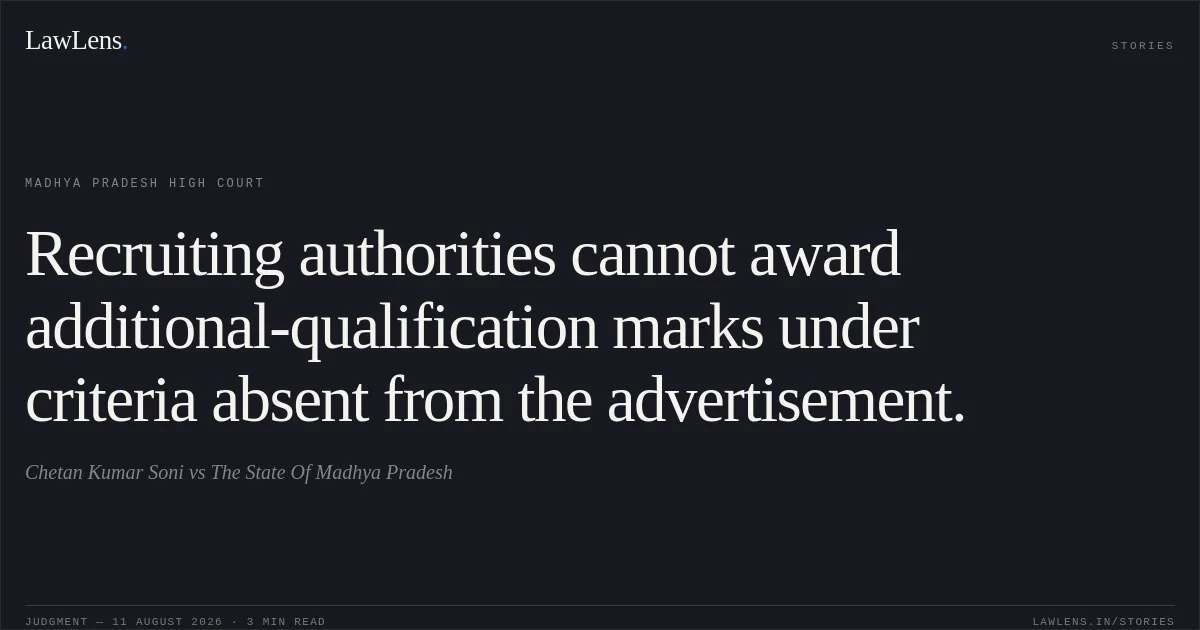
Chetan Kumar SonivsThe State Of Madhya Pradesh
Click to open original judgment
Original judgment, available to read, download and summarize on LawLens.in