Facts
The applicant was appointed as a Junior Engineer (Electrical) in 1999 and subsequently promoted to Assistant Executive Engineer on an "In-charge" basis
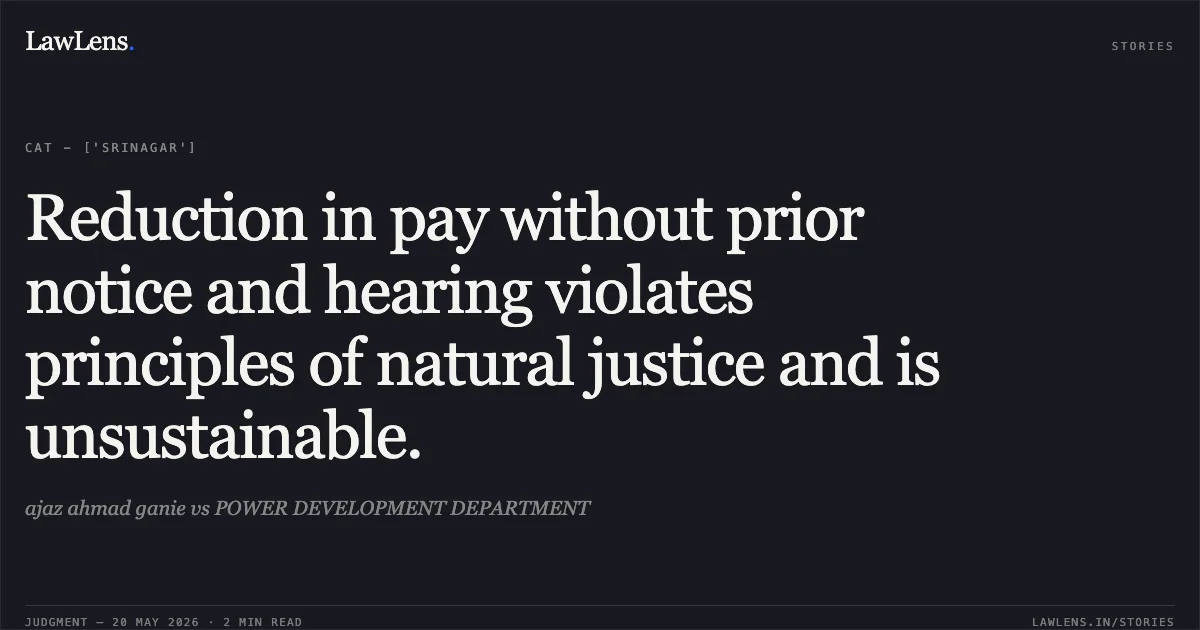
Source reference: para. 2He challenged his pay bill for April 2026, which unilaterally reduced his monthly emoluments from approximately Rs. 1,43,740/- to a lower amount without prior notice
Source reference: para. 3The applicant contended that this reduction amounted to a punishment inflicted without following the due process of law
Source reference: para. 4The respondents argued that the applicant should have first approached the Drawing and Disbursing Officer (DDO) to rectify any clerical or legal errors before filing the O.A.
Source reference: para. 6Issues
1. Whether the respondents could legally reduce the pay of the applicant without providing a prior notice or an opportunity to be heard
Source reference: para. 42. Whether the lack of adherence to the principles of natural justice vitiates the impugned pay bill
Source reference: para. 5Law Applied
The Tribunal applied the fundamental principles of Natural Justice (specifically Audi Alteram Partem), asserting that any administrative action resulting in civil consequences or financial loss must be preceded by a notice and a hearing
Source reference: para. 4, 5It relied on the landmark precedents of Mohinder Singh Gill v. Chief Election Commissioner (1978) and Maneka Gandhi v. Union of India, which establish that procedural fairness is an essential requirement of Article 14 of the Constitution
Source reference: para. 5Furthermore, it noted the precedent in Sita Ram v. U.T. of J&K (2025) regarding the necessity of exhausting departmental representations for rectifying administrative errors
Source reference: para. 6Reasoning
The Tribunal reasoned that while the competent authority possesses the inherent power to rectify errors in service books or pay fixations, such power cannot be exercised arbitrarily
Source reference: para. 5A reduction in pay constitutes a "punishment" or a significant adverse civil consequence; therefore, skipping the stage of a show-cause notice violates the rules of natural justice
Source reference: para. 4, 9The Tribunal observed that although the applicant had filed a representation, the respondents failed to dispose of it
Source reference: para. 8During the proceedings, the respondents conceded that the rules of natural justice must be followed and consented to setting aside the impugned bill provided they were allowed to pass a fresh order after a proper hearing
Source reference: para. 9Holding
The court held that any reduction in salary without a hearing is unsustainable in law.
The Tribunal allowed the O.A. and quashed the impugned pay bill for April 2026 as it pertained to the applicant. The respondents were directed to pass fresh orders within four weeks, ensuring the applicant is given an "ample opportunity of being heard" and that the procedure adheres strictly to service jurisprudence and the rules of natural justice
Source reference: para. 9, 12Acts & Sections Cited
1 provisions across 1 statute referred to in this judgment. Each provision opens on LawLens.
Administrative Tribunals Act, 19851
Original Court PDF
ajaz ahmad ganievsPOWER DEVELOPMENT DEPARTMENT
Click to open original judgment
Original judgment, available to read, download and summarize on LawLens.in