Facts
Respondent No. 1 appointed the Applicant as a subcontractor under four Work Orders dated 25 September 2017 for construction work at the “One Park Avenue” project; an Addendum followed on 17 February 2020.
Source reference: para. 2, 6–12, 42The Applicant claimed outstanding dues of Rs.12,37,88,534 and invoked the arbitration clause on 27 June 2025.
Source reference: para. 6–12, 42Respondent No. 1 did not oppose reference to arbitration. Respondent No. 2 denied being a party to the contract or arbitration agreement, while Respondent No. 3 denied involvement and relied on sale certificates naming Purva Oak Private Limited, a separate legal entity, as purchaser of the property.
Source reference: para. 6–12, 42The Applicant filed this Section 11 application seeking reference against all three Respondents.
Source reference: para. 2, 6–12, 42Issues
1. Whether an arbitration agreement existed between the Applicant and Respondent No. 1, and whether the disputes arising from the Work Orders could be referred to arbitration
Source reference: para. 13–14, 422. Whether Respondent Nos. 2 and 3, though not signatories to the Work Orders, could prima facie be treated as parties to the arbitration agreement and referred to arbitration
Source reference: para. 13, 20–23, 38–41Law Applied
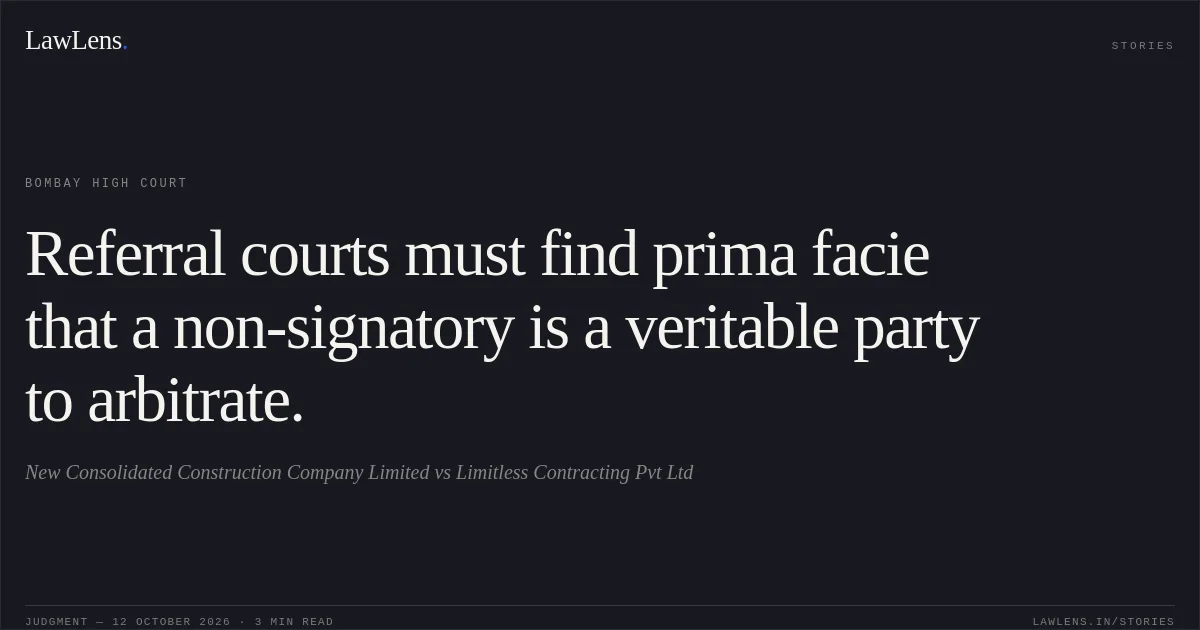
Under Section 11 of the Arbitration and Conciliation Act, 1996, the Referral Court must determine whether an arbitration agreement exists and whether there is a prima facie basis to treat a non-signatory as a party.
Source reference: para. 15, 18, 20, 22, 38–40The controlling question is whether the non-signatory consented to be bound; it must be shown prima facie to be a “veritable party,” and referral cannot be automatic merely because the Arbitral Tribunal may later consider jurisdiction under Section 16 (*Cox and Kings Ltd. v. SAP India (P) Ltd.*, (2024) 4 SCC 1, including paras. 84, 101, 117, 126 and 140; *Hindustan Petroleum Corporation Ltd. v. BCL Secure Premises (P) Ltd.*, (2026) 3 SCC 711, paras. 25 and 34).
Source reference: para. 15, 18, 20, 22, 38–40A corporate or commercial connection alone does not establish consent, and a person claiming “through or under” a signatory must derive a right through assignment, subrogation, novation or succession; mere connection is insufficient.
Source reference: para. 17–18, 35The Court also relied on *Mukesh Patel v. Pant Nagar Ganesh Krupa Co-operative Housing Society Ltd.*, 2025 SCC OnLine Bom 6393, for the requirements of de facto privity and consent to arbitrate.
Source reference: para. 24–28, 37Reasoning
The Work Orders and Addendum identified only the Applicant and Respondent No. 1 as contracting parties; the Applicant’s own case was that Respondent No. 1 appointed it, and its bills and demand were directed to Respondent No. 1. The Court therefore found an arbitration agreement and a referable dispute between those parties.
Source reference: para. 14, 17, 42Although Respondent No. 2 participated in project-related communications and meetings and was connected to Respondent No. 1, those circumstances did not show consent to Clause 17 or an assumption of Respondent No. 1’s contractual obligations.
Source reference: para. 15–19, 29–30As to Respondent No. 3, the sale certificates named Purva Oak Private Limited—not Respondent No. 3—as purchaser, and no assignment, novation, succession or other arrangement binding Respondent No. 3 to the arbitration agreement was shown.
Source reference: para. 32–36, 41The later allegations concerning the Applicant’s materials could support an independent remedy, if available, but did not make either Respondent No. 2 or 3 a party to the earlier arbitration agreement.
Source reference: para. 36–37, 44–45Holding
The Court held that the disputes were referable to arbitration between the Applicant and Respondent No. 1, but that the Applicant had not established a prima facie basis to refer Respondent Nos. 2 or 3.
The application was disposed of by appointing Mr. Tushad Kakalia, Advocate, as sole arbitrator to adjudicate disputes arising out of and in connection with Clause 17 of the Work Orders dated 25 September 2017; the arbitration was confined to the Applicant and Respondent No. 1, without prejudice to any independent remedies against the other Respondents.
Source reference: para. 45–47Acts & Sections Cited
4 provisions across 1 statute referred to in this judgment. Each provision opens on LawLens.
Arbitration and Conciliation Act, 19964
Original Court PDF
New Consolidated Construction Company LimitedvsLimitless Contracting Pvt Ltd
Click to open original judgment
Original judgment, available to read, download and summarize on LawLens.in