Facts
The respondents/plaintiffs instituted O.S. No. 317 of 2019 seeking refund of amounts paid under an agreement of sale dated 15 September 2012, creation of a charge over the suit property, and a permanent injunction restraining alienation or encumbrance of the property.
Source reference: paras. 4, 7Under the agreement, the defendant allegedly received an advance of ₹23,25,000 and a further sum of ₹75,000, agreeing to convey the property within one month.
Source reference: para. 7After the defendant allegedly failed to execute the sale deed, a legal notice was issued on 5 November 2012.
Source reference: para. 7The defendant disputed the sale transaction, characterised it as a loan transaction, and allegedly agreed to settle the amount within four months with interest at 24% per annum, but failed to repay it.
Source reference: para. 7The petitioner/defendant filed an application under Order VII Rule 11 CPC seeking rejection of the plaint on the ground that the suit was barred by limitation on its own averments.
Source reference: para. 5The trial court dismissed the application, holding that limitation involved disputed questions of fact requiring adjudication at trial.
Source reference: para. 6The defendant challenged that order under Article 227 of the Constitution.
Source reference: paras. 1, 6Issues
1. Whether a suit seeking only refund of advance money paid under an agreement of sale is governed by Article 62 of the Limitation Act, 1963, on the ground that the amount is secured by a charge over immovable property, or by the residuary Article 113.
Source reference: paras. 12, 15–202. Whether Section 55(6)(b) of the Transfer of Property Act, 1882 automatically creates a charge over the property in favour of an agreement holder who seeks refund of advance money without seeking specific performance.
Source reference: paras. 9, 17–193. Whether the plaint was liable to be rejected under Order VII Rule 11 CPC as being ex facie barred by limitation.
Source reference: paras. 5–6, 21–23Law Applied
The Court applied Order VII Rule 11 CPC, under which a plaint may be rejected where the suit appears from the statements in the plaint to be barred by law.
Source reference: paras. 5–6Section 54 of the Transfer of Property Act provides that a contract for sale does not, by itself, create any interest in or charge on the property.
Source reference: para. 14Section 55(6)(b) recognises a buyer’s charge for purchase money properly paid in anticipation of delivery, but the Court held that it does not automatically create a proprietary security immediately upon execution of an agreement of sale.
Source reference: para. 18Article 62 of the Limitation Act, prescribing twelve years for enforcing money secured by a mortgage or otherwise charged upon immovable property, presupposes an already existing charge and does not govern a purely contractual claim for refund.
Source reference: paras. 17–19A claim for specific performance is governed by Article 54, while a suit seeking only refund of advance money, in the absence of a specific limitation provision, is governed by Article 113 and must be instituted within three years from accrual of the right to sue.
Source reference: paras. 15, 20–21The Court also relied on the reasoning in A.S. No. 801 of 2012, decided by a Division Bench on 7 April 2026, concerning the interaction between Sections 54 and 55(6)(b) of the Transfer of Property Act and Articles 54 and 62 of the Limitation Act.
Source reference: para. 11Reasoning
The Court treated the plaintiffs’ claim, based on the plaint averments, as contractual in nature because it arose from the alleged failure to perform an agreement of sale and the consequent non-refund of the advance.
Source reference: paras. 7–8, 20Since the agreement of sale did not itself create any interest or charge under Section 54 of the Transfer of Property Act, the plaintiffs could not invoke the twelve-year limitation period under Article 62 merely by claiming that a charge should be created over the property.
Source reference: paras. 14, 17–19Section 55(6)(b) was held not to confer an automatic proprietary security at the agreement stage.
Source reference: paras. 17–19The right to sue for refund accrued when the contractual arrangement failed and repayment was not made; the Court held that the three-year period under Article 113 consequently applied.
Source reference: para. 21As the agreement was dated 15 September 2012 and the suit was filed only in 2019, the plaint disclosed a claim ex facie barred by limitation, making a trial on disputed facts unnecessary.
Source reference: para. 21The trial court therefore erred in refusing to reject the plaint.
Source reference: para. 22Holding
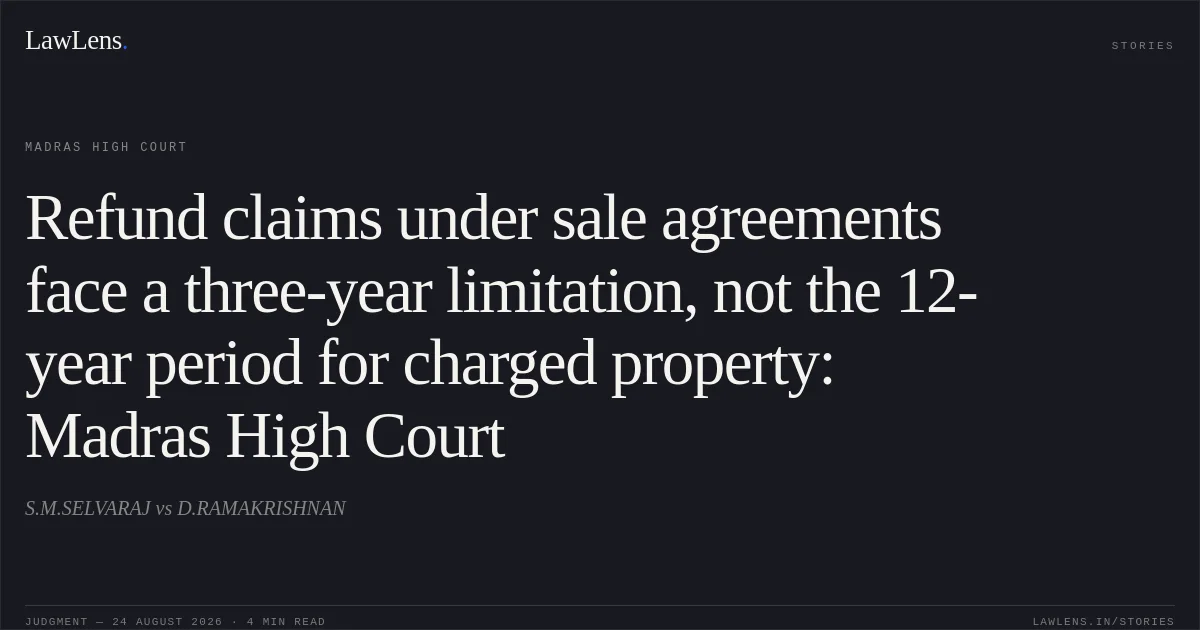
The Court held that a suit by an agreement holder seeking only refund of advance money is a contractual claim governed by Article 113 of the Limitation Act, not a suit to enforce an existing charge under Article 62.
The agreement of sale did not automatically create a charge under Sections 54 or 55(6)(b) of the Transfer of Property Act.
Source reference: paras. 17–19As the suit filed in 2019 was beyond the applicable three-year limitation period, the plaint was liable to be rejected under Order VII Rule 11 CPC.
Source reference: para. 21The order dated 20 April 2023 in I.A. No. 2 of 2019 in O.S. No. 317 of 2019 was set aside, the civil revision petition was allowed, and the connected miscellaneous petition was closed; no order as to costs was made.
Source reference: para. 23Acts & Sections Cited
4 provisions across 2 statutes referred to in this judgment. Each provision opens on LawLens.
Transfer of Property Act, 18822
Limitation Act, 19632
Original Court PDF
S.M.SELVARAJvsD.RAMAKRISHNAN
Click to open original judgment
Original judgment, available to read, download and summarize on LawLens.in
![Courts will not interfere with transfers absent mala fides or violation of statutory rules.. M Ramya vs EMPLOYEES STATE INSURANCE CORPORATION (ESIC). CAT - ['Chennai']. LawLens](/stories/thumbnails/courts-will-not-interfere-with-transfers-absent-mala-fides-or-violation-of-statutory-rules-a6845e9ca6f548fca284c51c8351957f.webp)
![Courts cannot direct one-time recruitment age relaxation absent authority in the governing rules or advertisement.. UT OF PUDUCHERRY vs M ANDAL. CAT - ['Chennai']. LawLens](/stories/thumbnails/courts-cannot-direct-one-time-recruitment-age-relaxation-absent-authority-in-the-governing-895d78fde47143e2a8ed0207c4b6a44f.webp)
![A review cannot correct an allegedly erroneous decision absent an error apparent on the record.. Ajit Kumar Jha vs RAILWAY BOARD. CAT - ['Delhi']. LawLens](/stories/thumbnails/a-review-cannot-correct-an-allegedly-erroneous-decision-absent-an-error-apparent-on-the-re-8ac952fd4eba470c92f7da20af72a220.webp)