Facts
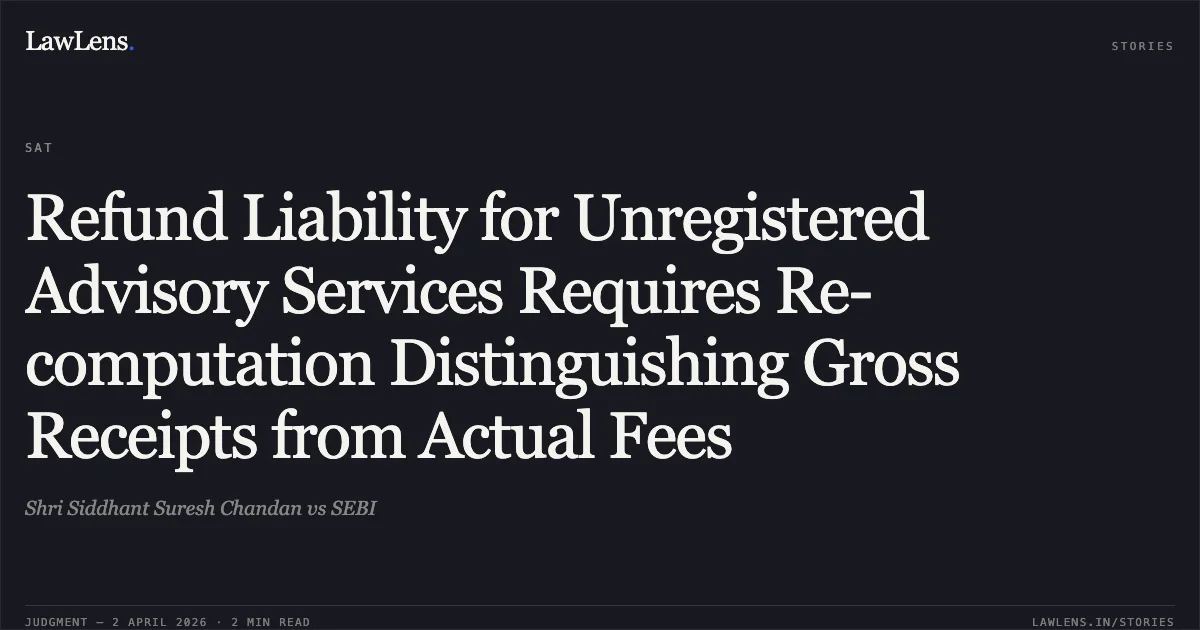
The appellant challenged an order dated March 15, 2023, passed by the Chief General Manager (CGM), SEBI.
Source reference: para. 3-4The impugned order found the appellant guilty of acting as an unregistered investment advisor and directed him to refund approximately ₹4.17 Crores collected from investors, imposed a penalty of ₹2 Lakhs, and debarred him from the securities market for two years.
Source reference: para. 3-4The appellant, appearing in person, contended that the sum of ₹4.17 Crores represented gross bank receipts rather than actual advisory fees and claimed he had already refunded fees to several clients.
Source reference: para. 5, 8Procedurally, there was a delay of approximately 600 days in filing the appeal.
Source reference: para. 6During the pendency of the appeal, the appellant deposited ₹50 Lakhs with SEBI as a condition for consideration of the matter.
Source reference: para. 8-9Issues
1. Whether the delay of 600 days in filing the appeal should be condoned to allow a hearing on the merits
Source reference: para. 6-72. Whether the quantum of fees (₹4.17 Crores) ordered to be refunded was accurately calculated based on actual advisory income versus gross bank credits
Source reference: para. 5, 113. Whether the matter should be remitted for re-computation of the refund amount to account for evidenced prior refunds to clients
Source reference: para. 10-11Law Applied
The Tribunal exercised its appellate jurisdiction under Section 15T of the SEBI Act, 1992
Source reference: no citationIt applied the principles of natural justice and the right to a fair adjudication, particularly regarding the accurate determination of financial liability.
Source reference: para. 10The court also considered the discretionary power of the Tribunal to condone delay and remit matters for factual verification when the appellant is a party-in-person facing financial constraints.
Source reference: para. 2, 9Reasoning
The Tribunal noted that while SEBI argued against condoning the 600-day delay due to the appellant's alleged non-cooperation during the initial investigation, the appellant had demonstrated some bona fides by depositing ₹50 Lakhs with the regulator.
Source reference: para. 6, 9The core of the dispute was a factual disagreement over the nature of the credit entries in the appellant's bank statements; the appellant argued that SEBI mischaracterized gross turnover as advisory fees.
Source reference: para. 5The Tribunal reasoned that in the "peculiar facts of the case," it was "just and appropriate" to allow the appellant a second opportunity to explain these entries through a professional, such as a Chartered Accountant.
Source reference: para. 10The Tribunal limited its intervention strictly to the mathematical computation of the refund, leaving the findings on the underlying violation (unregistered activity) and the resulting debarment and penalty intact.
Source reference: para. 11Holding
The Tribunal allowed the appeal in part. It set aside the order dated March 15, 2023, solely regarding the quantum of fees collected and the refund amount.
The matter was remitted to the CGM, SEBI, to re-compute the refund amount.
Source reference: para. 11(ii)The appellant was directed to appear before SEBI on April 21, 2026, with a professional representative to explain bank entries and provide evidence of prior refunds.
Source reference: para. 11(iii)-(iv)The penalty of ₹2 Lakhs and the two-year debarment remained undisturbed.
Source reference: para. 11(v)The Tribunal clarified that this order is not to be treated as a precedent due to the specific facts of the case.
Source reference: para. 11(vi)Acts & Sections Cited
1 provisions across 1 statute referred to in this judgment. Linked provisions open on LawLens.
Securities and Exchange Board of India Act, 19921
Original Court PDF
Shri Siddhant Suresh ChandanvsSEBI
Click to open original judgment
Original judgment, available to read, download and summarize on LawLens.in