Facts
The informant (Wife) married the petitioner in 2002. She alleged that after returning from Delhi, the petitioner and his family subjected her to cruelty and demanded a Hero Honda motorcycle and ₹2 lakhs in dowry
Source reference: p.2She further alleged physical assault on 13.05.2010
Source reference: p.2After investigation, a charge sheet was filed under Sections 498A, 323, and 506/34 of the IPC
Source reference: p.3The Trial Court convicted the petitioner under Sections 498A and 323 IPC
Source reference: p.5On appeal, the Sessions Judge acquitted the in-laws and found the allegations of dowry demand and physical assault to be false/untrue
Source reference: p.6However, the Appellate Court upheld the petitioner’s conviction under Section 498A IPC solely on the ground that the petitioner refused to live with his wife, instituted a divorce case, and stopped talking to her, which the court deemed "cruelty"
Source reference: p.6-7Issues
1. Whether the act of a husband living separately, refusing to talk to his wife, or seeking a decree of divorce constitutes "cruelty" within the ambit of Section 498A of the IPC.
Source reference: p.92. Whether the conviction of the petitioner was sustainable when the specific allegations of physical assault and dowry demand were found to be untrue by the lower courts.
Source reference: p.8-9Law Applied
The Court applied Section 498A of the Indian Penal Code (IPC), which defines "cruelty" as any willful conduct likely to drive a woman to suicide or cause grave injury, or harassment to coerce her into meeting unlawful dowry demands
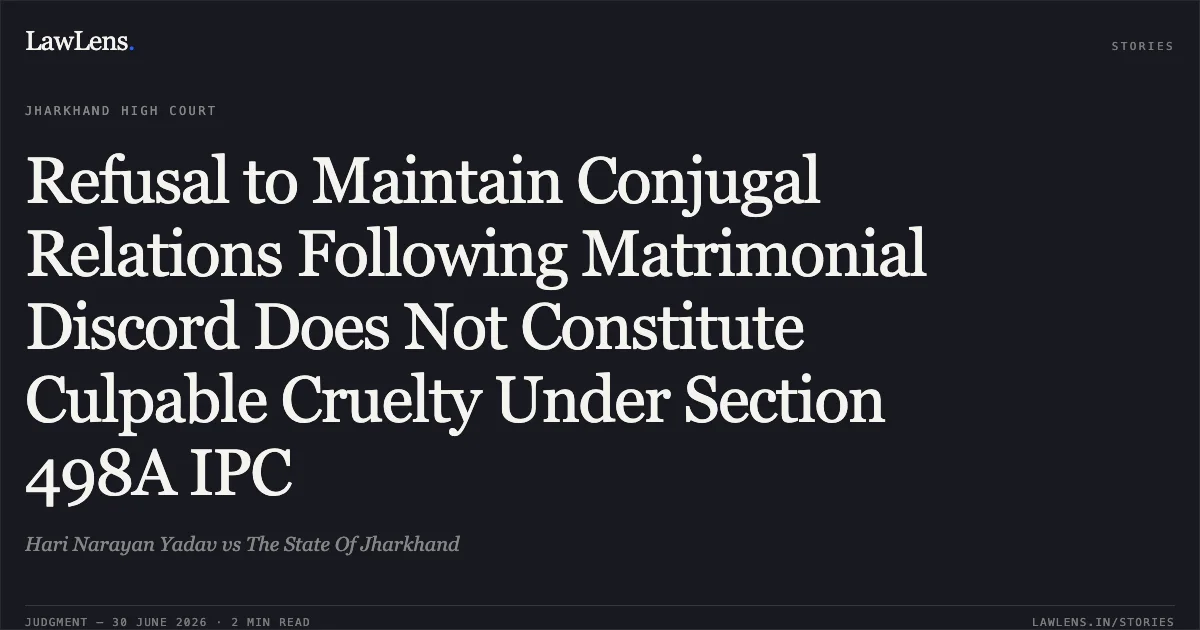
Source reference: p.8It further observed the principle that matrimonial discord, reluctance in discharging conjugal rights, or the mere status of a husband and wife paying no attention to each other due to a breakdown of marriage does not automatically fall within the definition of "culpable cruelty" under Section 498A IPC
Source reference: p.9Reasoning
The Court noted that out of the nine witnesses, most were hearsay, and the primary witness (the informant) admitted in cross-examination that there was no physical assault or illegal demand for money
Source reference: p.7-8The Court highlighed a critical flaw in the Appellate Court's reasoning: while the Appellate Court explicitly found that the allegations of dowry demand and physical assault were "not true," it still upheld the conviction based on "mental cruelty" because the husband was avoiding the wife and had filed for divorce under the Hindu Marriage Act
Source reference: p.6, 9The High Court reasoned that "matrimonial discord" and "reluctance in discharging conjugal rights" are insufficient to meet the high threshold of Section 498A
Source reference: p.9It found that the lower court's conclusion—that staying away from the spouse amounts to criminal cruelty—was based on conjectures and surmises rather than the statutory requirements of the IPC
Source reference: p.9Holding
The High Court held that the petitioner’s conviction was perverse and contrary to the evidence on record
The Court answered that mere matrimonial distance or the filing of a divorce petition does not constitute "cruelty" under Section 498A IPC in the absence of evidence of harassment for dowry or conduct intended to drive the woman to physical harm
Source reference: p.9Consequently, the High Court allowed the revision, set aside the judgments of the Trial and Appellate courts, and acquitted the petitioner of all charges
Source reference: p.10Acts & Sections Cited
5 provisions across 2 statutes referred to in this judgment. Each provision opens on LawLens.
Indian Penal Code, 18604
Hindu Marriage Act, 19551
Original Court PDF
Hari Narayan YadavvsThe State Of Jharkhand
Click to open original judgment
Original judgment, available to read, download and summarize on LawLens.in